
Thai Student Turns Backyard Cacao Experiments Into Fermentation Technology and Craft Chocolate
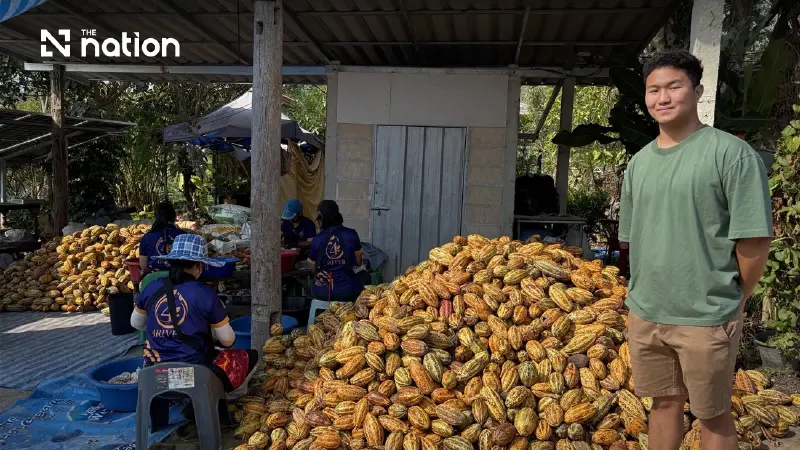


Naravid “Finn” Tejavanija began by wondering why cacao from different parts of Thailand produced different flavours. The question eventually took him from chocolate kitchens to farms, late-night fermentation experiments and his own bean-to-bar chocolate brand.
At 2 a.m., Naravid “Finn” Tejavanija would sometimes wake up, walk into his backyard shed and turn a box of fermenting cacao beans before going back to bed.
The beans could not always wait until morning.
After cacao pods are opened, the wet seeds are surrounded by sweet white pulp. During fermentation, microorganisms consume the sugars, the pile heats up and its smell changes from sweet fruit toward vinegar. Inside, the beans begin changing from bitter purple to brown as compounds important to chocolate flavour develop.
Finn wanted to understand when the beans needed to be turned.
His interest in cacao had started much more casually. During a summer job at a chocolate shop, he learned that Thailand grows cacao in several regions and that beans from different places can produce noticeably different chocolate.
He began wondering what happened before the beans reached the kitchen.
That question took him to cacao farms around Thailand, where he learned how much of a chocolate’s eventual flavour depends on what happens during fermentation. A well-fermented batch can command a higher price. A poor one can leave the beans bitter, uneven or unusable.

Experienced fermenters often judge a batch by its smell, heat and timing. Those instincts may take years, and many failed batches, to develop. For a small farmer, learning by trial and error can be expensive.
Finn decided to learn the process himself.
His backyard shed gradually filled with fermentation boxes, probes and cables. His laptop filled with temperature readings. Cacao beans regularly found their way into the family kitchen.
The experiments rarely behaved as neatly as the instructions he had read.
The same turning schedule could give different results. Weather changed. Batch sizes changed. Sugar levels in the pulp varied. Finn began comparing temperature curves from one batch to another.
He noticed a recurring pattern. As microbial activity increased, the temperature rose. When activity slowed, the curve flattened and began to fall. Turning the beans introduced oxygen and the temperature rose again.
From those experiments, Finn developed GOcacao, a system that monitors temperature changes during fermentation and helps indicate when a batch should be aerated.

The idea was not to replace the judgement of experienced fermenters. It was to give less experienced producers another way to understand what was happening inside a pile of beans they could not see.
Finn later took GOcacao out of his backyard and into field trials with cacao producers, including work in Sa Kaeo. Testing on farms exposed problems that were difficult to anticipate from home and led him to keep modifying the system.
It also taught him that getting the technology to work was only part of the challenge.
Some farmers were reluctant to pay upfront for unfamiliar equipment. Others had previously encountered agricultural schemes that promised higher incomes but failed to deliver. Finn began allowing growers to test GOcacao before committing money.
Then another problem emerged. Producing better beans did not help much if farmers could not find buyers willing to pay for the additional quality.
Finn decided to become one of those buyers.

He founded de’Finnitive Chocolates, sourcing Thai cacao while learning the other end of the process himself. He experimented with roasting, grinding, recipes and tempering, the careful control of cocoa-butter crystals that gives a finished bar its gloss and clean snap.
There were many batches that never made it outside the kitchen.
The better ones did.
GOcacao has since monitored more than four tonnes of cacao across eight sites in Thailand. The project was selected as a Global Finalist in the Diamond Challenge and recognised among its Top 100 Emerging Innovators worldwide. It also received the Grand Prize and a Gold Award at the CNX FINEX Innovation Competition at Chiang Mai University.
Finn’s chocolate has faced a different kind of judging. In 2026, de’Finnitive’s Sa Kaeo chocolate was selected as a Grand Jury Finalist at the International Chocolate Awards Asia-Pacific competition.

His experiments have also moved beyond the bean. Cacao pod husks are normally discarded or left to decompose after harvest, and Finn has been testing ways to turn some of that waste into products that could generate additional income for farming communities. Not every attempt has worked.
That has become familiar territory.
Finn still moves between farms, fermentation boxes and the kitchen. Farmers tell him what they notice in their batches. Chocolate making sometimes reveals problems that were difficult to see during fermentation. Unexpected temperature curves send him back to his notes.
And when a batch behaves differently from what he expected, Finn usually ends up back where much of the project began: beside a fermentation box, trying to work out why.

