
Commitment to efficiency and sustainability
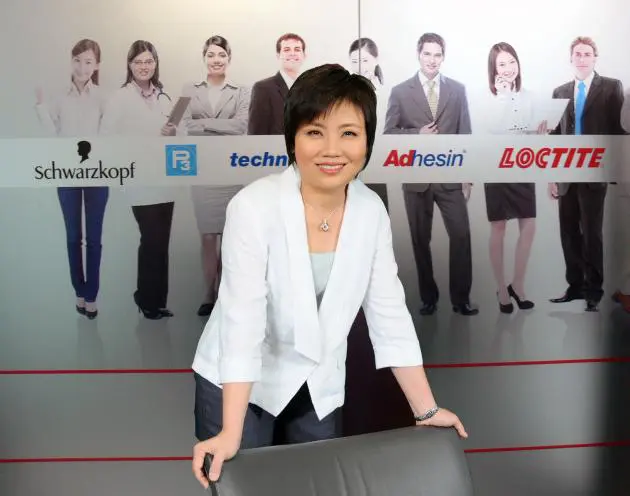


Henkel's top exec explains how going the extra mile helped the company cope with the floods
Chamaiporn Uerpairojkit, president of Henkel (Thailand), a local subsidiary of Germany’s leading industrial and consumer-products company, with well-known brands such as Schwarzkopf haircare line and Loctite industrial adhesives spoke to The Nation’s Pichaya Changsorn on her firm’s sustainability policy, its experience with the recent flooding in Bangkok, and its impact on the company’s results in 2011.
--What is the sustainability strategy of Henkel?
The company was founded in 1876 and we have been in the Thai market for 40 years. If sustainability was not a part of our DNA, we would not have come this far. This also links back to when I first introduced green technologies for adhesive and metal surface treatment products into the Thai market in 2003. Being the pioneer, the returns were not that much initially. However, we decided to go for it.
--What is your next step in sustainability initiatives?
Henkel’s new Sustainability Strategy 2030 was launched in October 2011. In Thailand, it was shared with employees on December 16 during a town hall meeting. The long-term goal is to improve efficiency by a factor of three. This means that by the year 2030, all products and processes should be three times as efficient as they are today. We triple the value we create while leaving the footprint at the same level, or we reduce the footprint down to one-third of today while delivering the same value. Either way, the net result should be to use one-third of the resources needed today for each euro we generate.
From 2010 until 2015, we want to increase efficiency by 30 per cent (or 5 to 6 per cent every year). This will involve every business unit, every business function. Regarding the five-year target until 2012, we achieved them by 2010 – in three years instead of five.
Sustainability Strategy 2030 means much more than efficiency or cost savings. Firstly, sustainability is one of our five core values which guide everything we do at Henkel and make us unique. Secondly, while global trends such as population growth and increasing pressure on resources demand more efficiency, they will also open up new business opportunities.
--How was the performance of Henkel Thailand in 2011?
Overall, in 2011, we expect that Henkel Thailand will be able to sustain and deliver a positive and strong performance, despite the difficult situation that we faced in the fourth quarter. It is partly because of the extra mile that we went in serving our customers in this difficult time. The electronics and automotive industries are heavily hit by this crisis, of course. But there are also new opportunities in some business sectors, like flood-protection sealants that should be used both before and after the flood. We also captured some business opportunities in cleaners and rust removal after the flood and even the paint emulsion is now a hot selling product. This is the strength of Henkel in terms of diversity of portfolio.
At first, I was quite scared and quite conservative. I alerted the regional office that the floods were coming and this could have an impact. But it turned out that with the extra efforts that we made, we did not lose out on the top-line business and even the impact on the bottom-line has been minimised.
As country president, my priority is to take care of employee safety on one hand and business continuity on the other hand. On the people side, we have to make sure everyone is safe – the employees and their families. This is a challenge, but we really have to take care of people well. We laid out the actions to safeguard employee safety.
Most of the employees were really touched by the way Kasper Rorsted, CEO of Henkel, cared for our safety, security and well being. He asked about the mood and tone. He called me on my mobile phone on October 22. This was Saturday and during his personal time. I was immediately encouraged by his thoughtfulness and concern. He asked nothing about the business. He asked ‘How are you? How are your staff? Are they affected?’ Kathrin Menges, a member of Henkel’s management board and executive vice president of human resources, also called me the following Monday. Knowing how much this would mean to the employees, when I went back to the office on Tuesday, I walked around to share this with them. It helped very much to lift the spirits of the people.
About 80 employees were affected at the peak of the crisis. In Bangkok, we have more than 200 staff. Our employees spent long hours to come to work. Some left their homes at 4am. The motivation to come to work was partly because of the encouragement from Kasper and Kathrin. At the same time, the employees knew they had to continue serving the customers to the best of their abilities. “Customer” is one of our core values, which is ‘We put our customers at the centre of everything we do’. Whatever difficulties we face, the customers also face the same situation.
We were still supporting and visiting customers even though we had to drive long hours to access those inundated areas to see them. At some point, we had to switch to air freight to serve customers and these are additional costs we have to absorb to keep the business running. We also need to manage the challenge of delivering the orders as some roads were submerged. Sometimes we had to shift the transportation from a pickup truck to a lorry just to send a few hundred kilograms of products. That is something the customers really appreciate – the extra effort and extra costs we have to bear.
This commitment and going the extra mile for customers plays a key role in enabling us not to lose the top-line growth, and minimises the impact on the bottom line. There was no stop in the operations or supply chain for us. Even the Min Buri plant in the high-risk area was closed only for one to two days. But we used the Bangpakong plant to back up and make up for this shutdown. One advantage we have in Henkel over our competitors here is that we have Henkel affiliates in many countries, so we were able to get supply support from, for example, Henkel Malaysia and Henkel China. We have the scale and resources and that helped us to secure our operations as well as the customers’ operations.
[email protected]
