
Hike in oil stocks calls for support: Bangchak


Play
Bangchak Petroleum has called on the Energy Ministry to provide support if it goes ahead and requires all retailers to lift their legal minimum oil reserves from 5 per cent of sales to 8 per cent.
Such a ministry requirement is being considered as a way of mitigating against the risk of military action being taken by the West against Iran over its nuclear ambitions, which could lead to a global petroleum shortage.
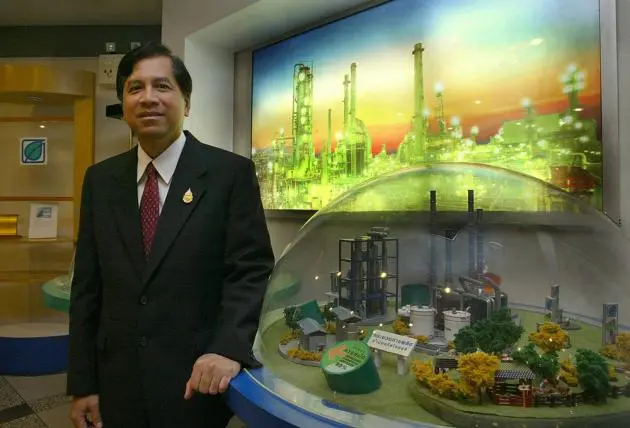
“We would have to increase our working capital by US$120 million [Bt3.7 billion] for the increased stock. We are willing to do as per the ministry’s request, but the increased cost is too much for us. So we need the Energy Ministry to have a measure in place to relieve the burden,” Bangchak president Anusorn Sangnimnuan said yesterday.
He said that regarding the commercial and legal stock demanded by the ministry, the company presently had to stock 6 million barrels for use over 45 days.
Under the possible new requirement to increase the stock from 5 per cent of sales to 8 per cent, Bangchak would have to increase its inventory by 1 million barrels, which would cost $120 million, for use over 55 days.
“We need working capital of $720 million for 6 million barrels of stock. The increased cost would be $120 million, or 30 to 40 satang per litre. This is too much for us, and the cost may have to be passed on to consumers if there is no measure to support the refineries,” he said.
Dubai crude on Friday closed at $121.27 per barrel, a rise of $1.90 from the previous week. Global oil prices are likely to continue to increase, mainly because of the tension between Iran and Western countries and the danger of military action being taken against the second-largest producer in the Organisation of Petroleum Exporting Countries.
Anusorn said Bangchak’s oil terminal was not large enough for an additional stock of 1 million barrels, and it would have to lease vessels at a cost of $20,000 per day.
He believes hiking the country’s crude-oil stock would be only a temporary measure to avoid risk from a petroleum shortage caused by a serious escalation of the conflict between Iran and the West.
Bangchak may talk with other retailers in the PTT Group about the leasing of vessels to reduce costs, he added.
In a separate matter, Bangchak yesterday announced a partnership with Big C Supercenter to set up Mini Big C convenience stores at its service stations.
The two companies will initially invest in pilot-project stores at five of Bangchak’s large-scale service stations.
Anusorn said the collaboration was in line with the refiner’s strategy to lift its ranking to No 2 in the retail market by investing more in non-oil business.
The Bangchak subsidiary responsible for the operation of Bai Chak convenience stores, the existing store brand at its service stations, will co-invest with Big C. The subsidiary will invest in the buildings, while Big C will be responsible for the decoration and retail management.
Bangchak will share the profits from the joint investment with Big C.
The company president said average sales from each Bai Chak convenience store were Bt30,000-Bt40,000 per day, with growth of 5-10 per cent per year.
The company expects sales growth to increase once the Mini Big C brand takes root, besides which it is expected that the new brand of convenience store will attract more customers to Bangchak’s service stations.
The five pilot stores will be located on Rama III, Charoenkrung, Nawamin, On Nuj 44 and Pattanakarn roads.
“We anticipate sales from the retail business in the stations where Mini Big C convenience stores are located to grow by 10-15 per cent. If the pilot projects in five stations are successful, we plan to jointly invest with Big C Supercenter to expand Mini Big C into other stations,” he said.
Mini Big C
He said the arrival of Mini Big C would not replace Bai Chak stores, as the existing brand would continue to operate in its standard service stations, while Mini Big C will be in large-scale stations and prime areas.
If the model proves to be a success, it will be possible to run convenience-store operations co-branded between Mini Big C and Bai Chak, he added.
Anusorn said Bangchak planned to invest Bt2 billion within two years to expand the number of service stations to 1,300 from around 1,000 currently. This would provide an opportunity to set up Mini Big C outlets in the new stations.
Meanwhile, Praphan Eamrungroj, Big C Supercenter’s executive vice president for properties, said the company planned to invest Bt5 billion to expand Mini Big C convenience stores to 1,000 branches within five years, up from 59 currently.
The model will help the company expand its business amid the current regulation to limit the growth of large-scale modern-trade stores, he said.
He added that Bangchak would terminate its Lemon Green convenience-store brand at service stations, and replace it with Mini Big C. Bangchak currently operates 30 Lemon Green stores.
Petrol retailers are increasingly tying up with modern-trade retail giants to increase revenue from non-oil business amid the tightening of oil marketing margins.
