
Thailand ripe for investment, says PM in Seoul


Play
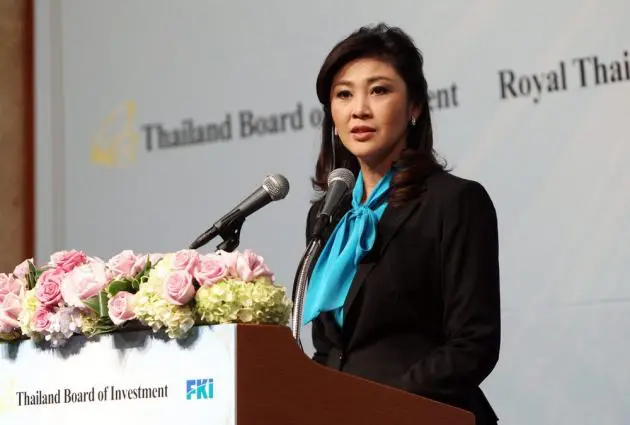
Prime Minister Yingluck Shinawatra has assured South Korean businessmen of Thailand's bright economic prospects, citing the government's business-friendly policies, flood-management measures and the cut in corporate tax.
In a speech in Seoul yesterday during a luncheon meeting hosted by South Korea’s four leading business organisations, including the Federation of Korean Industries, she said the Thai economy would expand by 5.5-6 per cent this year, supported by strong economic fundamentals despite last year’s flood disaster.
Meanwhile, the Fiscal Policy Office yesterday revised its economic growth projection for the year to 5.5 per cent from the 5 per cent it had forecast in December.
Siam Commercial Bank's Economic Intelligence Centre also adjusted its target for growth in gross domestic product to 5.6-5.8 per cent from the 4.7 per cent estimated in January.
These developments follow the Bank of Thailand’s announcement last week of an increase in its 2012 GDP growth target to 5.7 per cent.
Yingluck told more than 450 attendees that with its solid fiscal status, Thailand is able to launch policies to promote investment.
The corporate tax rate will be cut to 23 per cent this year, and to 20 per cent next year, while tax incentives are also available to encourage the establishment of regional headquarters in the Kingdom, she said.
Meanwhile, the government has set aside US$72 billion (Bt2.16 trillion) for mega-projects, including a high-speed rail route from Bangkok to Chiang Mai and a deep-sea port in Dawei, Burma, which will improve Thailand’s linkage with Asean and South Asia. The prime minister said she was convinced the projects would strengthen Thailand’s position as a hub for Asean investment.
Value-added industries
She invited Korean investors to pour investment into value-added industries such as electronics and electrical appliances, automobiles, machinery, alternative energy and agricultural processing. They were also urged to invest in research and development activities and software and entertainment businesses.
Attending the luncheon were executives of large companies such as Samsung, LG Electronics, Hyundai, Korea Water Resources Corp, SM Entertainment and Korea Railroad Corp. After the event, Yingluck engaged in one-on-one discussions with a number of companies, including LG, Samsung and Union Steel.
Meanwhile, although Thailand this year could run both budget and current-account deficits, the Finance Ministry has given an assurance that this is not yet cause for concern, according to the Fiscal Policy Office.
“Running a current-account deficit is not a bad thing, as we need more investment,” said director-general Somchai Sujjapongse. Investment in post-flood reconstruction would drive growth this year.
Private investment is expected to rise 11.9 per cent, against last year’s increase of 7.3 per cent, while public investment will expand 12.1 per cent after a contraction of 8.7 per cent experienced last year, due partly to post-flood reconstruction efforts.
High investment, however, will lead to a current-account deficit of 0.9 per cent of GDP, or about $3.5billion. The deficit will also partly be caused by an expected slowdown of exports, he said.
Having a current-account deficit would also lead to more foreign debt, Somchai conceded. The government plans to run a budget deficit of Bt400 billion for the current fiscal year ending in September, and a deficit of Bt300 billion for next year.
Headline inflation is expected to come in at 3.6 per cent this year, compared with 3.7 per cent last year. “So far, inflation is not as high as people had worried it might be,” he said.
