
Call to address urban-rural imbalance
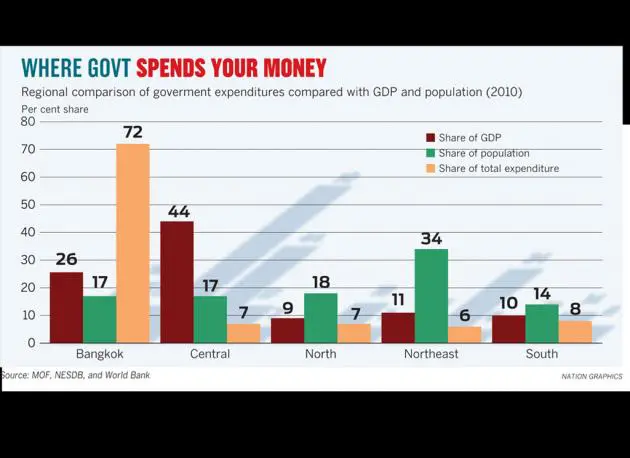


The government should allocate more funds to poorer provinces to ensure that residents can access public services including health, education and other infrastructure at a level that is comparable to that enjoyed by their counterparts in Bangkok, the Worl
While Thailand’s sustained economic growth has resulted in a remarkable reduction in poverty, economic growth and public services have been concentrated in the Central region, particularly Bangkok, according to the “Thailand Public Finance Management Report” released yesterday by the World Bank.
“Public spending can counteract regional disparities in provision of public services, which in turn contribute to improving human development and inequality. Thailand’s expenditure policy can be refocused towards services in delivery-deficient areas to bring them up to a good standard [as] can be seen in Bangkok,” said Shabih Mohib, World Bank senior economist and leader of the team that authored the report.
Although Bangkok is home to about 17 per cent of Thailand’s population and accounts for 25.8 per cent of gross domestic product, it benefited from about 72.2 per cent of total government expenditures in fiscal year 2010, the report said. This is in sharp contrast to the Northeast, which accounts for about 34 per cent of the population and 11.5 per cent of GDP, but received only 5.8 per cent of expenditures.
“Even correcting for the fact that Bangkok is the administrative capital of the country, such concentration of expenditures is extreme,” the report said.
“Expenditure allocated to Bangkok and the Central areas is 10 times [that allocated] to other regions,” Mohib said. Other central governments commonly allocate capital-area expenditure of about eight times the amount allocated to regional areas, the official said.
Education spending is concentrated in Bangkok, with spending higher in the North than in the Northeast and South, according to the report.
Health spending is also concentrated in the Central region, and is much lower in the Northeast, the report found.
“We do not advocate an end to allocating expenditures to Bangkok, but we suggest increasing expenditures in poorer provinces to the same level as Bangkok,” said Anwar Shah, co-author of the report.
The government should increase the equalisation element of its intergovernmental fiscal transfer formula from 2 per cent to at least 15-20 per cent of the total transfers, said Annette Dixon, World Bank country director for Thailand.
Dixon praised recent decentralisation reforms, but pointed out that duplication of work among regional and local administrations had raised administrative costs.
Multiple central agencies were involved with local governments in an uncoordinated fashion to deliver services at the local level, she said.
Some local administrative organisations (LAOs) may not be financially viable, she said.
The report suggested full integration of a unitary central-local relations system to reduce administrative costs, with the money saved reallocated to development projects. “Cost savings would be substantial,” Shah said.
He said some LAOs could merge with others for greater economy of scale.
More than 3,000 LAOs administer populations of less than 5,000. An international rule of thumb shows that to be financially viable, a local authority should administer at least 10,000 people, according to the report.
Shah added that partly because of the global financial crisis, many countries had consolidated regional and local governments to make the public sector leaner, more efficient and more accountable. In some countries, local governments have voluntarily merged, the World Bank official said.
