
Connectivity crucial for Asean


Play
Malaysian minister calls for stronger logistics linkages to facilitate investment
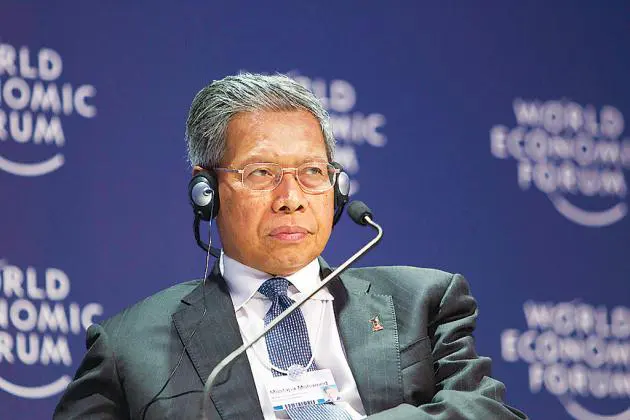
Mustapa Bin Mohamed, Malaysia’s Minister of International Trade and Industry, told The Nation in an interview that improving connectivity across the national borders of all Asean countries is the key to boosting regional trade and investment.
“Greater intra-Asean logistics linkages will ensure that investors can take full advantage of the reduction and elimination of tariffs for goods and services,” said the minister during his visit to Bangkok to attend last week’s World Economic Forum on East Asia.
In terms of regional connectivity, there are both physical and non-physical aspects. Regarding the physical connectivity, the Malaysian minister cited the Singapore-Kumming railroads and cross-border highways in the north-south economic corridor as examples.
These railway and highway connections will link the southern Chinese city of Kumming, Thailand, Myanmar, Malaysia, Singapore together with extensions that will also link Laos, Cambodia and Vietnam with other Asean member countries.
Regarding other aspects of connectivity, he said, IT linkages and institutional connectivity among Asean countries are also crucial to the success of the Asean Economic Community, which will be effective in 2015.
The Malaysian minister also said it is crucial to address the issue of non-tariff barriers (NTBs) which could become a hindrance to the freer flow of trade, investment, skilled labour, services and capital among the 10-country grouping.
For example, there will be the so-called Asean standards on goods and professions designated by the AEC, which could become NTBs, even though member countries have reduced the import tariffs on most products to zero to facilitate the free flow of trade.
Regarding the bilateral trade and investment ties between Thailand and Malaysia, he said in the first quarter of this year trade volume has increased by 11 per cent with exports from Thailand amounting to 10.05 billion ringgit (Bt99.40 billion) and imports 8.87 billion ringgit.
In 2011, Malaysia’s exports to Thailand amounted to 35.72 billion ringgit while imports totalled 34.51 billion ringgit.
“These figures confirm Thailand’s position as our fifth largest trading partner globally and second largest within Asean after Singapore.”
“Apart from Proton, a number of other Malaysian companies have also established a presence in Thailand. A good example is CIMB Bank Thai. The bank, which is the second biggest in Malaysia by assets and the fifth largest in Southeast Asia, has built up a strong brand presence in Thailand in a short period of time.
“Other leading Malaysian companies operating in Thailand include Petronas Retail Thailand, JRD Motors, Sime Darby, RHB Bank, Century Logistic Holding and Kurnia Insurance, White Horse Ceramic and Scomi Oil Tool,” he said.
In addition, 2.5 million Malaysian tourists visited Thailand in 2011, up 20 per cent from the previous year, while about 1.4 million Thais visited Malaysia.
