
German verdict eases worries
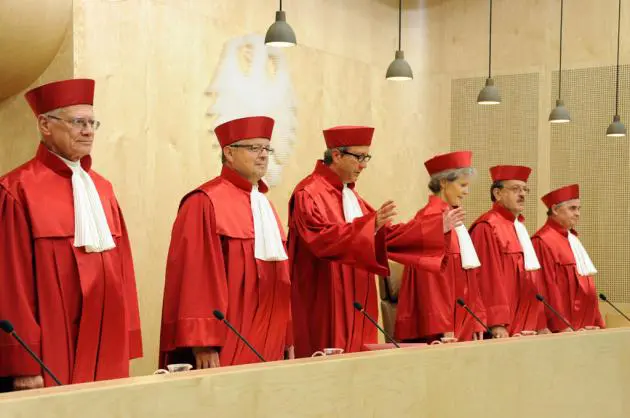


Business leaders, markets greet nod for bail-out fund, acknowledge a lot more needs to be done in the euro-zone crisis
Thai and international business leaders breathed a cautious sigh of relief after Germany’s Constitutional Court rejected petitions to block Europe’s massive rescue fund, removing another uncertainty from trouble-plagued efforts to solve the region’s debt crisis.
Rejecting injunction requests from 37,000 plaintiffs seeking to block the treaties, the Constitutional Court said ratification of the European Stability Mechanism (ESM) could go ahead with the “proviso” that German liability be limited to ¤190 billion (Bt7.6 trillion), as agreed in the ESM treaty. Any increase in that amount would require prior approval by the Bundestag lower house of parliament.
Domestic investors and analysts warned that the crisis is far from over, although the SET Index rose 11.6 points to 1,259.96 largely due to the court ruling. The index along with Asian stocks had fallen in nervous anticipation of the German court verdict.
Somjate Moosirilert, chief executive officer of Thanachart Bank, said Germany’s eventual backing for the ESM bail-out fund would help ease concerns over the euro-zone debt problems. “However, the euro faces many crises, which need many solutions,” he said.
Kannikar Chalitaporn, president of Siam Commercial Bank (SCB), said that the crises in Europe and the United States are all long-term, and “solutions” so far would only give policy-makers a little more time. Given the ongoing crisis, bank lending may decline later this year, especially loans to exporters, she said, adding that combined bank lending in the first seven months of this year grew by 16 per cent year on year while SCB loans increased about 19-20 per cent.
Sirichai Sombutsiri, senior executive vice president of SCB, said the crisis in Europe has lowered the bank’s lending for exports by 20 per cent.
Former prime minister Anand Panyarachun said the euro-zone crisis will continue for at least two or three more years. He believed it would impact Thailand and the rest of the world, adding that the growth slowdown in China would also adversely affect Thailand.
“The government’s export target of 15-per-cent growth will not be met this year, so the government cannot depend on exports for growth. It will have to turn to domestic demand but the effectiveness of its policies are yet to be realised,” said Anand.
Globally, reactions were similarly positive with caution, with leaders stressing that a lot more needs to be done. European Commission president Jose Manuel Barroso called for a quantum leap towards a form of United States of Europe.
This would require a new treaty, he said.
He told the European Parliament in his annual state-of-the-union speech that a “federation of nation states” was now required “to win the battle against nationalists, or extreme populists”.
Describing this goal as the EU’s “political horizon”, Barroso said there was a need for a “sharing of sovereignty in a way that each country and each citizen is better able to control their destiny”.
Barroso is one of four top EU figures drawing up plans for closer economic and political integration before a December target and he also has one eye on the June 2014 European Parliament elections.
He said newly presented proposals for a full EU banking and budget union, including a single bank sector regulator in the shape of the European Central Bank, were a first step on the road towards this new political construct. “The present EU must evolve,” former Portuguese premier Barroso said, insisting the bloc “needs to move to a federation of nation states”.
He said this leap to a new level of integration was required “because I think in these times of anxiety, it is a mistake to leave nations to nationalism and populism”.
He added that this was “precisely to win the battle against nationalists, or extreme populists”, although despite his officials being asked, he at no point spelled out which political forces he was referring to.
The euro rose above US$1.29 for the first time in four months after the German court ruling.
Even though the decision by the German Federal Constitutional Court comes with certain conditions, it means the ESM can be signed off by the country’s chancellor and come into force by early next year.
Stocks also got a boost, with Germany’s DAX up 0.9 per cent at 7,375 and the CAC-40 in France 0.7 per cent higher at 3,562. The FTSE-100 index of leading British shares was 0.2 per cent firmer at 5,805.
