
Nomura sees QE3, strong earnings prospects boosting inflow of foreign


The Thai equity market is expected to attract more foreign investment, thanks to the US Federal Reserve's third round of quantitative easing (QE3) and good earnings growth prospects among listed firms on the back of strong economic fundamentals, said Nom
“Thailand is our preferred market and the only recommended ‘overweight’ within emerging Asean. We expect the Stock Exchange of Thailand’s stellar performance to continue in the second half of 2012, albeit at a slower pace. Given the positive investment outlook, we favour banks, construction materials and contractors on this theme,” it said in research released recently.
The bad news is that more inflows to the equity and bond markets would lead to further baht appreciation, the research house said, adding that the Bank of Thailand is not expected to announce a special reserve requirement to counter such an inflow, as it did in 2006, but rather to seek other measures to promote outflows.
Nomura Global Economics expects further capital inflows to Thailand amid a global risk backdrop. Coupled with an improvement in domestic factors, this will support further baht appreciation against the US dollar.
It expects the baht to end the year at 30.80 per dollar, from 31.50 at the end of last year. The unit is forecast to strengthen to 30.40 next year, and to end 2014 at 30/$.
Foreign interests invested about US$2.1 billion (Bt65 billion) in Thailand’s equity market from the beginning of the US’s QE1 programme in December 2008 till its conclusion in March 2010. Under QE2, which started in November 2010, they invested about $2 billion between September 2010 (after Fed chairman Ben Bernanke’s Jackson Hole speech) and June 2011.
In the domestic government bond market, Thailand has been attracting steady inflows in recent years. Foreigners held $13.8 billion, or 14.4 per cent of the outstanding total, in local government bonds as of end-August, compared with $1.6 billion in January 2009.
The trend will continue with relatively light foreign positioning and as Thailand is rated three to four notches above non-investment grade, said Nomura Global Economics.
“In addition, similar to equity flows, we expect the latest round of quantitative easing to further boost flows into the local bond market. Overall, we think portfolio investment flow is likely to be another source of support for baht appreciation,” it said.
On the belief that the Thai economy will remain particularly resilient over the next two years despite strong external headwinds, Nomura Global Economics forecasts a 5.5-per-cent growth rate for this year and 4.7 per cent for 2013, above consensus expectations of 5.3 per cent and 4.4 per cent, respectively.
Domestic demand is dubbed the new growth engine, underpinned by the government’s huge investment, which would induce huge private investment. Domestic demand provides the offset to an export slump and is likely to continue to do so, boosted by more accommodative monetary and, importantly, fiscal policies, the company said.
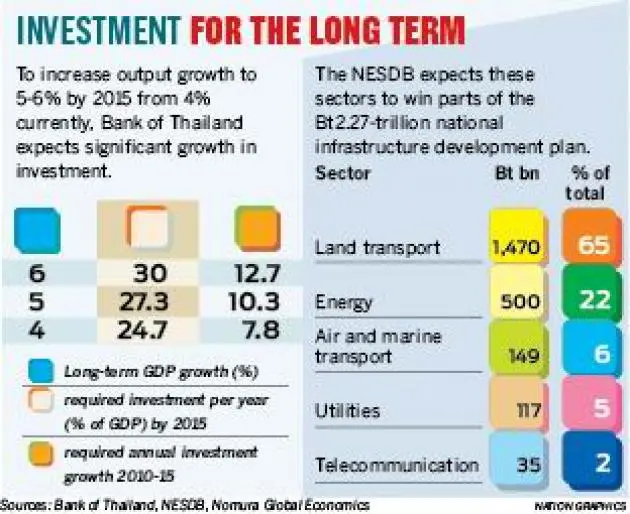
Having last year’s floods as the game changer, the government will invest Bt350 billion in flood-management projects and Bt2.27 trillion in infrastructure projects, it added.
The ratio of investment to gross domestic product fell significantly from a peak at 42 per cent in 1996 to 26.3 per cent last year. According to the Bank of Thailand, in order to increase potential output growth to 5-6 per cent by 2015 from 4 per cent currently, investment should be 27-30 per cent of GDP. This implies that annual investment growth should be 10-13 per cent from 2010 to 2015, said the research house.
Investment by the public sector accounts for about 20 per cent of total investment, and its share in GDP halved from 11.6 per cent in 1997 to 5.5 per cent in 2011, which is lower than Malaysia’s 9.8 per cent.
In growth terms, public investment has risen only 0.4 per cent per year during 2001-2011, despite various government plans to implement large-scale infrastructure projects. As a result, public investments contributed a negligible 0.02 percentage point to headline GDP growth each year.
This partly reflects the weak political will to implement investment plans, especially during times of political instability such as during 2008 and 2010, when public investment fell in year-on-year terms by 4.7 per cent and 2.2 per cent, respectively, the company said in its research.
To Nomura Global Economics, the Thai investment climate will also be supported by relaxed monetary policy. It expects the policy interest rate to be stable or lower through 2013. A rate cut this year is still possible, but likely depends on how much exports surprise on the downside.
