
Commitment to green shopping


Play
Giant retailer Tesco Lotus plans major investments, campaigns to protect environment
After investing an additional Bt1.2 billion this year, the chief of Tesco Lotus foresees more investments in the next few years to help the company achieve its “green” targets by 2020.
While a big chunk of funds would be poured into distribution, which is the heart of the retailer’s successful countrywide business, chief executive officer John Christie said there are plans to invest a sizeable amount to further raise consumer awareness about protecting the environment.
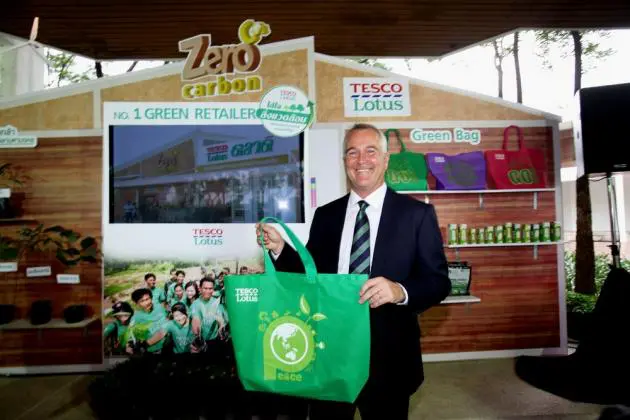
The giant retailer earlier this year launched a reusable bag to reduce the use of plastic bags. As an incentive, users of the bag are entitled to higher Club Card points and discounts on purchases of items from participating suppliers, led by Unilever.
This followed a campaign in 2010 to reward with Green Club Card points customers who don’t use plastic bags. To date, the company has already awarded more than 100 million points to customers.
Christie sees the need for more incentives if the company wants to rouse permanent green awareness among consumers.
“We have lined up high-impact campaigns to stimulate green shopping habits while continuing to engage staff and communities in combating climate change,” said Christie.
The company is now in talks with more suppliers to provide more green items. More distribution centres will be built to facilitate short-distance delivery to reduce fuel consumption. It is also in talks with the Transport Ministry for the introduction of double-container trailers, to maximise fuel consumption. The net weight of the trailers as well as routes where they could pass are on the discussion agenda.
All the plans are part of the objective to reduce carbon emissions at least by half by 2020. In Thailand, that will be equivalent to a reduction of 160,000 tonnes. Launched in 2006 – two years after the opening of the first Green Store in Southeast Asia – the green journey has cut carbon-dioxide emissions by more than 30 per cent.
With help from staff and communities, in 2007 the company launched a reforestation project to plant 9 million trees by 2013. To date, it has raised funds enough to grow 8 million trees.
In 2011, it opened the first zero-carbon store in Asia, using the latest technologies to reduce carbon emissions from electricity, and then completely offset the remaining carbon by using renewable energy sources on site. Though this is not intended to be a model for new stores, it is used to shed some light on consumer behaviour. For example, consumers were first reluctant to open refrigerators as they were pasted with paper board to keep temperature low. Some other successful practices, which could reduce energy consumption, are also deployed at other stores.
“As Thailand’s leading retailer, we realise it’s a big challenge to protect our environment. There is a big opportunity as well. We are working hard on working with suppliers, with customers, with staff and with the communities. Together, we are trying to make a difference. We know that working together we could achieve much more than purely Tesco Lotus could achieve on its own,” Christie said.
