
Rival FTI faction threatens takeover


Play
The Federation of Thai Industries' internal conflict took a further serious twist yesterday after the organisation's unofficial executive board threatened to take over the head office on January 24, when the next main committee meeting is scheduled, whi
The FTI’s existing chairman Payungsak Chartsutipol, meanwhile, announced he would sue anyone who used the federation’s name and symbol for his or her own benefit.
He expressed confidence that he would soon again be in a position to head the influential private-sector organisation as usual through to the end of his term in March 2014, after regaining support from members of the opposing camp at an ordinary monthly meeting the FTI held at the Queen Sirikit National Convention Centre in Bangkok yesterday.
The meeting also found the federation’s extraordinary meeting held on November 26 to be null and void. This is contrary to the line taken by the other side, which said the meeting was valid as more than 50 per cent of the FTI’s members had attended.
Of the organisation’s 348 committee members, 183 participated in the meeting held yesterday by Payungsak, higher than the number required under the FTI’s regulations for the consideration and approval of any agenda items.
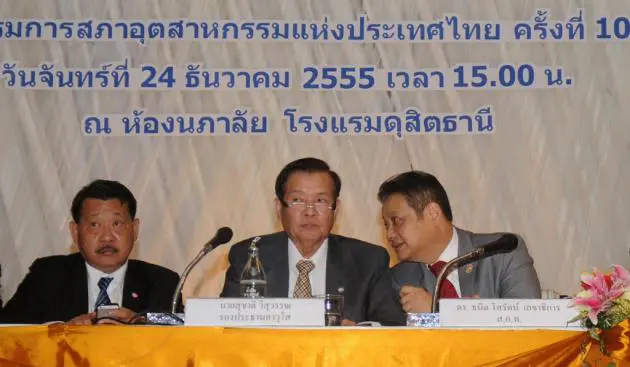
It was also reported that 178 members attended a separate meeting held yesterday at Bangkok’s Dusit Thani Hotel and led by Tanit Sorat, secretary-general of the opposing camp.
Tanit’s group proposed eight points in a bid to end the conflict, with the focus on setting up a joint committee consisting of members from the two opposing sides to manage the FTI jointly until the end of the chairman’s term in office.
In addition, Tanit, as secretary-general of the rival board, would head the FTI during the power vacuum, the group decided.
His group also resolved not to recognise Payungsak as the FTI chairman, as it claimed he had not held office since the November 26 meeting.
Among other proposals, Tanit’s group also called on the representatives of large industries who are FTI members to remain neutral in the conflict. It said the problems were dragging on because those industries had been pulled into the dispute for one side’s advantage.
Late last week, Payungsak insisted that yesterday’s meeting had not been called to win over more supporters, but was a genuine monthly meeting to consider both general and urgent issues.
Payungsak will next call an FTI executive board meeting on January 15, followed by an ordinary monthly meeting on January 28.
Acknowledging that the internal conflict had been a trying experience during the past two months, he said he wanted to see everyone join in tackling the urgent issues faced by the private sector, particularly the effect of the economic slowdown and the challenges presented by the coming single market under the Asean Economic Community.
“As to the conflict, I sent a letter explaining the facts to the industry minister,” Payungsak said.
He insisted yesterday’s meeting had gone ahead in accordance with the regulations governing the federation and that public would be able to cross-check that this was so.
He expects the problems at the heart of the FTI to ease soon.
“I’m very confident, as the number of committee members participating in the meeting was higher than the 50-per-cent requirement; we gained the support of 180 committee members” out of 348, Payungsak said.
The meeting also considered the Joint Public-Private Committee’s proposed assistance measures for small and medium-sized in 20 provinces after the nationwide minimum-wage increase to Bt300 next month, as well as a three-month extension period for foreign workers.
