
"Financial stability" tops MPC's concerns
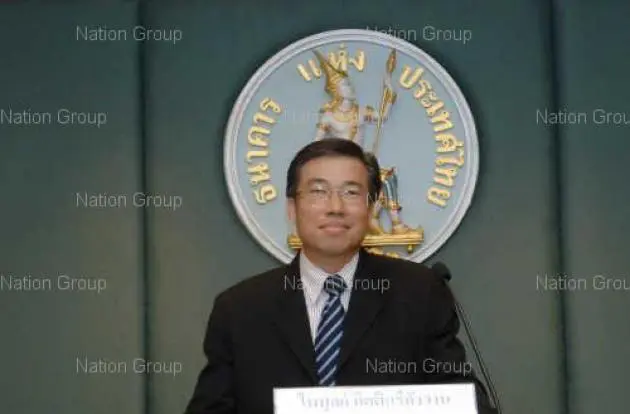


The Bank of Thailand has yet again defied political pressure, holding financial stability as the main reason to back its interest-rate decision yesterday.
The Monetary Policy Committee voted 5-1 to maintain the policy rate at 2.75 per cent, the level seen since October.
Paiboon Kittisrikangwan, secretary of the rate-setting committee, said the MPC was closely monitoring factors that could create bubbles. The circumstances are favourable for bubble formation, he said, with high loan growth, huge excess liquidity, and low interest rates. Savers are encouraged to channel money to high-return assets, despite the associated risks. These push the prices of some assets beyond fundamental levels.
Banthoon Lamsam, chairman and chief executive officer of Kasikornbank, echoed these concerns. He said the banking system’s overlending was now more worrisome than signs of bubbles in property prices. Pursuing higher margins, Thai banks are more exposed to high-risk products, such as personal and uncollateralised loans. He warned that if the authorities did not tighten control, the 1997 nightmare could return.
“At KBank, though we must follow the trend, we have tried to limit exposure. We experienced the boil burst once, and we don’t want to experience that again,” he said.
Moody’s Investors Service earlier expressed concerns over huge loan growth between 2010 and 2012, at more than 10 per cent per annum, well over the nominal growth in gross domestic product.
In a statement, the MPC expressed its view that the Thai economy was projected to moderate towards a normal growth trend in the first quarter, after accelerating in the fourth quarter of 2012. In the periods ahead, domestic demand should continue to be a key engine for growth, supported by favourable household income, high employment, and accommodative monetary and credit conditions.
Fiscal stimulus should also gradually pick up pace in the second half of the year, in line with the start of public investment in flood management and large-scale infrastructure projects, lending further impetus to private investment, the committee said.
Exports should expand slowly, in line with global economic conditions. Inflation remains within the target, but potential upward pressure from supply constraints and higher labour costs warrants monitoring.
The global economy has continued to recover gradually, but tail risks have edged up somewhat since the last MPC meeting on February 20, as financial crises in the euro zone could exacerbate the economic contraction.
The US economy has improved on the back of private consumption and investment, with fiscal sequestration weighing on growth.
The Japanese economy has benefited from planned monetary and fiscal-policy stimulus.
The Chinese and overall Asian economies have continued to expand as expected on the back of domestic demand, while the outlook for exports improved slightly.
In these circumstances, the MPC raised its 2013 economic-growth outlook, but Paiboon said it would not be much different from the current forecast of 4.9 per cent. The new forecast “taking into account the baht’s appreciation” will be announced on April 12.
Paiboon noted that the MPC was convinced that Thailand has economic resilience in accommodating risks associated with foreign exchange. Deputy Prime Minister Kittiratt Na-Ranong has so far pressured the MPC to lower the policy rate, believing that would deter capital inflows and hence slow the baht’s rise.
“Facts show that in past years, exports have expanded though the baht rose, reflecting the sector’s strengths. However, when the global economy declined, the baht dropped on outflows along with exports on weak demand. Key factors to export growth are thus the condition of the economy and demand, rather than forex rates,” Paiboon said.
At the meeting yesterday, only one MPC member voted for a rate cut while another member was absent due to overseas obligations.
“Favouring a rate cut, the member was concerned over capital inflows and growth momentum. The other members, however, are more concerned about economic stability,” Paiboon told a press conference yesterday.
