
SCG cautiously maintains Asean vision for growth
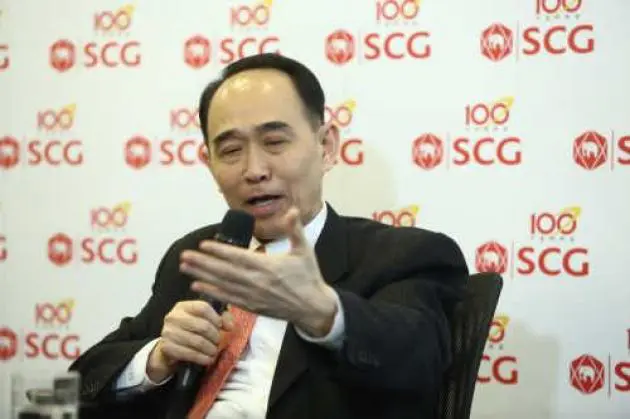


SIAM CEMENT GROUP is maintaining its vision to become Asean's sustainable-business leader in 2015, with commitment to invest Bt40 billion to Bt50 billion per annum over the next few years, but only in projects it consider commercially viable in the long
In an exclusive interview to The Nation, Kan Trakulhoon, president and chief executive of the country’s largest industrial conglomerate, said SCG would stick to this commitment despite signs of economic slowdown in the region. Last week, it announced a Bt12-billion investment in a cement plant in Myanmar and about Bt18 billion more in the cement business in Indonesia and Cambodia under the “go regional” concept and pursuit of more high-value-added products.
“The region is still experiencing a high growth rate,” he said. “Look at Indonesia: Even amid economic troubles, the growth rate will be at least 5 per cent this year.”
Kan acknowledged that economic prospects alone could not guarantee success. Hard lessons learned during the financial crisis in the 1990s still serve as reminders: For sustainable results, the group must gear its resources towards only the projects in which it is keen and has controlling power.
During its heyday, SCG spread its wings overseas in a rush. In 1995, soon after China opened its doors, SCG established a factory there without any information on local demand and distribution. Only two executives were dispatched there, only to observe the operations, while distribution was left in the hands of the Chinese joint-venture partners.
A similar approach was adopted when it expanded to Mexico.
When crisis hit the Thai economy in 1997, SCG was one of the local companies forced to restructure business focus. From 10 business areas, SCG decided to refocus on only five that demonstrated its true strengths. Many business units, including those in China and Mexico, were sold.
“When we set a new corporate vision in the early 2000s to expand in Asia, fears were high that history might repeat itself. Our vision is thus geared towards Asean, and the board resolved that in whatever market [we enter], the priority is to acquire sufficient information on product distribution,” Kan said.
Under the revised investment model, SCG first exported products from Thailand to target countries, focusing on items with comparable quality and designs to local products. Establishing a dealer network is next, as 90 per cent of its products are distributed through the network.
It would consider establishing a factory only when sales volume is above 50 per cent of the plant’s capacity, which was decided for an economy of scale. At that time, the local teams would get enough insight to understand market preferences.
Business expansion
This business model was applied with the expansion of SCG’s cement business into Cambodia. Export started in 1993 and in 2005 sales volume built up to half of its plant’s capacity of 900,000 tonnes per annum. The capacity was raised to 1 million tonnes last year, before the board of directors approved another US$180 million (Bt5.8 billion) for the second production unit this year.
A few tens of thousand tonnes of kraft paper were also first exported to Vietnam in 1997, when consumption in Thailand fell because of the crisis. Sales volume was built up until it reached 140,000 tonnes per annum in 2006.
The board of directors’ approval was sought for a plant with annual capacity of 220,000 tonnes. When the plant was completed in 2009, sales volume then spiked to around 160,000 tonnes.
Production in Thailand was relocated there one product at a time. In 2012, the plant ran at full capacity and in August this year, it was shut down for debottlenecking, which should raise next year’s capacity to 250,000 tonnes per annum.
“It’s vital to start by understanding market preferences. We’re good at making quality products, and some are overqualified. Yet we also need deep understanding of market demands,” Kan said.
Another key point lies in the shareholding proportion of such overseas ventures, he added. SCG must hold at least 50 per cent of the ventures to ensure full control over product quality and marketing. The majority stake also requires the consolidation of the ventures’ results into the company’s financial results.
“Without the consolidation, the ventures’ performance could be decreased. We need a majority stake to maintain financial discipline,” he said.
The model will be applied to expansion in the coming years, mostly in non-petrochemical businesses that will be supported mainly by mergers and acquisitions. It decided to invest in a greenfield cement project in Myanmar as there is no player in that market, where SCG sells 1.8 million tonnes of cement per annum. Since 2007, M&A deals have accounted for 33.7 per cent of new investment, and the rest through investment in greenfield and brownfield projects.
At the same time, SCG is putting emphasis on foreign-exchange management, by relying heavily on equity financing, not debt financing. Another emphasis is on compliance with laws and regulations in the countries it is investing in.
Kan promised that everywhere SCG made its presence felt, above-standard practices and risk management would be implemented.
“People in Asean will love us,” he concluded.
