
"Long-term policies needed"


Play
Emerging markets need to build on strengths, correct weaknesses as developed world copes
Thailand has the ability and potential to enhance its international competitiveness ranking, but to do so it requires the right set of policies to invigorate strengths and correct weaknesses, according to the IMD World Competitiveness Centre.
As the developed economies struggle with their own issues, it is high time for emerging markets, including Thailand, to strengthen themselves, Stephane Garelli, director of the centre, said in his keynote speech at a Thailand Management Association-hosted conference yesterday.
Garelli acknowledged that Thailand is facing several short-term hindrances, like the slowdown in exports and domestic demand, besides which political stability is worsening the situation.
Meanwhile, the tapering of quantitative easing in the US could send a short-term impact, but the pull-back has been anticipated and the effect “would not be as bad as in 1997”, he said.
“But competitiveness is a long-term issue – this is what’s very important. Thailand has all the elements to put in place the long-term perspective of competitiveness, whether it is on infrastructure or products you can rely on for exports. You have everything in order to heighten competitiveness. This is for the long term.
“For the moment, Thailand has just to make sure that it responds to that. For competitiveness, companies can in fact adapt to anything, but they need policies. So, predictability is a very important factor for competitiveness in the long term,” he said on the sidelines of the conference.
Investors will look beyond growth, he said, as Thailand’s attractiveness is not affected very much by growth or business registration.
Corporate tax is lowered, liberalisation in the financial sector continues.
As a plus, Thailand has been an open economy for years and foreign investors around the world know the environment they are going to, he added.
Yet, he remarked that Thailand would need to differentiate infrastructure per se and logistics, with the latter requiring infrastructure as well as better procedures at Customs and improved management.
Moreover, Thailand cannot rely on low wages, as other countries like Myanmar can offer cheaper costs. A challenge requires Thailand to invest more in education, so as to ensure a sufficient number of engineers or technicians for the country to strengthen itself, for example in the food industry, Garelli said.
“Thailand’s image is good abroad. Foreign investors will look at the long-term perspective. They are not investing here for the next few months, but for many years ahead. Importantly, you [need to] make a difference between infrastructure and logistics, or how you connect the infrastructure. Thailand is a good brand. People are attracted to Thailand,” he said.
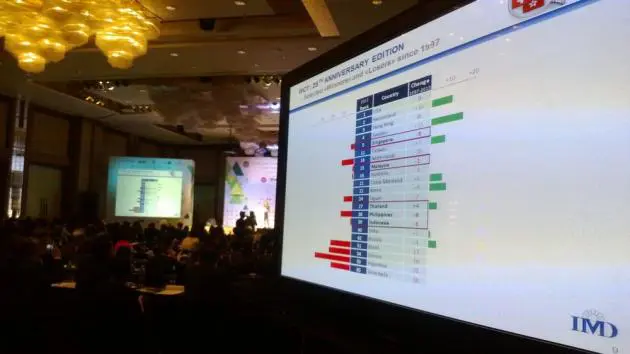
In the “IMD World Competitiveness Yearbook 2013”, Thailand’s overall ranking is 27th out of the 60 economies covered. Among five Asean countries in the IMD ranking, Thailand (ranked the 27th) is in the middle, sandwiched by Singapore (5), Malaysia (15), the Philippines (38) and Indonesia (39).
Meanwhile, the country’s overall competitiveness ranking by the World Economic Forum is 37th among 148 economies.
Anne-France Borgeaud Pierazzi, senior economist and head of IMD World Competitiveness Centre operations, said that to move up the ladder, Thailand needed to focus more on weak areas like low spending on research and development, political instability, inefficient small and medium-sized enterprises, and corruption.
To her, there are good examples to learn from. Ranked 40th in terms of innovation at all levels, Thailand can learn how Japan and the US achieve success in that area.
Ranked 39th for distribution of infrastructure, the Kingdom can also learn from Switzerland, she said.
“Thailand has the ability and potential to move up in the future,” she added.
In his speech, Garelli advised emerging markets to look at long-term issues. For example, how to increase the tax revenue ratio to gross domestic product; how to ease the conduct of business given the complexity of regulations; how to increase youth employment; how to better manage cities where growth is concentrated; and how to cope with re-industrialisation when more robots will be in use.
It will take time for the US and Europe to clear their public debts, he said. For the US, the federal debt amounts to US$16.7 trillion (Bt534 trillion), on top of the debts accumulated by individual states. On the contrary, emerging markets are sitting on combined foreign reserves of $6 trillion, and they need to establish global brands.
“The real issue is to recycle the money and invest it elsewhere,” he said, while applauding Thai companies’ purchases of some European companies.
For now, dominating the “Financial Times Global 500” are companies from the US and Europe. Meanwhile, there is only one Thai company, PTT, in the “Fortune 500” list, he said. While the developed economies are tackling their own problems, emerging markets can cash in on work power and purchasing power, he said, adding that they will however need to invest more in innovation and brand power, in order to “move up with value-added products”.
Aside from the right policies, companies are also advised to come up with new business models.
"You can’t compete if you cannot have the Made-in-Thailand concept,” he said, pointing out that products can be made anywhere in the world, as long as they contain the country’s branding.
