
SET Index dips after gloomy
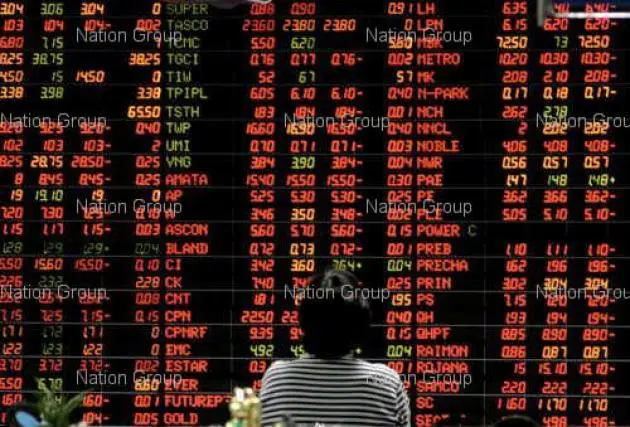


The Stock Exchange of Thailand declined yesterday on the back of poor September export data as well as the central bank's downward revision in the economic-growth forecast.
The Bank of Thailand’s Monetary Policy Committee (MPC) at its October 16 meeting sharply cut the projection for 2013 growth in gross domestic product from 4.2 per cent to 3.7 per cent. Under the revised projection, the BOT predicted export growth of only 1 per cent this year, from the previous projection of 4 per cent, in light of longer-than-expected declines in consumption and investment as well as delayed spending in big government projects.
In July, it cut the GDP growth forecast from 5.1 per cent to 4.2 per cent.
Data from the Commerce Ministry also showed that exports, which contribute 70 per cent of the country’s GDP, expanded by only 0.05 per cent in the first nine months of this year.
The SET Index yesterday was down 11.44 points or 0.78 per cent to 1,454.88 points on a very thin turnover of Bt28.3 billion.
Asian markets also slipped, led by Japan. Despite a positive lead from Wall Street, there are ongoing concerns over whether the government’s much-touted "Abenomics" growth blitz will reverse two decades of stagnant growth and falling prices. The yen advanced and hurt many export-oriented Japanese companies.
Meanwhile, the baht fell 0.3 per cent this week. The currency has risen 0.5 per cent this month, paring its loss this year to 1.8 per cent.
In September, Thailand’s exports to the United States dropped by 0.7 per cent, to the European Union 2.7 per cent and to Japan 13.6 per cent – the so-called G3 economies. Exports to China rose by 1.2 per cent and to Asean 6.6 per cent. While the export value dropped 7.09 per cent year on year to US$19.3 billion, imports dropped by 5.23 per cent to $18.83 billion, leaving $473.3 million (Bt14.715 billion) in trade deficit.
The export value in the first nine months of the year rose only 0.05 per cent year on year to $172.14 billion. Against imports of $189.8 billion, Thailand registered a trade deficit of $17.67 billion.
While releasing the October issue of the Monetary Policy Report, Paiboon Kittisrikangwan, an assistant governor and secretary of the MPC, said exports recovered more slowly than expected despite recovery in the global economy given Thailand’s minor share in the growing market for high-technology products.
"Our exports demonstrate lower-to-medium-level technology such as hard-disk drives. Demand for these products is declining in developed countries, against higher demand for tablets and smartphones, which led to lower demand for personal computers," Paiboon said.
Slowing exports combined with an expected increase in capital goods imports for private investment and government projects could raise Thailand’s current-account deficit. The central bank predicted the deficit at $6.8 billion or 1.8 per cent of GDP. However, excluding gold import value, the current account would be in a surplus equivalent to 1.2 per cent of GDP.
In the Monetary Policy Report, the MPC took the view that GDP growth would be lower than forecast in July as domestic demand has moderated more than expected and export recovery has been slow.
Inflationary pressure continued to be modest, despite the strengthening of the G3 economies.
The US economy picked up on the back of private consumption and investment in the housing sector. Euro-area economies finally bottomed out, and both industrial production and private spending began to show signs of improvement. Meanwhile, the Japanese economy expanded favourably from the government’s economic stimulus measures, and China’s economy also improved.
Nevertheless, growth of the Asean economies fell short of expectation, albeit only slightly, as a result of measures to address stability concerns.
Overall, growth of Thailand’s trading partners’ economies was likely to be close to the previous assessment.
"The Thai economy moderated more visibly than expected," the MPC’s report said. "The slowdown in private consumption persisted longer than anticipated, especially the purchases of durable goods after the expiration of the government’s first-car tax rebate scheme. Consumers were also more cautious in their spending in line with softening confidence and rising debt burden.
"At the same time, fiscal stimulus fell short of expectation due to delays in budgetary disbursement and extra-budgetary infrastructure projects. The latter [is] expected to be stepped up in 2014. In addition, export recovery took longer than anticipated given Thailand’s minor share in the growing market for high-technology products.
"Nonetheless, economic growth [is] likely to improve in 2014, with favourable household income and employment lending support for the return of private consumption to its normal growth trend. Continued fiscal stimulus, accommodative monetary policy, and recovery of the global economy [will] lead to a stronger export performance and encourage more corporate investment for capacity expansion and efficiency enhancement."
The forecast for headline inflation for 2013 is trimmed from 2.3 per cent to 2.2 per cent, and from 2.6 per cent to 2.4 per cent for next year.
