
Mega-projects 'to boost growth'


Play
Prajin says investment of Bt2.4 trillion will help economy grow 4-5 per cent next year
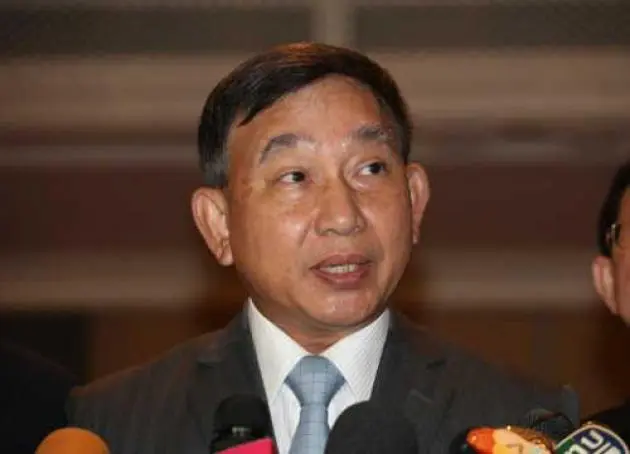
THE JUNTA’S economic csar, Air Chief Marshal Prajin Juntong, yesterday said the government’s plans to allocate Bt2.4 trillion for infrastructure investment would lead to the creation of long-term, sustainable growth of the economy.
Speaking at the “Thailand Focus 2014: Reforming for Thailand’s Sustainable Growth” seminar – arranged by the Stock Exchange of Thailand, Phatra Securities and Bank of America Merril Lynch – Prajin, who is deputy chief of the National Council for Peace and Order (NCPO), said the junta would return Thailand to a properly functioning democracy in three phases.
It also aims to achieve sustainable economic growth in the future via the infrastructure investment master plan, he said.
Prajin oversees economic matters for the junta and has been tipped as a deputy PM responsible for economic affairs when Prime Minister Prayuth Chan-ocha announces his government team.
The NCPO is aiming for economic growth of 2 per cent this year. It expects gross domestic product to expand by 3-3.5 per cent in the second half of the year, and by 3.5-4 per cent next year.
The Bank of Thailand expects the economy to be able to grow by 5.5 per cent next year, which is closer to the country’s real economic potential as it is growing from a lower base and many economic stimulus that were put on hold in 2014 will present themselves next year. “Confidence has been restored and the economy is recovering well, but much more needs to be done to put Thailand back on the path of stable long-term growth. In this respect, we are focusing our efforts on four fronts, namely, transportation, ICT [information and communications technology], energy and investment,” he said.
Prajin explained that the investments to improve transportation would cover all four modes – road, rail, water and air – along with the establishment of strategic linkages with neighbouring countries and southern China.
The NCPO also attaches importance to the development of ICT and the building of fibre-optic networks to link up with other countries, because it believes that the sector is crucial for the country’s competitiveness and the growth of other sectors, he said.
Another key aim is to reduce the Kingdom’s dependence on fossil fuels to support the growing demand for energy from industries and households, he added.
Arkhom Termpittayapaisith, secretary-general of the National Economic and Social Development Board, told the seminar that he expected the economy to continue recovering in the second half and achieve the 2-per-cent maximum-growth mark for the full year.
He outlined the state’s budget priorities for next year, splitting them into spending by government agencies and investment by state-owned enterprises. Government agencies’ spending will consist of infrastructure development projects to improve irrigation and transportation such as roads, while state enterprises plan to invest primarily in the transportation and energy sectors.
“If all goes well with the infrastructure plans, people will be able to travel freely across Asia, as they do in Europe, by 2020,” he added.
Prasarn Trairatvorakul, governor of the Bank of Thailand, said the central bank would play a supporting role for the government’s economic-growth development plans by maintaining financial stability.
“The BOT’s roles in lifting growth potential still exist … Firstly, there is the role of maintaining economic stability, as stability is a prerequisite to structural changes that lift productivity … Secondly, there is the developmental role, in the form of supply-side policies, to enhance financial-sector efficiency and create a favourable financial environment for investment that would lead to higher productivity growth,” he said.
The governor also expressed confidence that the economy could grow by as much as 5.5 per cent next year, which he said was closer to the country’s real economic potential, as it would be growing from a lower base and there were many economic stimuli that had been put on hold this year, but which would present themselves next year.
“Economic potential has to be viewed in two levels. The first is to find out what is our true potential, and second is how we can increase this potential,” he said, adding that the economy has the potential to grow consistently by 4-5 per cent per year.
