
BEC floats idea of simulcast for Channel 3


Play
Bangkok Entertainment Company (BEC) says its analogue Channel 3 could be simulcast on a digital-TV channel obtained by its affiliate, BEC-Multimedia, if the broadcasting regulator allowed it to do so.
Chatchai Thiamthong, vice president for finance at BEC World – the parent company of BEC – insisted yesterday after a meeting with the five members of the broadcasting committee of the National Broadcasting and Telecommunications Commission (NBTC) that BEC was a separate entity from BEC-Multimedia.
BEC-Multimedia, which is wholly owned by BEC World, won three licences to run terrestrial-based digital-TV channels for variety in high and standard definition, and another one for kids and family viewing.
“It seems to breach the licence-bidding condition, which said the owner of a digital-TV licence must be the same entity as the digital channel operator. But if the NBTC gives a green light to do so, we will simulcast,” he said.
“Therefore, the NBTC should look into this matter, in order to make simulcasting possible,” he added.
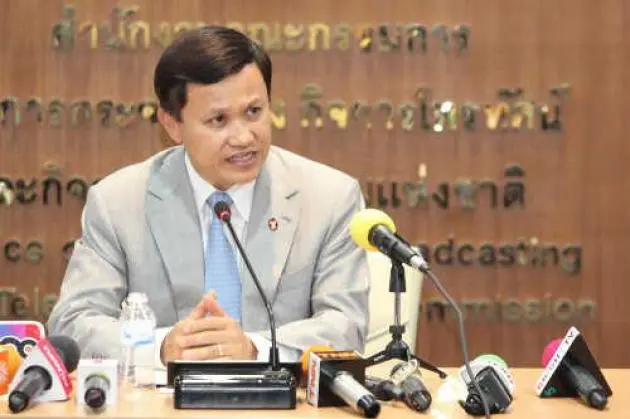
The NBTC’s broadcasting panel, led by chairman Natee Sukonrat, invited high-ranking executives at BEC – executive member Pravit Maleenont, deputy managing director Prasarn Maleenont, Chatchai and a legal adviser – to yesterday’s meeting to seek a way out of the problem of Channel 3 having been blacked out on cable and satellite TV, after the NBTC issued an order to operators to drop the channel.
Supinya Klangnarong, a member of the NBTC, said after the meeting “We appreciate [the proposal] to look into this matter, as Channel 3 expressed an interest in simulcasting as a solution.”
However, she suggested that Channel 3 also had another option, in that it could apply for a pay-TV licence in order to be allowed to broadcast via cable and satellite-TV platforms, although it must comply with the regulations governing pay-TV broadcasting service if it were going to follow this path.
Better way out of impasse
This may indeed be a better way out of BEC’s impasse, because the ownership of digital-TV channels was not only mentioned in the licence-bidding conditions, but also in the Broadcasting Act, Natee added.
Natee, meanwhile, said his committee was seeking other ways to resolve the problem if simulcasting was not the answer.
The conflict between the NBTC and Channel 3 emerged after the watchdog redefined free-TV broadcasting service to cover only the 24 digital terrestrial-TV channels, thus freezing the channel out because its operator had not taken part in last year’s digital-licence auction.
