
Thai-Japan trade ties to continue: PM


Play
Prime Minister General Prayut Chan-o-cha has sought to allay worries among Japanese investors about the future of business opportunities in the Kingdom.
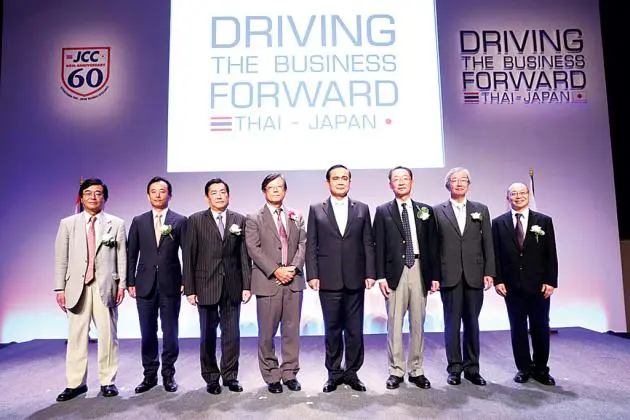
The Japanese Chamber of Commerce invited Prayut, Thai Chamber of Commerce chairman Isara Vongkusolkit, Cabinet ministers and others to an event called “Driving the Business Forward, Thai-Japan”.
The Japanese chamber said the event was aimed at expressing gratitude to Thais for contributing to the sustained improvement of the economic relationship between the two countries, and to show Japanese companies’ strong determination to strengthen and develop the Thai economy as the Asean Economic Community approaches.
In his opening speech, the president of the Japanese Chamber, Hisamichi Koga, thanked Thais for their generous help for earthquake victims in his country and for their long-standing friendship, noting that Thais also received invaluable help from the Japanese when they were hit by disastrous floods a few years ago.
He said Japan contributed 55 per cent of the foreign investment flowing into Thailand and Japanese were the largest group of foreigners residing in the Kingdom.
“We do hope that we will be the world’s best partners as we have always been. Japan and Thailand shall join hands to foster mutual development forever,” Koga said.
In his speech, Prayut said: “Realising that the recent political conflict in Thailand has caused worries to Japanese investors in Thailand, I would like to say that there still needs to be reform in Thailand. At present, sustainable democracy is what we require most in order to drive the economy towards greater stability. And definitely, the government will solve current problems with transparency and accountability, which are the two central pillars of good governance.
Development in all perspectives
“The government is now seeking to develop the country in all perspectives including the economy, energy resources, infrastructure, flood prevention, agrarian reform, small and medium-sized enterprises and technological advancements.
“In the meantime, we focus upon maximising the country’s competitiveness through the development of the logistics system, goods transport, infrastructure, and transport between Thailand and neighbouring countries, with Thailand standing as the region’s centre along the main stream of the Mekong River, making it convenient for Thai and Japanese trade and investment.
“With reference to investment, we are pursuing a free-trade policy while amending some rules and regulations to allow for easier investment.”
Prayut claimed that his regime, which seized power from the elected government in May after opposition forces had laid siege to Bangkok for months, was “revising numerous measures to attract foreign investment for greater business competition so that we can get out of the middle-income trap and achieve more sustainable development. The enhancement of our investment climate and the revision to our business standards and profits are therefore compulsory.”
He added: “I am confident that our participation in the Japan-Thailand Economic Partnership Agreement, the Asean-Japan Comprehensive Economic Partnership and the Asean Economic Community will definitely open up more wonderful opportunities for Japanese investors in the Asean region.”
