
Relief for SMEs, low-income earners


Play
The Finance Ministry yesterday has received the Cabinet's approval for four key measures aimed at lowering costs and improving the competitiveness of small and medium-sized enterprises (SMEs), encouraging people to save and helping those on low incomes to
The measures that gained approval are a nano-finance scheme; the lowering of corporate income tax for SMEs; the reduction of import taxes for tools and machinery crucial for SMEs’ production and operations; and the offer of Bt100 billion worth of high-interest savings bonds for the general public.
Finance Minister Sommai Phasee said two more measures would be considered by the Cabinet next week, and were currently being revised by Deputy Prime Minister MR Pridiyathorn Devakula.
They are believed to involve the setting up of a venture-capital fund worth around Bt50 billion, which would be spent on joint investment projects with SMEs, a national savings fund, and programmes submitted by state banks, such as lending schemes by the Government Savings Bank to help small business operators.
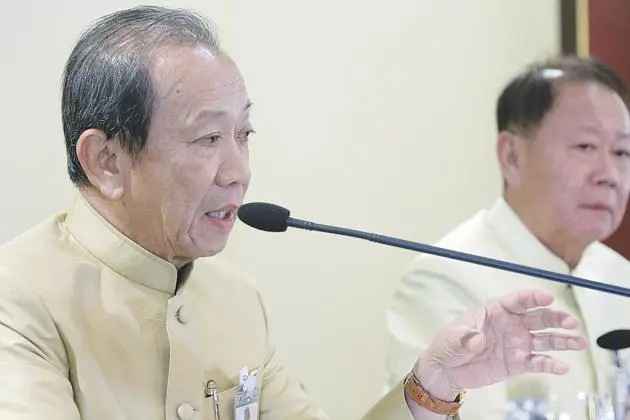
“These [four measures] are not gifts for the New Year, but they are measures that the ministry has been working on for the past two months that are aimed to help people on low incomes, and for SMEs to lower costs and increase their competitiveness,” said Sommai.
The nano-finance scheme will allow businesses, state and commercial banks, or anyone who has approval from the Bank of Thailand with a minimum capital of Bt50 million, to organise nano-financing.
Small loans of no more than Bt100,000 will be available to individuals at an interest rate of no more than 36 per cent per annum, averaging 3 per cent a month, he said, much lower than what they pay for sharkloans.
Approved businesses should be able to start offering nano-financing by February, and the central bank will supervise and monitor these businesses to make sure they do not charge interest rates higher than what is permitted, he added.
Rungson Sriworasat, permanent secretary at the Finance Ministry, earlier revealed, after the “Asean+3 Finance and Central Bank Deputies’ Meeting” in Tokyo, that the Financial Services Agency of Japan was willing to share its experience and expertise on nano-finance, especially in regard to training in running such an operation. Sommai said the reduction in corporate income tax would commence on January 1 and would apply to SMEs whose annual net income is more than Bt1 million but no higher than Bt3 million.
Such businesses will benefit from a tax deduction from the current 20 per cent to a new rate of 15 per cent.
The measure is expected to help around 28,000 SME operators to save costs of around Bt100,000 per business per year. This is expected to cost the government around Bt1.9 billion annually in lost income, but the likely increase in the number of SMEs as a result of the measure should compensate for the revenue shortfall, he added.
Meanwhile, the lowering of import duties for parts, machinery and materials that are crucial for domestic production and increasing the competitiveness of the manufacturing sector will also begin on January 1, and will be separated into two categories. In the first category, raw materials crucial to production and 1,274 small machinery parts that are not available in the country will be exempted from import tax.
The second will cover the import of 258 types of machinery and machine parts needed for production, whose import duty will be slashed to 10 per cent.
These import-duty measures are estimated to cost the exchequer Bt1.6 billion per year, said the minister.
The final Finance Ministry proposal agreed yesterday is the offer of Bt100 billion worth of high-interest savings bonds to the general public.
Bt50 billion worth of 10-year bonds will be offered by the government to cover borrowings in the fiscal 2014 budget, while Bt50 billion worth of five-year bonds will be offered by the Bank for Agriculture and Agricultural Cooperatives.
A first lot of bonds will be offered to the public from January 12-16, with a maximum purchase of Bt2 million per individual or group.
The second batch will be offered on January 19-20, with no limit as to how many can be bought.
