
Tea entrepreneur banks on niche strategy in competitive market
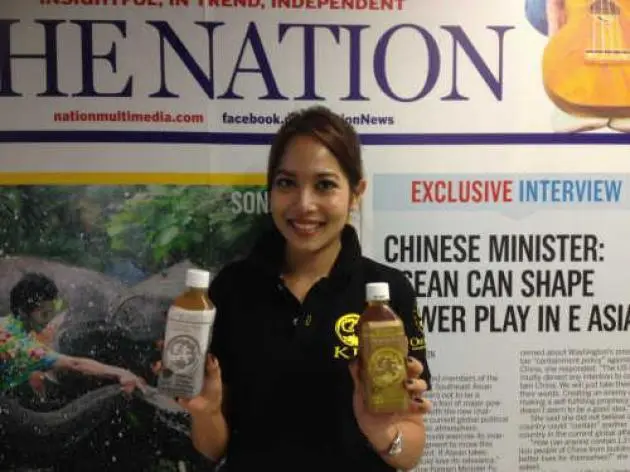


THANASSAYA Chatidesa set up her own ready-to-drink tea business nearly three years ago after seeing a niche opportunity in what is a highly competitive market.
While Thanassava, 31, is from a family whose business is the manufacture and export of silver jewellery products, she and her husband, Chatchawat Ulpathorn, decided to form their own company – Guidance Inter Group – in May 2012 to market and sell ready-to-drink green-tea products under the Kio brand.
Chatchawat is now managing director of the company.
“Ready-to-drink tea business is highly competitive and is already dominated by major players that are contesting aggressively, but we still find that Thai people have few choices of beverage in the market. We try to focus on health-concerned consumers, who are growing in number nowadays,” she said.
Although Thai consumers generally prefer sweet-tasting tea, there are many people who look for non-sugary ones. These people are not limited to the elderly or those with diabetes, but also include those who want to stay in shape, said the co-founder of the company.
“We want to create a functional drink that tastes nice, a healthy beverage with a fashionable design, and a herbal tea that is easy to drink. So far, the ginseng, ginkgo and goji berry components in each Kio tea make it unique,” she added.
She said Guidance Inter Group aimed to sell at least 2 million bottles of Kio tea by the end of this year.
The products are now available in 7-Eleven convenience stores, Maxvalu, The Mall supermarkets and Tesco Lotus hypermarkets.
The company plans to expand the distribution to more convenience-store chains and supermarkets over the course of the year.
“We plan to extend our product line into other functional drinks with different functional components. Kio will be a healthy beverage brand. Our research and development teams are developing more drinks for the market, and they are expected to be on the shelves in six months,” said Thanassava.
While both her and her husband’s families are in the silver-jewellery export business, she said she had found that being an original-equipment manufacturer for foreign brands and shops was quite risky.
“Twenty years ago, there were very few silver jewellery manufacturers in Thailand, and we all had an advantage in doing such business in the region. But since China emerged, we have lost our clients because of their cheaper labour.
“However, we have survived the situation, but still have to depend on foreign economies, commodity prices and currency fluctuations. I have noticed that our [jewellery] competitors are from everywhere. As a manufacturer, we cannot reach the end-users of our products,” she said.
Thanassava graduated with a master’s in business law from Thammasat University.
She has always believed that one person can take care of two businesses, or even more, at a time. Today, she still participates at jewellery trade shows around the world for the family business, while taking care of her own tea business.
“It takes time for me to learn, but I have realised that my life is all about learning new things all the time. As a lawyer, my mindset is to search for ‘gaps’ and ‘risks’ in every project, which sometimes becomes an obstacle, as I always find more risks than opportunities. We, lawyers, are trained to avert clients from all conflicts.
“Entrepreneurs insist that conflicts are occasional and unavoidable in the business world. However, my advocacy helps when it comes to contracts and negotiations. Sometimes you need a lawyer’s skill to distinguish fact from opinion, being more careful of what you say and avoiding unnecessary commitments,” said Thanassava.
For her, the jewellery business is totally different from the tea business. However, while the family jewellery business deals with fashion and is obsessed with how to differentiate its designs from those of others in the market, this differentiation strategy has had a positive influence on the development of Kio tea, she said.
“We also learned to create a story in each jewellery collection, and so we have been doing the same with our tea packaging and advertising. It just comes naturally, I cannot compromise when it happens to be a beauty issue,” she added.
