
Digital TV delay to hamper licensing
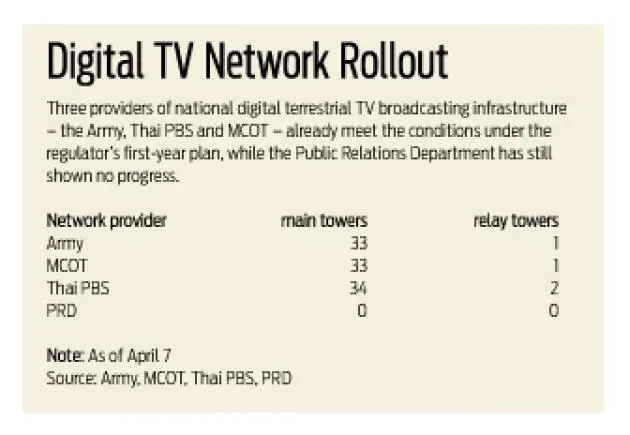


The broadcasting regulator admits that the delay of the Public Relations Department in rolling out its terrestrial-based digital TV network might affect the impending licensing of nine public digital TV stations.
Supinya Klangnarong, a member of the Broadcasting Committee, said last week that the PRD was the only national network provider that had not installed transmitters for this new broadcasting service.
The committee is negotiating with the PRD to solve this problem, but the PRD seems to have its hands tied as its Bt980-million network rollout plan is still postponed by the government.
The contest to award eight or nine digital terrestrial TV licences for public service could be affected.
Parliament TV’s channel 10 and Thai PBS’ family channel 4 were among those expected to get public digital TV licences.
In an interview with The Nation last year, Chumporn Kruakhwan, executive director of the PRD’s engineering support and development bureau, said his office had shifted its focus to public service after the Army, MCOT and Thai Public Broadcasting Service (Thai PBS) were picked up by all 24 commercial digital TV operators.
At that time, the PRD was in talks with several government bodies such as Parliament, the Education, Defence and Agriculture ministries and National Police.
So far, the Army has installed transmitters at 33 main towers and one relay site. MCOT has transmitters at 33 main towers and one relay site. Outpacing its rivals, Thai PBS has transmitters at 34 main towers and two relay sites.
By June, the three networks’ coverage must reach at least 80 per cent of all households through 39 main towers each.
Sivaporn Chomsuwan, director-general of MCOT, insisted that his state enterprise must meet the requirement by June 1.
Its Bt1.8-billion digital TV network project would break even within six years.
Under a commitment with the broadcasting regulator, the network providers must provide access to all 23 million households by 2017.
