
Economy will expand to 4.7%: Prayut
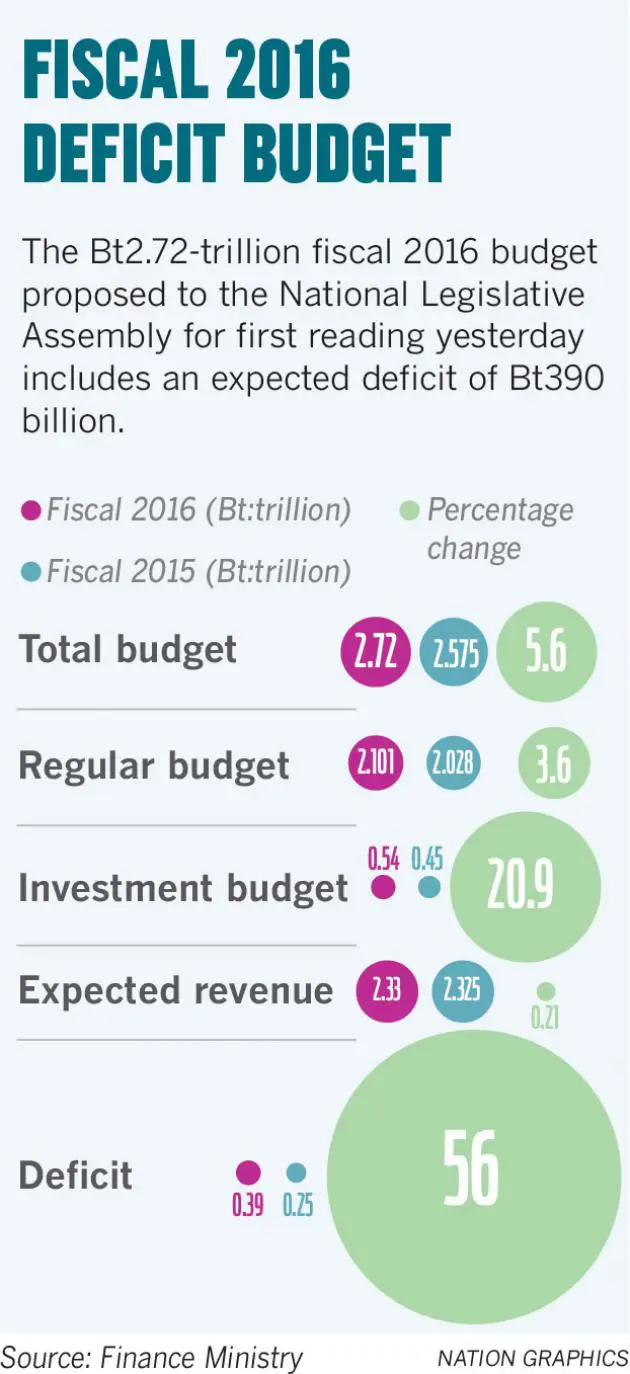


Prime Minister General Prayut Chan-o-cha expects the economy to expand by 3.7 to 4.7 per cent next year, when the government starts spending the Bt2.72-trillion budget earmarked for the 2016 fiscal year.
He made the prediction at the first vetting of the 2016 budget bill by the National Legislative Assembly (NLA) yesterday. Meanwhile, the second and third vetting of the inheritance tax was set for the same day, but was postponed to the next meeting as discussions on the budget took longer than expected.
The premier also said that the government believes the gross domestic product for this year will expand by 3.5 to 4.5 per cent.
"I believe the disbursement of the government’s fiscal budget is crucial for the implementations of its policies and economic and social-development measures," he added. "The disbursement of the investment budget will be based on priority. Projects that are most tangible, promising and advantageous to the country will commence first, while other projects that do not have such qualities will be put on hold pending future funding to lower the burden on the budget."
Prayut explained that economic expansion in 2016 is expected to be better than in 2015 because the global economy is also expected to improve, which will help Thailand’s export sector, while crop prices have the potential to stabilise and rise.
"Up to 70 per cent of our exports are agriculture products, so if the crop prices rises and external demand is more [when compared to this year], then the export situation will be better next year," he said.
The expected increase in external demand would also boost the confidence of the private sector, while further expanding government spending on mega-projects and special economic zones. Accelerated budget disbursement should also continue to help with the expansion of the economy next year, he explained.
Meanwhile, while vetting the 2016 budget bill, most NLA members commended the government’s decision to boost the investment budget, though some said more funds should be earmarked for research and development. Also, some called for fixed expenditure and spending on state-owned enterprises to be lowered further via the public and private partnership model.
Larger R&D budget sought
NLA member Somchai Sawangkarn said the R&D budget should be increased from the current 1 per cent (Bt25.46 billion) earmarked for fiscal 2016 to 3 per cent in fiscal 2017 to back the creation of value-added, high-technology products.
Montian Boontan and Nisada Vechayanont, also NLA members, proposed that the government give the private sector more responsibility for public service as they are more efficient and this would also lower the government’s annual fixed budget, because it will not need to hire any more personnel for the services.
If the budget bill is passed, the investment budget for fiscal 2016 will be set at Bt543.635 billion, which is Bt94.16 billion or 20.9 per cent higher than in fiscal 2015. Most of this budget will be concentrated on projects for water management, basic infrastructure, road connectivity and school buildings.
Around Bt520 billion will be allocated to the Education Ministry, Bt402 billion to the central budget, Bt343 billion to the Interior Ministry and Bt207 billion to the Defence Ministry (marking a 7 per cent increase). The budget for provinces and provincial groups is Bt25.199 billion, up 41.7 per cent; for the Transport Ministry Bt138.886 billion, up 25.4 per cent; and for the Natural Resources and Environment Ministry Bt36.420 billion, up 20.4 per cent.
The 2016 state budget will account for 20.4 per cent of the gross domestic product, which is the same as the 2015 budget. The 2016 fiscal budget year begins on October 1, 2015.
The NLA will conduct the second and third vetting, starting on August 27, after setting up a 50-member committee for the task.
