
Sharp improvement in fundamentals strong shield against external events


Play
EIGHTEEN YEARS have passed since the financial crisis erupted in 1997. Looking both at the past and ahead, the private sector is confident that Thailand will not experience a similar crisis in the near future, thanks to the sharp improvement in its econo
Kasikorn Research Centre (KResearch) has said the basic fundamentals of the Thai economy all meet the “above-average criterion”, despite the current weakening state of the economy following a period of political instability and the slowdown in global demand.
The 1997 crisis was sparked by massive inflows, which were channelled into unproductive sectors, and into property development in particular.
Speculative buying was rampant, boosting the developers’ balance sheets. Yet, the short-term gains were wiped out – and that was the lesson learnt by all.
Thai Condominium Association president Prasert Taedullayasatit says that those developers who survived the financial crisis in 1997 have since refocused on real demand. They all also work hard at maintaining their debt-to-equity ratio at below 2:1.
“We learnt from the crisis. We also balance the sources of income, which should come from sales or investment,” Land & Houses president Naporn Sunthornchitcharoen said earlier.
Land & Houses was one of the property firms negatively affected by the financial crisis, selling a stake to the Government of Singapore Investment Corporation, which still has a 15.56-per-cent holding in the listed developer.
The Kingdom’s extremely flexible exchange-rate policy, its much lowered foreign-debt ratio from 62.7 per cent of gross domestic product (GDP) in 1997 down to 36.6 per cent currently, and current short-term debt of 40 per cent when compared to 45 per cent in 1997, all reflect the claims of improved financial stability and flexibility, according to KResearch.
KResearch’s head of money and banking, Thanyalak Vacharach-aisurapol, said the financial crisis in 1997 had changed the loan structure of Thai financial institutions, as the sector had learned from those events that it should balance its loan portfolio to diversify the effects from unknown factors.
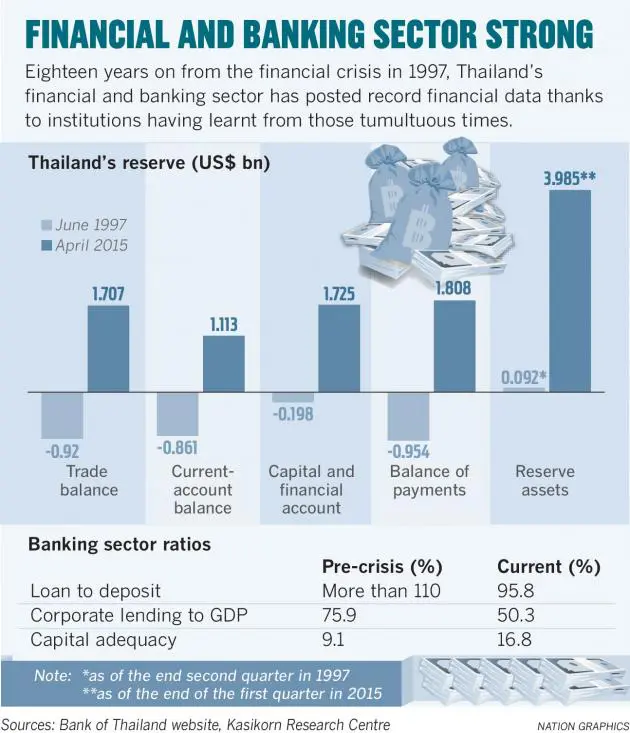
Before the financial crisis, financial institutions had an overall loan-to-deposit ratio of more than 110 per cent, and their loan exposures were particularly evident in the corporate sector, especially in real estate, she said.
Now, however, loan concentration from real estate in the past has been migrated to the manufacturing and services industries, with the restructuring of banking industry’s loan portfolio helping small and medium-sized enterprises to access lending, which in turn has helped spur the economy in the past decade, she explained.
Corporate lending by the banking sector before 1997 accounted for 76 per cent of GDP, representing 86 per cent of the industry’s overall loan portfolio.
Since the crisis, banks have migrated their loan portfolio to SMEs and retail – or individual – customers, resulting in the ratio of corporate loans to GDP declining to 50.3 per cent, and the proportion of corporate lending having fallen to 65.5 per cent of outstanding loans, said Thanyalak.
The company’s research found that after expanding loans – especially mortgages – to retail customers, and with the banks having had to offset the project finance for real-estate operators, the proportion of pre- and post-finance to GDP as of end of last year had reached 31.1 per cent, while the proportion of property loans to GDP in 1997 was just a little higher, at 32.8 per cent.
Lending to the property sector should, therefore, be closely monitored, said the researcher.
In the current economic climate, the global growth slowdown has directly impacted on the competitiveness of SMEs, which are considered the most sensitive sector, while the high level of household debt during the past decade has pulled down savings in the country.
It might, therefore, be risky for the Thai banking industry to mobilise funds from outside to cope with the coming increased investment from the public and the private sectors, she warned.
Resisting the unexpected
Piti Tantakasem, chief of wholesale banking at TMB Bank, said the existing structure of Thai banks in respect of their capital-adequacy ratio and high loan-loss provisioning confirmed that the industry was strong enough to resist the unexpected.
Furthermore, each bank has been subjected to a stress test to see |how it would cope with uncertain situations.
What the sector should be more careful about is the growth of banking from now on, he said, pointing out that driving loan growth would be more difficult as the banks had been shifting their loan portfolios to SMEs and retail customers for more than 10 years. Both lending segments enjoyed healthy growth during most of that period, but SME and retail loan demand is significantly slower this year, he added.
Anuwat Luengtawekul, executive vice president of Thanachart Bank, said that with their strong capital position and developed risk management, Thai banks were now able to withstand economic vulnerabilities.
However, their customers might not be as durable as the banks themselves, he said, stressing that the principle of doing banking business is that both banks and their customers must grow together.
Current external factors affecting loan demand are therefore an uncontrolled element for banks, he added.
Meanwhile, looking beyond the property industry, other major private-sector players that faced a major debt burden in 1997 but survived the financial crisis, have since showed strong financial results – and have also expanded their business overseas.
They include SCG Group, which had to revise its business expansion in 1997, but is now expanding its investment in Asean.
Central Group, which had to sell a major stake in Big C to France-based Casino group, and a stake in Tops Supermarket to Netherlands-based Royal Ahold, has since bought back its stake in the latter and is also expanding its investment overseas. According to the Stock Exchange of Thailand, the market capitalisation of all listed companies was worth Bt14.14 trillion as of end-June, compared with Bt1.6 trillion on June 30, 1997.
Meanwhile, listed companies reported a combined net profit of Bt226.86 billion at the end of the |first quarter, in stark contrast to 18 years ago when most of them posted net losses.
