
SME stimulus 'within 1-2 weeks'


Play
THE SECOND PHASE of the government's latest economic stimulus package, aimed at helping small and medium-sized enterprises, will begin in a week or two, while the third phase aimed at wooing foreign investors will be initiated via a roadshow in three mon
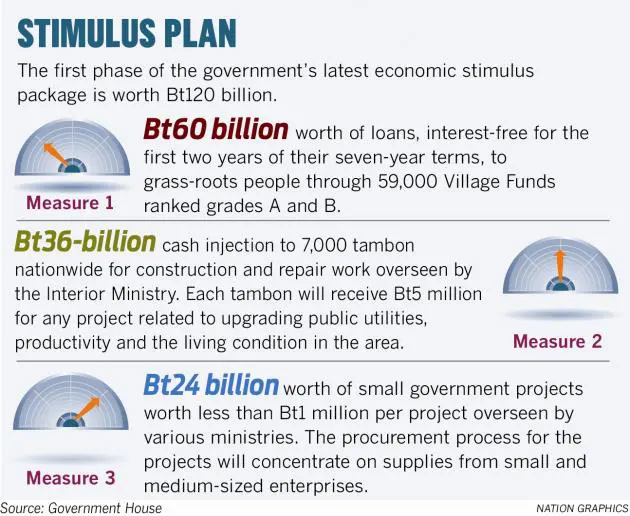
The Cabinet yesterday approved the first phase of the package, which entails Bt120 billion worth of new capital – Bt60 billion injected into the Village Fund scheme, Bt36 billion in cash handouts to 7,000 tambon, and Bt24 billion worth of small government projects.
The package also includes the acceleration of the investment projects under the 2015 fiscal budget, worth a total of Bt16 billion, which brings the total value of the new package to Bt136 billion.
“The government has the intention to rebuild the economy from within to balance the current expansion of exports, and this [the first phase of the stimulus package] is the starting point,” Somkid said after the Cabinet meeting.
“The first phase is to ease the financial problems of the majority in this country, which will lead to the circulation of capital within the economic system, while the second phase to help SMEs will come out in one to two weeks’ time,” he said.
Somkid said the second phase was extremely important as it would encourage investment activities via the budget-acceleration process and increased incentives for the private sector. These would determine the success of this three-phase economic stimulus effort.
“All new business incentives including the work to build the seven clusters are expected to be done before December. Then the roadshows to other countries will begin because by then we will be able to tell [investors] we have to offer, how ready are we and what we have done to boost our domestic consumption and help increase the competitiveness of our SMEs and the export sector,” he said.

The Bt60-billion increases to the Village Fund programme in the first phase will come from loans via the Bank for Agriculture and Agricultural Cooperatives (BAAC) and the Government Saving Bank (GSB). The cash handout programme and the new small government projects will be partly funded by the central budget and the rest by advances from the 2016 fiscal budget.
The new projects are basically existing projects within the fiscal budget that have been put on hold from prioritisation.
Ammar Siamwalla, a scholar at the Thailand Development Research Institute, has expressed concerns that handing out zero-interest loans will exacerbate the high level of household debt. But Somkid insisted they were a needed relief measure for low-income people during this tough economic time. He also said disbursements “will be carefully monitored by the Village Fund committees in each village”.
Finance Minister Apisak Tantivorawong added that the condition forbidding the taking of the loans for re-finance purposes was designed to lower the effect on the household-debt level.
The projects under the tambon cash-handout programme will be decided by their provincial governors, while the Interior Ministry will oversee the necessity and the benefits of the projects along with its procurement process.
New projects from the cash-handout programme and the small government projects are expected to commence within the next three to four months, Somkid said.
