
Airlines to charge for food, seats, other facilities to up ancillary income
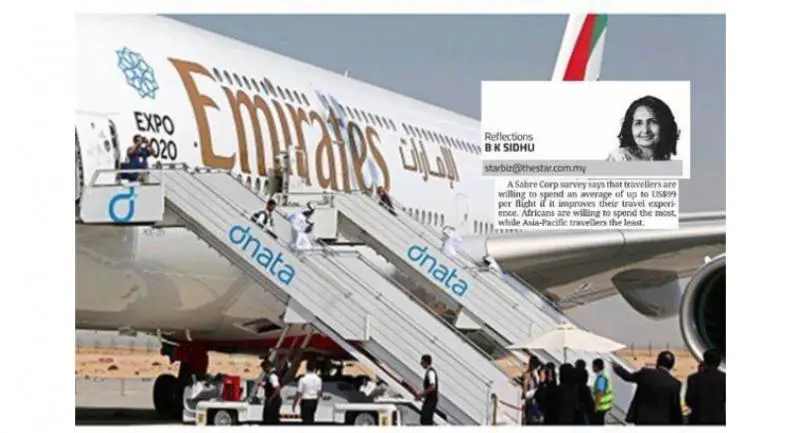


EMIRATES, the world’s largest airline by international passenger traffic in 2015 which saw a 75 per cent drop in profit for the six months to September this year, is now charging a seat assignment fee for its lowest price fares.
Come January 11, British Airways will start charging for snacks and drinks for its European flights on economy class, complimentary now, on short-haul flights defined as five hours or less.
This is part of the plan to grow ancillary income, which is non-ticket sources such as baggage fees, on-board food and services, seating, selling frequent flier miles to parties and even early boarding.
Ancillary revenue for long was the domain of low-cost carriers (LCCs), but increasingly, full-service carriers (FSCs) are into the game, given the handsome returns.
Why the FSCs want to be part of this is due to depressing yields and intense competition. The new wave of digitalisation has also opened new channels for them to sell services.
A recent report by ancillary revenue consultancy, IdeaWorks, and online car rental booking company, CarTrawler, predicts that ancillary incomes will reach $67.4 billion this year.
This is a 200 per cent increase from $22.6 billion (Bt806 billion) in 2010. It based its projections on the ancillary revenue activity of 178 global airlines.
Globally, ancillary revenue is estimated to represent 9.1 per cent of the $740 billion airline revenue for 2016.
The split was $44.9 billion from optional services, such as onboard sales of food and beverage, checked baggage, premium seat assignments and early boarding benefits, and $22.5 billion from non-fee activity such as the sale of frequent flyer miles to programme partners, and commissions earned on the sale of ground-based services to travellers, such as hotel accommodation and car rentals.
Last year, the reported ancillary income was $40.5 billion.
It is the traditional airlines such as Air New Zealand that will make the big bucks from ancillary revenue.
Last year, the top ancillary earners were United States ultra-LCC Spirit Airlines at 43 per cent of revenue, followed by fellow American Allegiant Airlines at 38 per cent, and Hungary’s Wizz Air at 36 per cent and Britain’s Jet.2.com at 29 per cent.
The US carriers that earned big bucks in ancillary income last year were United Airlines with $6.2 billion, American Airlines with $4.7 billion and Delta Air Lines with $3.8 billion, which are adopting the business models of their low-cost competitors.
Locally, AirAsia Bhd has seen a steady increase in ancillary income year-on-year, and with technological advancement, it wants to push revenue per passenger from 46 ringgit (Bt368) now to 60 ringgit next year, a 14 ringgit rise.
