
Hong Kong sets to capitalise on Belt and Road initiative


The Belt and Road initiative has the potential to boost Hong Kong's status as a major financial, economic, trade, business and transportation centre in the world. Here are four reports from ANN media.
SAR’s aviation hub status in line for a big push

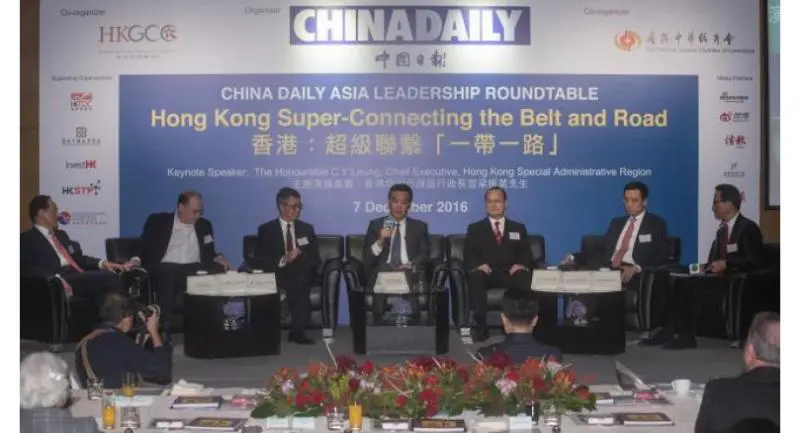
(From left)K.Y. Edward CHEN, President, Qianhai Institute for Innovative Research, Mark E. TUCKER, Group Chief Executive and President, AIA Group Limited, Stephen T.H. NG, Chairman, Hong Kong General Chamber of Commerce, C Y LEUNG, Hong Kong Chief Executive, Dr. Jonathan CHOI, Chairman, The Chinese General Chamber of Commerce, Ivan K L CHU, Chief Executive, Cathay Pacific Airways Limited and Alexander WAN, Senior Advisor, China Daily Asia Pacific attend the China Daily Asia Leadership Roundtable Luncheon and Panel Discussion: ÒHong Kong Super-Connecting the Belt and RoadÓ at teh Hong Kong Convention and Exhibition Centre, Wan Chai on Dec 7, 2016.(Roy Liu/China Daily)
The Belt and Road (B&R) initiative would endow Hong Kong’s aviation sector with vast opportunities that would help ensure the city’s status as a major global aviation hub.
“The B&R Initiative will further unleash Hong Kong’s connectivity role in trade, tourism, people-to-people exchange, import and export of cargoes, as well as logistics; and this will generate future benefits for the next generations,” Cathay Pacific Airways' Chief Executive Ivan Chu Kwok-leung told China Daily on the sidelines of the roundtable forum.
Hong Kong is a major international aviation hub, with more than 100 airlines operating out of its airport, and is also the world’s third-largest cargo transportation hub. International visitor arrivals in the special administrative region (SAR) are projected to exceed 70 million this year. A five-hour flight from Hong Kong can reach up to 48 per cent of the population of the B&R economies.
The SAR’s flagship international carrier is banking on the local aviation sector reaping the long-term economic benefits from the strategic nation-led initiative. Currently, the travel-and-tourism industries account for 8 per cent of the employment created in Hong Kong, with 5,000 jobs in the airport area.
By 2024, Cathay Pacific will take delivery of more than 60 new aircraft costing 180 billion Hong Kong dollars, which will bolster Hong Kong’s connectivity role by enhancing the frequency of services, as well as flight destinations.
Since 2014, the carrier has added seven new destinations — New York (Newark), Manchester, Zurich, Boston, Dusseldorf, Madrid and London (Gatwick). Having doubled the number of its European destinations in the past two years, the company currently operates almost 100 flights weekly to 10 European cities.
From March next year, Cathay Pacific Airways will commence four weekly flights to Tel Aviv, the business capital of Israel. Hopefully, this will be upgraded to a daily service in a bid to boost economic connectivity between the Chinese mainland and the B&R destinations, as well as between Asia-Pacific countries and destinations along the B&R routes.
“The flight to Tel Aviv from Hong Kong can link up the mainland with Israeli technology, as there are trade and investment opportunities between Israel and the mainland. In addition, there are many Israeli investment funds with assets on the mainland,” Chu said.
“The Hong Kong-Tel Aviv route can also complement Israel’s role in the diamond processing business, with Hong Kong’s role as major jewellery distribution centre,” he added.
Cathay Pacific is also contemplating launching a direct passenger service to Iran. However, the plan could not be realised until Hong Kong and Iran have finalised an aviation agreement.
“The B&R Initiative will bring benefits to the future generations, so I hope young people can embrace and engage themselves in this vision,” said Chu.
State-owned enterprises can rely on Hong Kong’s rich experience in B&R investment
The Belt and Road (B&R) initiative will strengthen Hong Kong’s role as a super-connector that can facilitate mutual investments between companies from the Chinese mainland and their counterparts from economies along the B&R routes, cashing in on the city’s decades-long experience in liaising with regional peers, a prominent business leader stated at the China Daily Roundtable Leadership Luncheon on 'Hong Kong Super-Connecting the Belt and Road' held on Wednesday.
“For example, many of our members are Hong Kong companies with 40 to 50 years’ experience in investing in the Asean (Association of Southeast Asian Nations) countries and are thus very familiar with these markets. If SOEs (State-owned enterprises) are interested in the Asean, they can cooperate with Hong Kong enterprises in doing business there. As Premier Li Keqiang has said, mainland and Hong Kong enterprises should tap the opportunities in international markets,” said Jonathan Choi Koon-shum, chairman of the Chinese General Chamber of Commerce.
Before the kick-off of the B&R project, Hong Kong was already an investor, with an established business reputation in the B&R markets, especially the Asean countries, and several Hong Kong enterprises have rich experience in investing in the property, finance and manufacturing sectors in those economies.
To set up a strong combination of Hong Kong and mainland companies in going globally, Choi urged mainland enterprises to create joint ventures with their Hong Kong peers and adopt Hong Kong’s business management experience, which is more suitable for the B&R economies. In addition, mainland companies can have stakes in their Hong Kong counterparts, which have well-established themselves in overseas markets.
Hong Kong has been pushing to take up the role of a 'super-connector' for the B&R project since it was mooted by President Xi Jinping three years ago. Choi said the SAR, as a 'super-connector' to promote bilateral investments, can also act as a financing centre, such as a hub for fundraising or initial public offerings. The city can further offer professional services, such as legal and accounting services, in line with international standards, making it easier for mainland companies to go out.
However, he warned that investing in the B&R countries does bring risks.
“The biggest challenge is political instability. Prior to the B&R Initiative, Hong Kong’s relationship with Southeast Asian countries, for instance, was purely based on trade, but there are now geopolitical issues — the relationship between China and other countries, as well as the uncertainties in these countries, all of which pose challenges to investment,” he noted.
Choi allayed fears over the mainland’s tighter capital control on capital outflow, adding that capital control will not have any impact on B&R investments, as Hong Kong can be a fundraising centre. So, it’s unnecessary to transfer money from the onshore to the offshore market.
“Indeed, implementing capital control measures is to prevent illegal money-transfers but not real investments,” he said.
Another notch in Hong Kong’s belt
Hong Kong has the potential to play a bigger role in the Belt and Road (B&R) Initiative, according to Qianhai Institute for Innovative Research President Edward Chen Kwan-yiu.
One solution is greater cooperation with Shenzhen’s Qianhai special economic zone, he told China Daily on the sidelines of a China Daily Asia Leadership Roundtable Luncheon on Wednesday.
Chen said while the Hong Kong government has placed greater emphasis on its participation in the B&R Initiative, the city is certainly able to achieve more, especially in the involvement of its banking sector.
“So far, there are very few big projects to our knowledge. The banking sector (of Hong Kong) seems to be rather reluctant to participate, as the payout period is too long,” he said.
“Hong Kong banks don’t like the payout period to be longer than 10 years, but the investment period for most infrastructure projects (of the B&R economies) are at least 20 years,” he pointed out.
Hong Kong should ideally be a financing platform for infrastructure projects, due to the city’s status as a global financial centre, but then there seems to be a mismatch in terms of the structure of payback periods.
While a payback period of 20 years may seem too long, it does not mean that Hong Kong cannot play an important role through financial innovation, including securitising long-term investment and turning the investment into bonds or other financial instruments, Chen said.
The central government has placed Shenzhen’s Qianhai as a special economic zone to experiment with new financial policies, he said. This decision was taken due to Qianhai’s proximity to Hong Kong, so that Qianhai could learn from the financial expertise, experience and institutions of its neighbour.
He pointed out that Hong Kong and Qianhai complement each other, as Qianhai enjoys favourable and innovative policies, while Hong Kong possesses talent and experience — by working together, the two will be able to form bigger roles in the region.
Chen said Qianhai is eager to cooperate with Hong Kong. He added that Hong Kong should set up large companies in Qianhai to take advantage of the favourable policies. Doing so would make it easier for Hong Kong companies to invest in projects in the B&R region, particularly in terms of risk management, he explained.
“We can work together with Qianhai to introduce new financial products and launch them on the Chinese mainland, for example, to raise funds,” he said.
As Hong Kong banks are not so keen to undertake long-term investment, they should partner with Chinese mainland institutions to introduce more new financial products, securities and long-term loans to fund the infrastructure projects, Chen said.
“I think somehow we have underestimated the importance of Qianhai in terms of our own financial development and our own role in the B&R Initiative,” he said.
Hong Kong poised to benefit from B&R pole position
Hong Kong is ideally positioned to reap the benefits of the three-year-old Belt and Road (B&R) Initiative to expand its presence in markets around the region and the world, stated Chief Executive Leung Chun-ying.
This means Hong Kong is pushing forward with efforts to boost its role as a super-connector for the 60-plus economies that make up the B&R, focusing in areas that it excels in, according to Leung.
“Working together — the government, business and community — we Hong Kong will be the key link, the super-connector, for the Belt and Road, and for Belt and Road economies and the Chinese mainland,” he said.
“We have been doing a lot of messaging on the mainland about Hong Kong’s (role),” he added.
However, there remains a caveat, he warned.
“Hong Kong is too small to pretend. We can be all things to all men,” Leung said, adding that a greater focus on professional services — larger contributors to the city’s gross domestic product (GDP) than tourism — could serve Hong Kong well.
Leung made the comments during the China Daily Asia Leadership Roundtable Luncheon at the Hong Kong Convention and Exhibition Centre on Wednesday. The event focused on 'Hong Kong Super-Connecting the Belt and Road' and was attended by about 270 executives and opinion makers.
“It is a hugely ambitious project and we, members of the public and the media, are keen to see tangible results,” said Zhou Li, an editorial board member at the China Daily Group and publisher and editor-in-chief of China Daily Asia Pacific.
Leung said the government has continued to work toward improving financial connectivity, using the example of the Legislative Council approving tax concessions for corporate treasury centres.
Another push is the allocation of 200 million Hong Kong dollars to help support professional services, with applications now open for non-profit projects to enhance competitiveness. The Hong Kong stock market now boasts connect programs with markets in Shanghai, with the Shenzhen link going live on Monday.
Connectivity possible

ZHOU Li, Editorial Board Member, China Daily Group; Publisher & Editor-in-Chief, China Daily Asia Pacific give a welcome speech during the China Daily Asia Leadership Round table Luncheon and Panel Discussion: “Hong Kong Super-Connecting the Belt and Road” at teh Hong Kong Convention and Exhibition Centre, Wan Chai on Dec 7, 2016.(Roy Liu/China Daily)
The roundtable also heard that the 'super-connector' role of the Hong Kong special administrative region (SAR) is also visible in other areas, most notably logistics. A world-class airport and port, both of which are among the busiest in the world, make this connectivity possible.
Hong Kong’s links to the mainland, through the 'One Country, Two Systems' approach, facilitates access to both the mainland and markets around the world.
Despite these advantages, Leung said much work remains to be done, and information will be the key.
“We need to step up our information-gathering efforts,” he said.
Hong Kong is also working to set up more trade offices abroad, adding to the five on the mainland and 12 elsewhere in the world, with Jakarta and South Korea likely to follow suit.
“We are, at present, underrepresented outside Hong Kong,” Leung said.
The sheer scope of the B&R Initiative continues to impress and open new opportunities, other roundtable panellists said.
“B&R is an ambitious initiative and promises to present a new frontier for growth at a time when growth is sadly lacking,” said Stephen Ng Tin-hoi, chairman of the Hong Kong General Chamber of Commerce.
“Without markets open, there would be no Hong Kong as we know it today. That is why we need to defend Hong Kong as the world’s freest economy,” he remarked.
For Hong Kong enterprises, the opportunities, stemming from the B&R, are likely to fall under two main categories. One is in infrastructure investment, which is likely for large companies, such as banks. The other is consumer goods, likely to apply to more small- and medium-sized enterprises.
“Hong Kong can facilitate enterprises to engage in investment and financing of infrastructure projects along the Belt and Road economies,” said Jonathan Choi Koon-shum, chairman of the Chinese General Chamber of Commerce.
“Companies in both Hong Kong and Asean (Association of Southeast Asian Nations) can join hands and explore together the opportunities,” he said.
‘Lifeline’ for Hong Kong
Under the initiative, Hong Kong should consider what and who it is connecting, said Edward Chen Kwan-yiu, president of the Qianhai Institute for Innovative Research. He suggested that while geographic connections between the land and historic Silk Roads are important, the SAR should also improve the connectivity of trade in goods and services.
“The third question is ‘how to connect,’” Chen said.
“Simply, you have to establish the connections before you can super-connect,” Chen noted.
Considerations of declining trade numbers could also come into play, he said.
“‘One Belt, One Road’ is possibly a lifeline to revive Hong Kong’s entrepot position,” Chen said.
'Hong Kong is the last bastion of free trade'
Mark Tucker, group chief executive and president of AIA Group, said some of the pieces to accomplish these goals are already in place.
“Infrastructure, as an asset class, is a natural base for insurance companies. We are wonderfully placed as a city, and with infrastructure,” he said.
He said while Hong Kong has some catching up to do, he remains confident it can be achieved.
“Hong Kong is perfectly placed today as the major centre for renminbi, the basis of opportunity to expand the renminbi market, there is no limit,” Tucker said.
Hong Kong’s long-standing logistical strengths are also important considerations.
“Hong Kong has been the biggest cargo hub in the world,” said Ivan Chu Kwok-leung, chief executive of Cathay Pacific Airways, adding it was also the third-largest passenger airport in the world.
“For a long, long time, Hong Kong has been playing this connectivity and super connectivity role,” Chu said.
“The transport sector is ready too and has been doing a fantastic job,” he added.
He said increased communication and publicity could help more people embrace the B&R and Hong Kong’s business model, taking into account that the city has always been about more connectivity. The B&R could also be an antidote to the anti-globalisation trend now visible around the world.
“Helping people — young people — understand the huge opportunities unleashed by the B&R is key,” Chu said.
