
Carmakers won’t relocate instantly, but risks persist, expert says
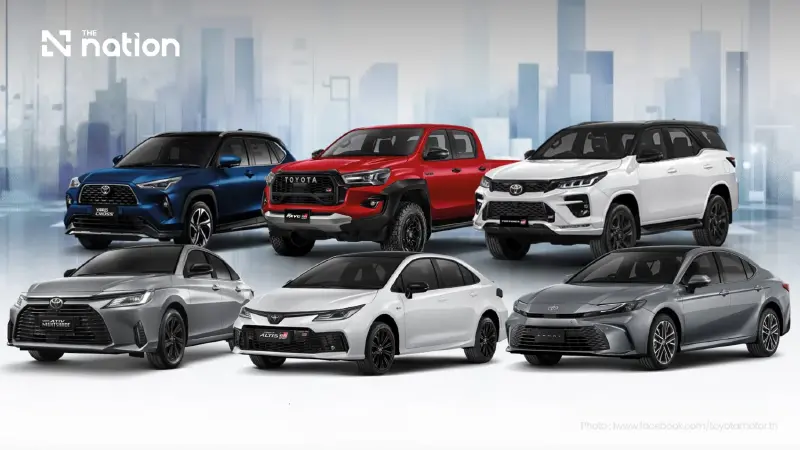


Japanese carmakers are unlikely to relocate soon, but Chinese EVs and policy risks threaten Thailand’s auto industry.
Japanese carmakers will not relocate manufacturing hubs instantly, but the current flood of Chinese electric vehicles is catalysing price wars in the Thai market, according to Dr. Archanun Kohpaiboon.
As Indonesia has urged Toyota to move its production base from Thailand to Indonesia with investment incentives, Archanun said it is too early to say whether Toyota would move, but Japanese automakers have voiced concerns over policy discrimination.
“The policy discrimination, especially from the policy promoting the use of battery electric vehicles in Thailand, starts from point zero. I think that is the real concern, that it imposes a very price distortion into the system,” he said.
Archanun, an expert in Thailand’s automotive industry and professor at Thammasat University’s Faculty of Economics, said the risk of Toyota or other Japanese automakers shifting production to Indonesia is real, but any relocation would likely happen gradually.
Thailand’s established automotive industry has a complex network of parts and component suppliers, making it costly and difficult to move an existing production base, particularly for internal combustion engine vehicles.
“The supply chain is very complex. So it is not easy, and it’s costly to move,” he said. “The risk seems to be real to me, but it would not take place suddenly. It could take place gradually.”
Toyota and Honda, along with other Japanese automakers that have operated in Thailand for decades, have raised concerns about what they see as unfair competition with newer EV manufacturers, he said.
“In my opinion, it creates a huge price difference and very unfair competition to the incumbents like Japanese carmakers,” he said.
Thailand must address the influx of Chinese EVs
He welcomed the government’s plan to revise excise taxes for domestically produced vehicles, but said Thailand must also address the influx of Chinese-made BEVs.
Under the ASEAN-China Free Trade Area, he also pointed to the combination of preferential tariffs and preferential excise-tax treatment as factors contributing to the price gap in the Thai market.
Archanun also urged Thailand to set realistic targets for EV investment, saying the technology is still developing and companies may need more time before committing to large-scale overseas manufacturing, particularly in critical areas such as batteries and core electronic components.
He also warned that Thailand needs to improve enforcement of localisation requirements attached to EV subsidies, ensuring manufacturers receiving government support actually develop domestic production and supply chains.
On Indonesia’s efforts to attract Toyota, Archanun said the country’s larger domestic market and growing supply chain could make it an attractive alternative, but these factors alone would not necessarily trigger an immediate relocation.
Investors also need confidence in long-term policy stability, particularly amid economic challenges in both countries.
“It could be, but it’s yet to be certain at this stage,” he said, adding that the next one to two years could provide a clearer indication of whether Japanese automakers will seriously consider shifting more production to Indonesia.
Meanwhile, he warned that the continued influx of Chinese EVs could undermine Thailand’s ambition to remain a major automotive production hub.
“If they keep flooding like this, no one will survive. It’s impossible for anyone to start real manufacturing here. You have to balance this,” he noted.
Archanun said Thailand should therefore move quickly to address market distortions while maintaining a competitive environment for both established Japanese manufacturers and new EV producers.
“If the government should fix it as soon as possible, otherwise the distortion could affect badly, severely, the existing Thai automotive and supply chain,” he said.
Government moves to retain Japanese carmakers
The government has moved to address the concerns, with Prime Minister Anutin Charnvirakul ordering a review of vehicle taxes and other investment measures aimed at retaining Japanese automotive production and ensuring established manufacturers are treated fairly as Thailand transitions towards electric vehicles.
Speaking to reporters in Canberra during an official visit to Australia, Anutin sought to ease concerns that Japanese carmakers could relocate production because of dissatisfaction with Thailand’s EV policies.
He stressed that Thailand remained open to investors from all countries, while highlighting the long-standing contribution of Japanese manufacturers, which have made Thailand a major production base and become deeply integrated into the country’s automotive supply chain.
“Japanese investors were among the first to come to Thailand and have been here for so long that, when it comes to using Thailand as a production base, it is difficult to separate what is Thai from what is Japanese,” Anutin said.
“We are ready to remove obstacles and assure them that we have not abandoned them. We cannot agree to everything when we need them, only to impose additional conditions once they are doing well.”
Anutin said the government wanted Japanese manufacturers to remain in Thailand and would work to preserve the country’s position as one of their key global production bases.
The government’s move comes as Thailand faces pressure to balance its push to attract new EV investment with the need to maintain the competitiveness of Japanese automakers and the extensive local supply chains they have built over decades.
