
BOI backs Toyota’s THB1.49bn hydrogen Hilux production
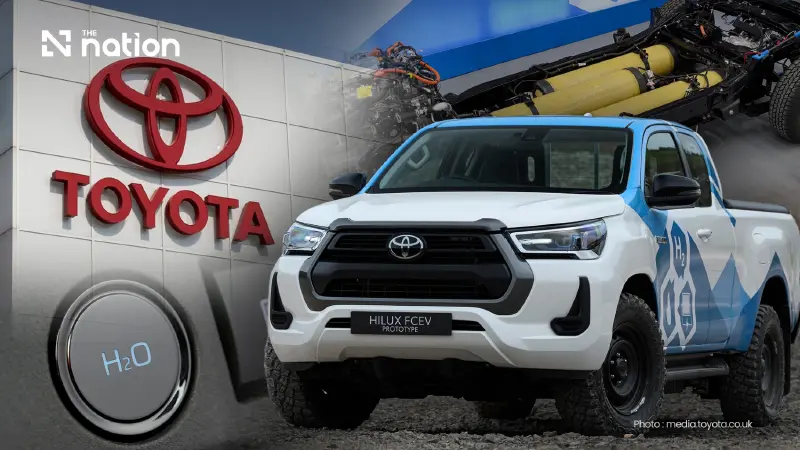


BOI approves Toyota’s THB1.49bn hydrogen Hilux project in Thailand, with production due from December 2027 for export markets.
Thailand’s Board of Investment (BOI) has approved Toyota Motor Thailand’s THB1.49 billion investment to produce hydrogen fuel-cell electric pick-up trucks, strengthening the country’s role as a production base for next-generation vehicles.
BOI Secretary General Narit Therdsteerasukdi said the project will produce the new Hilux Fuel Cell Electric Vehicle (FCEV) at Toyota’s Ban Pho plant in Chachoengsao, marking the first production of hydrogen fuel-cell pick-ups in Thailand.
The project will have annual production capacity of 3,000 vehicles, with the new production line expected to begin operations in December 2027.
Initial production will be entirely for export, particularly to Europe, Australia and New Zealand.

Thailand gains role in Toyota’s hydrogen strategy
Toyota will integrate its latest hydrogen fuel-cell technology into the existing Hilux production line in Thailand.
Narit said the investment reflected Thailand’s importance within Toyota’s global manufacturing network, particularly as a major production and export base for the Hilux.
Thailand’s established automotive supply chain and experienced workforce provide a foundation for moving into more advanced clean-vehicle technologies, he said.
The investment also aligns with Thailand’s strategy of remaining a global automotive manufacturing base covering multiple technologies, including internal combustion engines, mild hybrids, hybrids, plug-in hybrids, battery-electric vehicles and FCEVs.
The strategy is intended to support Thailand’s carbon-neutrality and net-zero ambitions while maintaining an investment environment open to carmakers from different countries and technology platforms.
“Toyota has continued to place confidence in Thailand throughout more than 60 years of investment,” Narit said.

He said bringing hydrogen FCEV pick-up production to Thailand showed that Toyota continued to regard the country as a strategic partner as automotive technologies and markets evolve.
The project would also create opportunities for workforce development, technology transfer and Thai parts suppliers seeking to enter future automotive supply chains, he added.
Ban Pho plant to add FCEV production equipment
Toyota will build the FCEV model on its existing Hilux production line at the Ban Pho plant.
The company plans to upgrade manufacturing processes and add workstations for key fuel-cell powertrain components, including hydrogen tanks, fuel cells, battery packs, electric motors and power-control systems.
A hydrogen refuelling station will also be installed inside the factory to support vehicle production and testing.
Toyota officially confirmed in 2025 that the new-generation Hilux would include an FCEV variant as part of its multi-pathway approach to carbon neutrality, with introduction in Europe and Oceania scheduled from 2028.

Project to use THB640m of Thai parts annually
The project plans to source about THB640 million worth of locally produced materials and components each year.
These will include air-conditioning and cooling systems, seats, wheels and tyres, wiring harnesses and interior components.
Toyota also plans to develop domestic suppliers, particularly Thai companies, through technology and knowledge transfer in manufacturing, quality control, safety, environmental management and human-resource development.
The BOI expects this to help local suppliers meet the requirements of FCEV production and increase their opportunities to enter global automotive supply chains.

Toyota has three vehicle plants in Thailand
Toyota Motor Thailand was established in 1962 and currently operates three vehicle plants at Samrong, Gateway and Ban Pho.
According to Toyota’s latest company information, the three factories have combined production capacity of about 770,000 vehicles a year and the company employs more than 13,000 people in Thailand.
Toyota has continued to use Thailand as a major production and export base, particularly for pick-up trucks.
The hydrogen Hilux project forms part of Toyota’s multi-pathway strategy, which uses different powertrain technologies according to energy conditions, infrastructure and customer requirements in individual markets.
BOI supports more than 200 EV projects
As of September 2026, the BOI had approved investment promotion for 203 projects across Thailand’s electric-vehicle ecosystem, with combined investment exceeding THB141 billion.
The projects cover mild hybrids, hybrids, plug-in hybrids, battery-electric vehicles and FCEVs, as well as batteries, key components and supporting infrastructure.
Narit said the range of projects showed that Thailand was building an automotive ecosystem capable of supporting multiple technologies rather than relying on a single type of powertrain.
Toyota’s FCEV investment is expected to add hydrogen fuel-cell capabilities to that ecosystem and strengthen Thailand’s position as the global automotive industry transitions towards cleaner technologies.
