
Thai commerce minister launches trade, tourism and local economy plan


Four working groups will tackle the visitor economy, agriculture, SMEs and international trade in response to five major global shifts.
- Thailand's Commerce Minister has launched a new economic plan establishing four working groups to drive the visitor economy, agriculture, SMEs, and international trade in response to global shifts.
- The tourism strategy will pivot from increasing visitor numbers to creating a value-driven "Experience Economy," targeting diverse traveler types and ensuring economic benefits flow down to local communities.
- The plan aims to strengthen the local economy by initiating an "Agricultural Revolution" to boost farm productivity and supporting the nation's
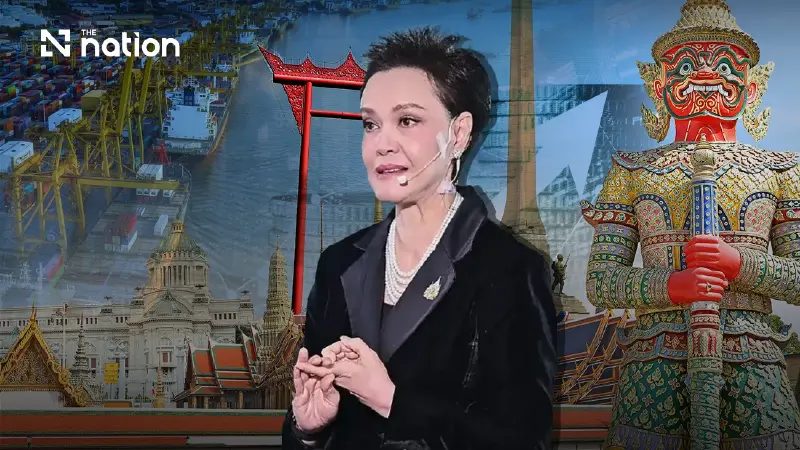
Minister of Commerce Suphajee Suthumpun led a team in presenting a vision and strategic plan to drive trade, tourism and the community economy on Wednesday (August 19, 2026).
Held in Studio 1 at the Government Public Relations Department (PRD), the briefing formed part of the work of the Trade & Services Engine subcommittee under the Joint Public and Private Sector Committee for Economic Problem Solving (JPPCC).
Suphajee said Thailand was facing five major global shifts: geopolitics, risk diversification, digital technology and artificial intelligence (AI), the environment and an ageing population.
These were directly affecting the country’s economic and trade structures and its competitiveness.
However, as a medium-sized country exposed to competing pressures from major powers, Thailand needed a new stance.
It should avoid excessive reliance on established markets, adapt to global green rules, use technology to identify opportunities sooner and prepare for a shrinking population, which would reduce the workforce while increasing welfare obligations.
The government of Prime Minister and Minister of Interior Anutin Charnvirakul has therefore adopted a cluster-based economic structure built on four pillars: investment, trade and services, human capital and public-sector efficiency.
The Trade & Services Engine, which Suphajee oversees as deputy prime minister, covers tourism and wellness, the creative economy, agriculture and food, retail and wholesale trade, and international trade.
Suphajee said the five challenges had been translated into four working groups covering the creative economy and Visitor Economy; agricultural products and food security; the community economy and SMEs; and international trade.
Nine experts will provide strategic recommendations and help turn the work into concrete results.
Weerasak Kowsurat chairs the creative economy and Visitor Economy group and the international trade group, while Kobsak Pootrakool chairs those on agricultural products and food security, and the community economy and SMEs.
Every group must deliver a Quick Big Win and a Big Win, both with tangible results.
On agriculture, Suphajee said reforms were needed across the upstream, midstream and downstream stages.
Thailand has 7.7 million farming households, representing 29.3% of households nationwide, and they use 23.52 million hectares but generate only 8.8% of GDP.
The country therefore needs to raise productivity, expand processing and develop new markets under a demand-driven approach.
Thai rice prices have now risen to just over US$400 per tonne, at times exceeding those of India and Vietnam.
The challenge is to ensure farmers benefit when prices are favourable instead of having sold their produce beforehand.
Durian has generated more than THB130 billion in revenue this year, but almost all of the fruit is still sold fresh, making faster progress on processing and storage essential to ease seasonal pressure.
On SMEs, Suphajee said Thailand has about 3.28 million such businesses, accounting for 99.5% of all enterprises.
Support should cover every stage, from starting and scaling a business to becoming a leader and a regional player, through finance, technology, market access, regulatory reform and measures to prevent nominee arrangements and create a level playing field.
On international trade, Suphajee said Thailand must retain existing markets while expanding into new ones at city, provincial and state levels.
It should accelerate negotiations on and the use of free trade agreements (FTAs), lower barriers, increase local content and link SMEs to global supply chains.
The new trade structure must connect Thai businesses with global value chains in practice.
The strategy is to take Thai products to markets and bring markets to Thailand, with farmers, communities, SMEs and Thai entrepreneurs at its core.
It calls for cooperation among the government, private sector, associations and academia so that the Thai economy can grow with greater resilience, support a broader distribution of income and withstand an increasingly volatile world.
Weerasak said the modern creative economy should not be measured by sales alone, but also by its ability to create new flavours, scents, emotions, stories and experiences for visitors.
Thailand should no longer treat every visitor as the same type of tourist.
Instead, it should recognise different purposes for travel, including health, education, business, weddings, film production and Work from Anywhere, as well as niche groups with high spending power.
The model to be advanced is a ‘five-tier waterfall’.
It begins with the Local Economy, ensuring benefits reach communities, workers and local areas, before moving up through the Tourism Economy, Visitor Economy, Experience Economy and Service Economy.
It aims to let value flow from the top down rather than remain concentrated among large businesses or major cities.
Data show that Thailand’s creative economy was worth THB1.44 trillion in 2025, or 8.01% of GDP.
Visitor numbers stood at 32.97 million in 2025 and 16.21 million in the first 6 months of 2026.
The goal is not simply to increase the total, but to use a data-driven approach to turn visitor numbers into economic value.
Kobsak said about 1 in 3 people in Thailand are part of the agricultural sector, yet it generates less than 10% of GDP.
The sector therefore needs an Agricultural Revolution, following countries that have upgraded farming through soil, water, crop varieties, machinery, technology and a new generation of farmers, particularly Young Smart Farmers, who adapt more quickly.
At the upstream stage, laws must be changed to allow the use of the best plant varieties and technologies.
Midstream, the private sector should be brought in to add value through processing, packaging and branding.
Downstream, market channels must be expanded, from outlets in industrial estates and direct-from-farm e-commerce to delivery through Thailand Post at costs farmers can afford.
Turning to SMEs, Kobsak said the main problems were the licensing system and hidden costs.
Some hotels require as many as 30 licences, while restaurants or barbecue outlets need more than 20.
The system should therefore be simplified through measures such as SME ID, Single License and a single database.
The plan also calls for ‘community accountants’ to help community enterprises manage costs and accounts.
Kobsak proposed upgrading Big Brothers Plus so that large companies help medium-sized firms, which would in turn support smaller businesses.
He also proposed advancing SME-GP, MiT, SME Catalogue, Design Centres, SME Online Platform, AI Coaches, SME Software and Transition Loans so that small operators can gain genuine market access and are not left behind in the face of low-priced imports.
