
PM Anutin meets 76 representatives to advance economic diplomacy


The government plans to turn foreign ties into wider market access, quality investment, technological cooperation and a stronger role in the Association of Southeast Asian Nations.
- The meeting was part of a proactive policy to use foreign affairs as a tool to secure economic opportunities, technology, markets, and investment for Thailand.
- A key strategy is to accelerate Free Trade Agreements (FTAs) with partners like the EU, Canada, and South Korea to position Thailand as a regional production hub and gateway to ASEAN.
- The government is pursuing targeted regional strategies, including re-establishing its role in ASEAN, positioning itself as a food security partner for the Middle East, and seeking tech cooperation with East Asian nations.
- The overarching goal is to rebrand Thailand as an open, trusted country and a regional hub to attract high-quality investment amid global supply chain reorganizations.
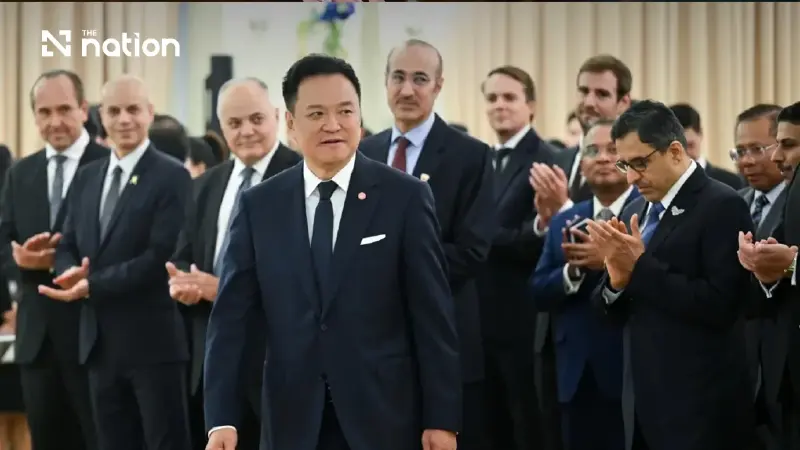
A Government House source said a meeting between Prime Minister Anutin Charnvirakul and 76 ambassadors, foreign consuls and heads of international organisations based in Thailand at Government House on Friday (September 4, 2026) was more than a routine diplomatic reception.
It formed part of the proactive diplomacy policy previously announced by the government and efforts to remap Thailand's economic diplomacy.
Anutin has prioritised using foreign affairs as a tool to open doors to economic opportunities, technology, markets and investment.
The discussion agenda for the diplomatic representatives was consequently structured around nine regional groups so that each relationship could be developed to deliver tangible benefits.


"The government's central priority is to bring Thailand back to the world's attention as an open and trusted country and a regional hub within the Association of Southeast Asian Nations (ASEAN) amid geopolitical volatility, energy and food crises, and the reorganisation of global supply chains," the source said.
The source said ASEAN was the first region where Thailand needed to re-establish its role.
Anutin has so far made official visits to five countries, namely the Lao People's Democratic Republic (Lao PDR), Singapore, Viet Nam, Malaysia and Indonesia, and is preparing to visit the Philippines, Brunei Darussalam and Timor-Leste.
The government now sees the Middle East crisis as a warning that ASEAN must accelerate economic, energy, food and supply-chain integration.
At the same time, Thailand must co-ordinate closely with Singapore to ensure continuity across the ASEAN chairmanships in 2027 and 2028.
The source said Anutin's government was using free trade agreements (FTAs) as a tool to put Thailand back on investors' radar.


The government was accelerating work on FTAs between Thailand and the European Union, Canada and South Korea, advancing the concluded FTA between Thailand and the European Free Trade Association (EFTA), and pursuing access to new markets through Peru, Sri Lanka, the Bay of Bengal Initiative for Multi-Sectoral Technical and Economic Cooperation (BIMSTEC) and ASEAN-Canada.
The push to accelerate FTAs was not only about expanding export markets, but also about giving Thailand an advantage as a regional production and business base.
Investors entering Thailand would look beyond the domestic market and see it as a gateway to ASEAN, Asia and developed markets.
The government also sees a need to spread risk more quickly across new markets, including Africa, the Middle East, Latin America, South Asia and Central Asia, with Thailand's strengths in food, processed agricultural products, the halal sector, clean energy, medical services, wellness and logistics serving as bridges for cooperation.
In the Middle East, the source said Thailand was seeking to position itself as a long-term food security partner while expanding cooperation in energy, tourism and medical services, as well as cooperation concerning Thai labour.
In Africa, the government would work through the Thailand-Africa Initiative (TAI), linking political cooperation, economic cooperation, development cooperation and global strategic cooperation.
The source said the government's focus in relations with China, Japan, South Korea and other East Asian countries would be on strategic cooperation in technology, innovation, artificial intelligence (AI), new industries and combating online crime.
Priority would be given to ensuring that the investment Thailand seeks is high quality, creates added value and does not leave problems associated with illegal capital in the country.
The source said the next phase of efforts to advance Thailand's global role would include several engagements, including the United Nations General Assembly, the Pre-COP meeting, a visit to Fiji, Thailand's hosting of the Annual Meetings of the International Monetary Fund (IMF) and the World Bank Group in Bangkok, and the ASEAN Summit.
These would be important opportunities for the government to present Thailand's potential to the international community.
"Prime Minister Anutin's government does not merely want good relations with other countries, but wants to turn those relations into new markets, new investment, new technology and a new role for Thailand in ASEAN," the source said.
