
Ruangroj warns of ‘AI theatre’ citing AI investment at 1.7% of revenue in 2026
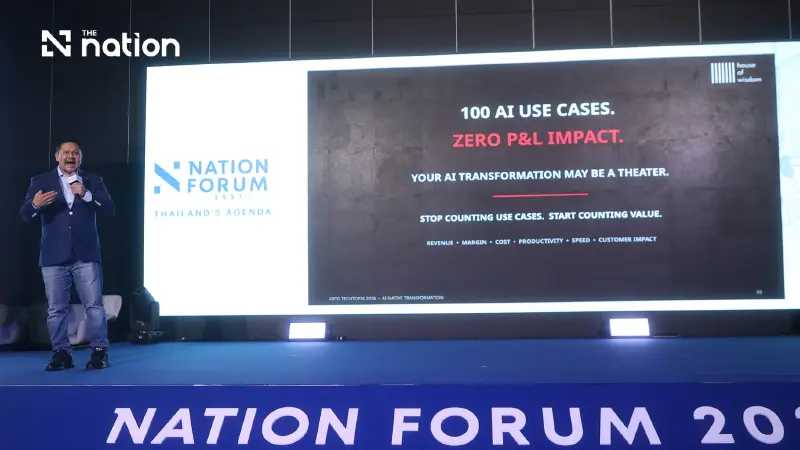


Ruangroj Poonpol tells a Bangkok forum that firms must redesign workflows and develop staff to turn AI investment into measurable business gains.
- Ruangroj Poonpol warns of "AI theatre," where companies increase AI investment—projected to rise from 0.8% to 1.7% of revenue in 2026—without achieving comparable business gains.
- He argues that simply adding AI technology to existing, unchanged workflows fails to deliver value and can even increase workloads, creating the illusion of progress.
- To avoid this trap, businesses must fundamentally redesign their processes, products, and business models to become "AI-native" rather than just piloting new tools.
- Poonpol emphasizes that successful AI transformation is 70% about people and change management, requiring leadership vision and employee reskilling, not just technology implementation.
Companies risk falling into an “AI theatre” trap by expanding artificial intelligence (AI) projects without generating comparable business gains, House of Wisdom (H.O.W.) Club co-founder Ruangroj Poonpol told Nation Forum 2027 in Bangkok on Tuesday (October 20, 2026). Citing figures showing AI investment rising from 0.8% to 1.7% of revenue this year, he argued that businesses must redesign how they work rather than simply add technology to existing processes.
Ruangroj, also known as Krating, addressed “People | From AI Tools to AI Teammates” under the theme “The Intelligence Economy | AI, Robotics & Quantum” at Nation Forum 2027: Thailand’s Agenda.
Almost every company was experimenting with or deploying AI through pilots, practical use cases and AI agents, Ruangroj said. However, rapidly improving technology and a growing number of projects did not automatically produce greater business value, creating what he described as “AI theatre”.
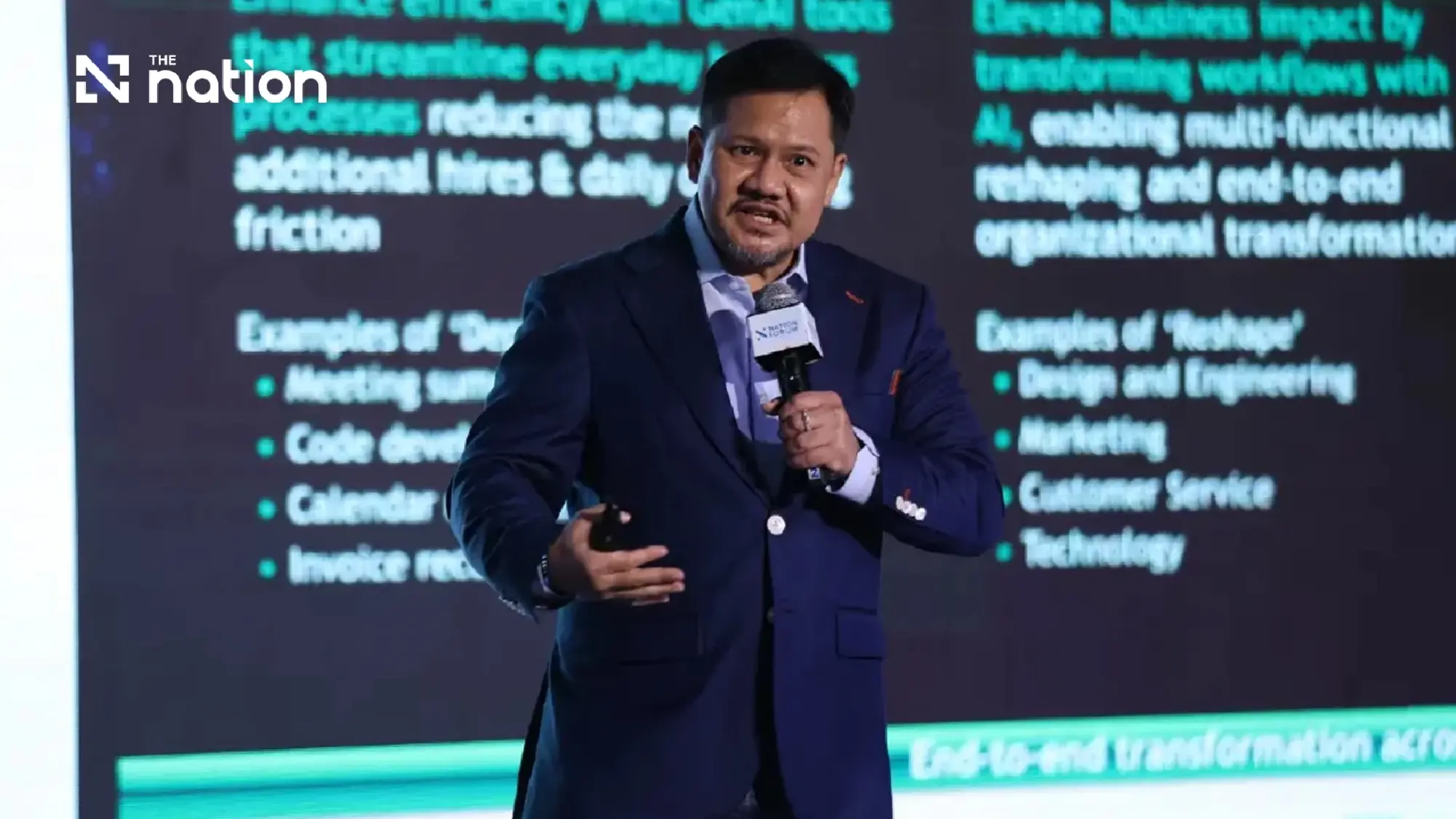

Ruangroj calls for business redesign beyond AI pilots
Ruangroj argued that companies needed to redesign business processes rather than insert AI into unchanged workflows. Adding an AI-powered step and then another checking stage could increase workloads instead of reducing them.
Profit margins, costs, productivity, operating speed and customer experience should determine whether AI is delivering results, Ruangroj said. Faster execution of an existing process was not enough without considering whether the process itself should change.
An “AI-native” company would incorporate AI into its design from the outset, Ruangroj explained. His proposed transformation framework has four elements:
- AI-native transformation: Chief executives, senior managers and organisational leaders must develop the vision and mindset to understand the technology and establish a clear direction for change.
- Reinvent: Redesign products, customer experiences and business models, including flexible or modular structures, to reflect AI’s capabilities.
- Reskill: Develop employees’ skills and adjust working practices as workflows and workforce requirements change.
- Human judgement: Preserve human responsibility for decisions requiring an assessment of values and an understanding of context.
Ruangroj identified five reasons why transformation fails: leaders without a clear vision, use cases that generate no business value, unsuccessful change management, fragmented experimentation without direction, and workflows that remain unchanged.
“If we build your company today with AI available from day one, would we design in this way?” Ruangroj asked, challenging executives to distinguish genuine business transformation from making old methods more efficient.


Ruangroj puts people and company knowledge at the centre
Ruangroj illustrated the importance of organisational change through a framework assigning 10% to AI technology, 20% to technology and data infrastructure, and 70% to people and change management. The breakdown emphasised that technology alone would not determine success.
Ruangroj identified four essential human capabilities: foresight and imagination; curation, or selecting important information and filtering out unnecessary material; conviction and sound judgement; and turning a vision into reality.
Workers needed AI skills, analogue skills and human skills together to use technology effectively without losing their ability to think, analyse and decide independently, Ruangroj said.
Ruangroj proposed replacing “Forecast – Plan – Execute” with “Imagine – Prepare – Adapt”. Strategic foresight would help leaders recognise early signals of change, prepare for possible futures and adjust as circumstances developed.
Company-specific information also needed greater attention, Ruangroj said, highlighting “dormant data” that remained unused and the institutional knowledge accumulated by employees. Off-the-shelf AI might not fully understand an organisation’s information, language or experience, making that knowledge important to practical applications while requiring companies to retain control of their data.
“Don’t make your company’s AI smarter, your employees dumber, and your competitors smarter still,” Ruangroj warned.
Human resources departments should move beyond a support role to lead transformation alongside chief executives, Ruangroj said. Developing people’s capabilities and responsibilities, rather than simply reducing headcount, should guide organisational changes.
Ruangroj described a possible shift from pyramid-shaped companies with many junior employees towards diamond or hourglass structures with more experienced, mid-level staff. In the model he outlined, junior employees’ share could fall from 45% to 7.5%, while mid-level staff could account for 50%.
Organisations would need to decide which tasks should remain human-led, which required collaboration between people and AI, and which could be automated, Ruangroj said.
“Put the right AI into the right job at the right tokenomics and right risk profile,” Ruangroj said, explaining that the choice of system must reflect usage costs and acceptable risk.
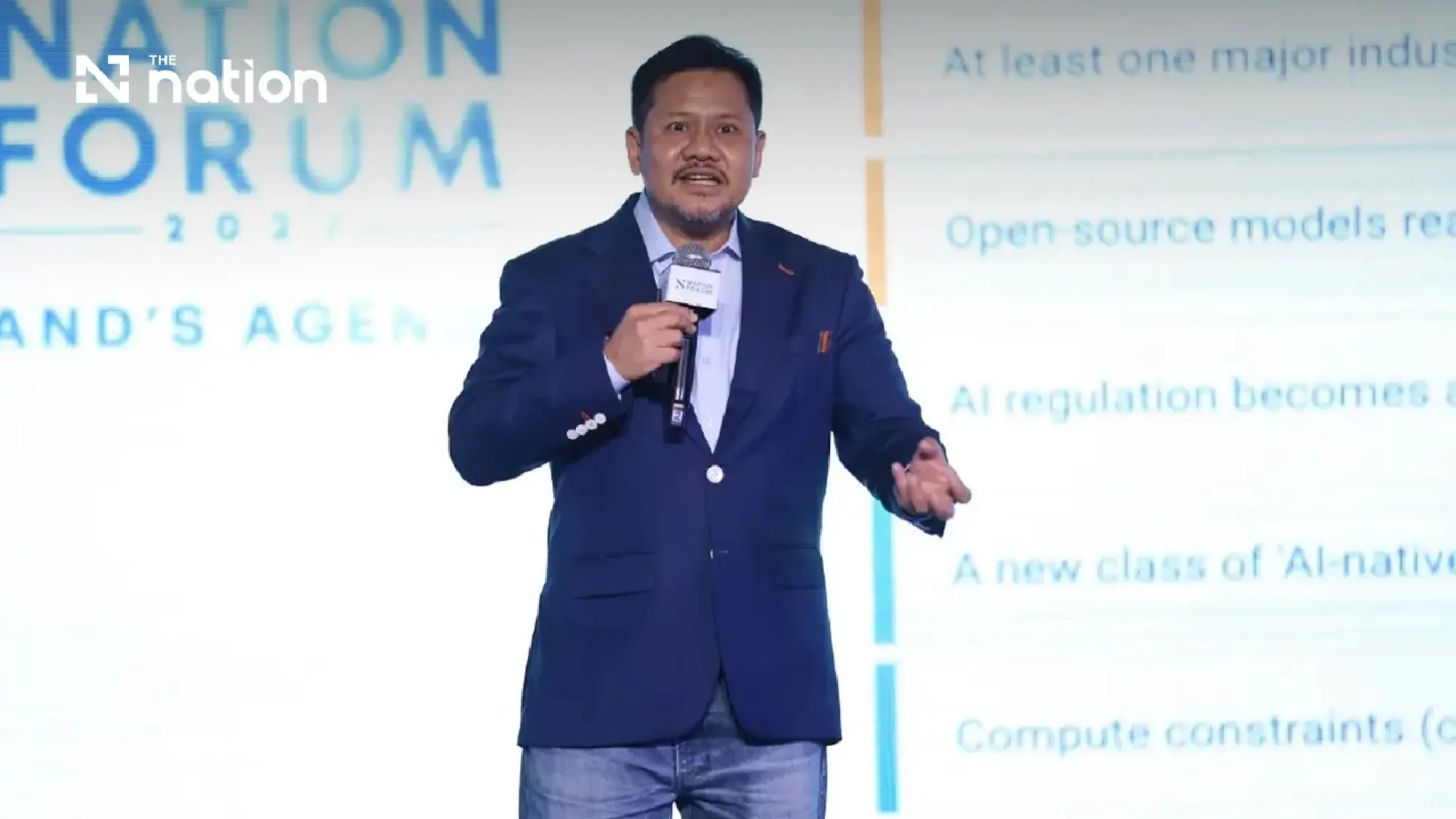

AI agents could reshape shopping and squeeze profits
AI agents could change both consumer behaviour and business operations, Ruangroj said, citing a forecast that around 60% of consumers would use them for shopping in 2027. Figures presented in his discussion put current familiarity with AI tools at 73%.
Under “agentic commerce”, AI agents would search for products, compare options and make purchases for consumers, including payments through compatible tools, Ruangroj explained. E-commerce systems would need to work with those agents, while brands could lose influence as product selection shifted from people to AI.
Ruangroj highlighted a risk that profits could fall by as much as 5% through price competition, customer fragmentation and declining brand importance. Acceptance of AI agents would nevertheless vary by industry.
Consumer trust remained a particular constraint in financial services, Ruangroj said, citing figures showing that only 7% of consumers felt comfortable allowing an AI agent to manage their money.
Ruangroj also cited a forecast of companies moving towards an “autonomous enterprise” model within the next four years, with automation and AI playing a greater role in running their operations.
Chief executives must lead AI governance
AI transformation cannot be left solely to the chief information officer, Ruangroj said. Chief executives must lead the process, understand the technology’s limitations and establish appropriate governance.
Among the risks Ruangroj identified were sycophancy, or responses designed to please users; hallucinations, meaning fabricated information; and what he called “Brand AI Bias”, involving bias relating to brands or algorithms.
Ruangroj also highlighted “AI Sneaking”, which he described as changes to intent or outcomes without users’ awareness, and “AI Darkness”, referring to harmful effects on future generations.
Despite 20 years in technology, Ruangroj said he had returned to intensive study of data and AI over the past year, studying from 9pm to 7am and recently completing an 11-month programme at the National University of Singapore (NUS). The experience demonstrated the need for leaders to keep learning, he said.
Ruangroj asked executives to consider what future they were building, whether they were transforming their businesses or merely automating existing practices, which AI projects could materially change their business economics, and which decisions must remain a human responsibility.
The goal was to create new organisational capabilities rather than accumulate tools and projects, while preserving people’s role and value, Ruangroj said. Humanity was worth more than intelligence alone, he added: “Never surrender your humanity to AI.”
