
Thai army accuses Cambodia of politicising border temple display
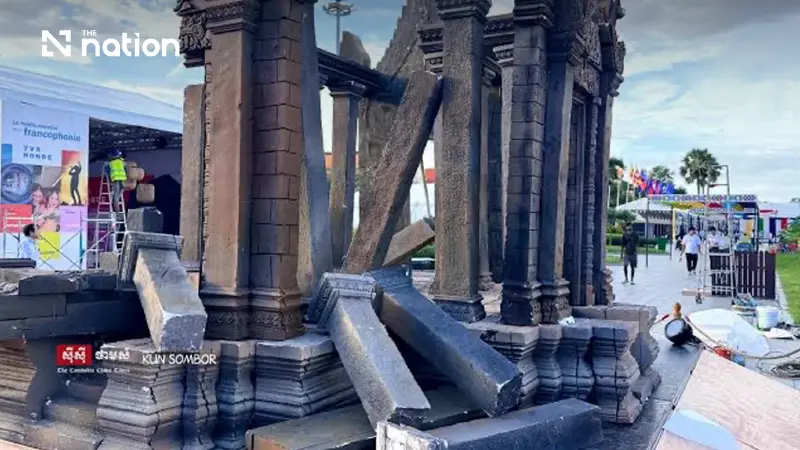


The Thai army accuses Cambodia of politicising a Phnom Penh temple display and questions prospects for bilateral cooperation.
- The Thai army has accused Cambodia of using a temple exhibition at an international summit to politicise their border conflict and portray Thailand as an aggressor.
- Thailand objects to the display's suggestion that temple damage was from a "war of aggression," arguing instead that its military actions were self-defence against Cambodian forces who had militarized the cultural sites.
- The army also alleges Cambodia is using the exhibition, which features temples on what Thailand claims is its sovereign territory, to legitimize its own territorial claims and undermine Thailand's international reputation.
- A Thai army spokesman stated that Cambodia's "distorted information" contradicts the summit's peace theme and could hinder future bilateral cooperation between the two nations.
The Thai army has accused Cambodia of politicising a temple exhibition at a Francophonie event in Phnom Penh to portray Thailand as an aggressor in their border conflict.
Royal Thai Army spokesman Major General Winthai Suvaree also indicated that a bilateral process for which Cambodia had requested Thailand’s cooperation might not proceed soon, citing what he described as distorted information.
Winthai issued the statement on Saturday (November 14, 2026), following media coverage and social media criticism of the display at the Village de la Francophonie. The event runs from 13–17 November alongside the 20th Francophonie Summit.
Dispute over portrayal of temple damage
The exhibition features models of Preah Vihear, Ta Muen Thom and Ta Kwai temples.

Winthai objected to interviews that, he said, suggested the monuments had been damaged in a “war of aggression”, potentially leading foreign journalists to regard Thailand as the aggressor.
He accused Cambodia of using the international platform to distort the account of the conflict and present itself as a victim for political gain.
Army cites military use and sovereignty claims
The Army alleged that Cambodian forces had deliberately violated international humanitarian law by converting archaeological sites into military bases.

According to its statement, Cambodian troops installed mortars, artillery, ammunition depots and other weapons systems at the sites, which were used as bases for attacks on Thai military personnel and civilian communities.
The Army argued that this military use had caused the sites to temporarily lose their protection under the 1954 Hague Convention.
It maintained that Thailand’s military response was an exercise of self-defence under Article 51 of the United Nations Charter and had been limited to military targets posing a threat.

The Army attributed the resulting damage to what it described as Cambodia’s use of cultural heritage as “human shields” and military cover, a practice it condemned as contrary to international rules.
On sovereignty, the Army reaffirmed its position that Ta Muen Thom and Ta Kwai are located within Thai territory and have always been under Thailand’s sovereignty.
It accused the Cambodian government of deliberately displaying landmarks associated with sensitive border issues and historical territorial disputes to legitimise unilateral claims and undermine Thailand’s reputation abroad.
Ceasefire allegation and summit’s peace theme
Winthai also alleged that Cambodia’s dissemination of misleading information violated the ceasefire agreement between the two countries, linking this accusation to his comments about the prospects for bilateral cooperation.
The Army contrasted the exhibition with the summit’s theme, Réinvestir dans la paix pour une prospérité partagée et une stabilité durable, meaning “Reinvesting in peace for shared prosperity and lasting stability”.
Winthai argued that showcasing disputed cultural heritage sites while allowing rhetoric that encouraged hostility towards a neighbouring country contradicted the event’s stated commitment to peace.
The Army contended that such messaging could generate negative perceptions and fuel extreme nationalism through distorted information.
Winthai urged media organisations in both countries to report developments and historical context impartially, while avoiding the amplification of misleading claims that could encourage hatred.
“I urge the public and the international community to consider information from different perspectives with care, so they do not become tools of information operations and political narratives intended to damage Thailand’s image,” he said.
