
Oil-contaminated waste treatment monitored at Rama 9 data centre
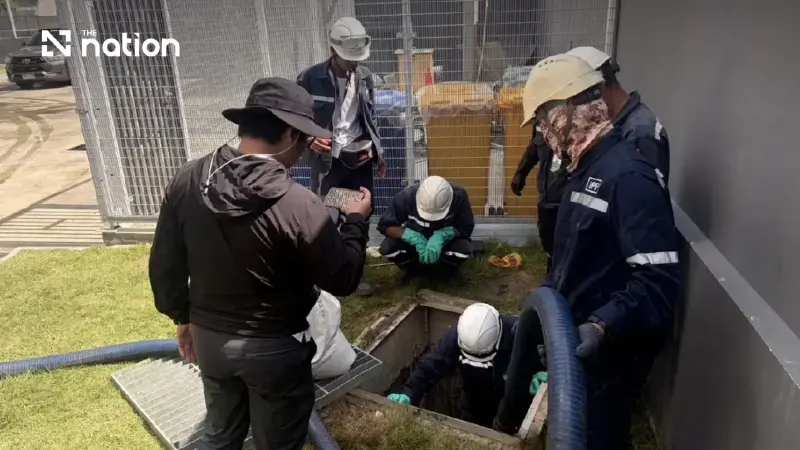


Oil-tainted wastewater and sediment are being treated and removed to protect Rama 9 Canal, with follow-up environmental safety checks planned.
- Pollution control officials are monitoring the treatment of oil-contaminated wastewater and sediment at the DAMAC data centre in Rama 9.
- The contamination was discovered in the data centre's drainage system and a public drain outside, posing a risk to the Rama 9 Canal, following public complaints about an oil-like smell.
- A hired contractor is using sandbags to contain the spill and will pump all contaminated water for off-site treatment, ensuring none is released into the environment.
- An inspection also found the facility was storing over 200,000 litres of diesel without a license, and the Department of Energy Business has ordered its removal.
The Pollution Control Department (PCD), together with the Huai Khwang District Office, visited the DAMAC Digital Thailand (BKK 01) data centre in the Rama 9 area to monitor the treatment and disposal of oil-contaminated wastewater and sediment within and around the site.
The action followed the discovery of oil residue in a wastewater holding pit inside the premises and in a public drain outside, raising the risk that contaminated water could flow into Rama 9 Canal.
Surin Worakijthamrong, director-general of the PCD, said the department and the district office monitored progress in managing the oil-contaminated wastewater and sediment at 10am on Sunday (September 6, 2026).
Officials had earlier found oil residue and an oil-like odour in the data centre’s drainage system, making it necessary to contain and control the contamination quickly to prevent it from spreading into public areas and nearby bodies of water.
To address the problem, the data centre hired Genco to treat and dispose of all oil-contaminated waste.

Sandbags will be placed within the premises to isolate areas containing contaminated water and sediment.
An oil-removal agent will also be used to clean the area before all the wastewater is pumped into a truck and transported for treatment and disposal under appropriate procedures.
Outside the premises, officials and the contractor placed sandbags at the drainage point to block and contain contaminated water before it could enter Rama 9 Canal.
They also cleaned oil residue from inside the pipe and pumped all water from the system for treatment and disposal.
Genco said all water produced during the cleaning process, both inside and outside the premises, would be treated and disposed of, with none released into the environment.
The incident followed complaints in early September from members of the public and business operators in the Rama 9 area about an oil-like smell around the data centre.
Relevant agencies had previously inspected the site and found oil residue in the drainage system.

Initial checks also detected volatile organic compounds (VOCs) in the wastewater, leading the Huai Khwang District Office to order the operator to rectify the drainage system urgently and prevent contamination within a specified period.
The Ministry of Energy also inspected the data centre on Wednesday (September 2, 2026) after receiving complaints about an oil smell.
It found that more than 200,000 litres of diesel were stored as a reserve for emergency generators.
The Department of Energy Business said the storage had not been licensed as required under legislation governing fuel oil control and that it had ordered the diesel removed from the site.
Surin said that once treatment and cleaning were complete, the PCD would repeat environmental measurements at the wastewater holding pit inside the premises and the external drain.
The tests will measure volatile organic compounds (VOCs), hydrogen sulphide (H₂S) and the lower explosive limit (LEL) to assess safety and determine whether the site has been properly managed.
The PCD will continue monitoring the situation, particularly the connection between the data centre’s drainage system and the public drainage network, to prevent oil-contaminated wastewater or sediment from reaching the environment and reduce risks to the public and the water quality of Rama 9 Canal.
