
Thailand steps up southern flood preparations as Chao Phraya water levels face renewed pressure
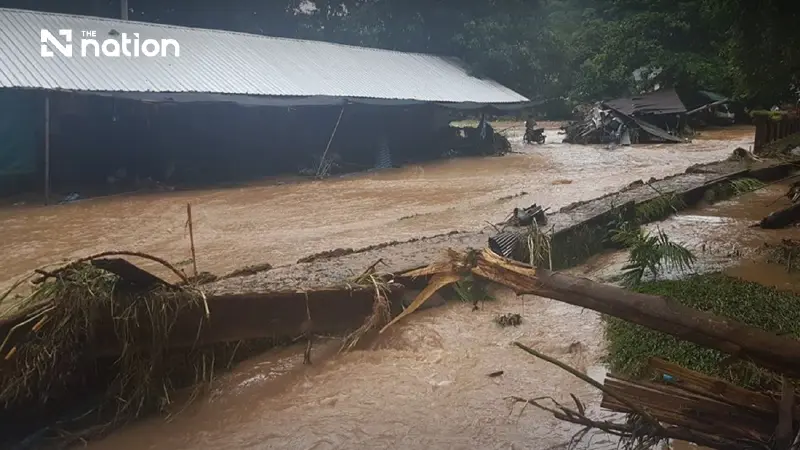


ONWR is monitoring eight southern provinces for heavy rain on 11–14 and 18–21 November, while 11 Chao Phraya basin provinces prepare for higher dam releases.
Thailand's Office of the National Water Resources (ONWR) has placed eight southern provinces under heightened surveillance as two periods of heavy to very heavy rain threaten flash floods, runoff and landslides, particularly in foothill communities.
The first period is expected from 11–14 November 2026, followed by another from 18–21 November.
The provinces identified for special monitoring are Chumphon, Surat Thani, Nakhon Si Thammarat, Phatthalung, Songkhla, Pattani, Yala and Narathiwat.
The assessment was presented at an urgent water management meeting chaired by ONWR Secretary-General Chayant Muangsong. Assistant Secretary-General Chumlarp Techasen and representatives of relevant agencies attended in person and online.
The meeting reviewed weather forecasts, flood preparedness, reservoir management and efforts to address water contamination in several provinces.

Southern provinces prepare for flash floods and landslides
Forecasts from the Thai Meteorological Department and the Hydro-Informatics Institute indicate that the northeast monsoon over the Gulf of Thailand and the South will strengthen, bringing heavy to very heavy rain to some areas.
ONWR is particularly concerned about provinces along the eastern side of southern Thailand, where several days of persistent rainfall have left the ground saturated.
The accumulated moisture increases the likelihood of flash floods, rapid runoff and landslides, especially on hillsides and near the foot of mountains.
Chayant instructed local agencies to ensure that machinery, emergency equipment and water pumps remain operational and available around the clock.
Officials must also closely monitor rainfall and water levels while strengthening coordination between provincial authorities, local administrations and community networks.
The aim is to ensure that residents in vulnerable areas receive early notification and have sufficient time to prepare or evacuate if conditions deteriorate.

Eleven Chao Phraya provinces prepare for higher dam releases
Authorities are also monitoring water levels in the Central region after the Royal Irrigation Department announced plans to increase discharge through Chao Phraya Dam to 1,000–1,200 cubic metres per second.
The department issued its notification on 10 November, noting that higher releases could raise river levels and affect low-lying communities outside flood protection embankments.
Urgent notices have been sent to governors in 11 provinces within the Chao Phraya basin, instructing them to prepare precautionary measures and inform residents along both banks of the river.
People living in vulnerable riverside areas have been advised to monitor water levels closely and move belongings to higher ground where necessary.
Meanwhile, authorities expect drainage from the 11 low-lying flood retention areas in the Chao Phraya basin to be completed by mid-January 2027, allowing conditions to return to normal.
Water management agencies have been instructed to maintain a balance between accelerating drainage and limiting disruption to agricultural land and nearby communities.

Water allocation plans prepared for 2026–2027 dry season
Despite relatively high water storage levels at major reservoirs and dams nationwide, ONWR has instructed agencies to prepare detailed allocation plans for the 2026–2027 dry season.
The plans must ensure sufficient supplies for household consumption, agriculture, industry and the maintenance of ecosystems.
Officials have been directed to consider actual water reserves in individual areas alongside weather trends and rainfall forecasts for each river basin.
ONWR emphasised the need for careful allocation to maintain water security throughout the dry season and reduce the risk of future shortages.
Arsenic contamination in Chiang Rai remains under investigation
The meeting also reviewed ongoing water-quality problems in Chiang Rai and Prachin Buri.
In Chiang Rai, the Pollution Control Department reported that water quality in most major rivers remains within acceptable levels. However, arsenic concentrations continue to exceed regulatory standards at certain monitoring locations.
To improve testing and surveillance, the department plans to coordinate with the Massachusetts Institute of Technology (MIT) on developing and trialling simplified water-testing kits.
The proposed equipment is intended to help officials and communities detect arsenic contamination more conveniently and accurately.
Thai authorities are also preparing discussions with Myanmar on possible long-term measures to prevent and address cross-border water contamination.
Prachin Buri pollution-control designation under consideration
In Prachin Buri, relevant agencies are accelerating a proposal to designate affected areas as a pollution control zone following persistent water contamination.
Officials have collected water, soil and sediment samples for detailed laboratory analysis to identify the sources and causes of pollution.
The results are expected within two to four weeks.
ONWR confirmed that it would continue coordinating the agencies responsible for flood and landslide preparedness, dry-season water allocation and water-quality restoration.
It also stressed the importance of delivering timely information to communities to reduce risks to lives, property and livelihoods.
