
PM Anutin orders action with Myanmar on arsenic in two Chiang Rai rivers
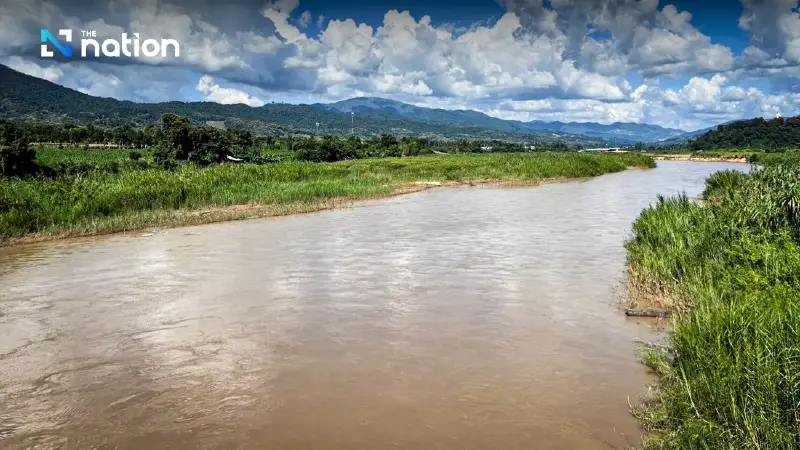


Thailand and Myanmar will discuss water quality in Bangkok. Four projects to supply water to Chiang Rai homes and farms are expected to benefit 345 households.
- Prime Minister Anutin Charnvirakul has ordered the Ministry of Natural Resources and Environment to work urgently with Myanmar to address the source of arsenic contamination in Chiang Rai's Kok and Sai rivers.
- To accelerate cooperation, a Joint Working Group meeting between Thailand and Myanmar on water quality management has been moved forward to late November.
- Thailand will propose joint water quality monitoring on the Myanmar side of the rivers, data sharing, and both short-term and long-term joint action plans.
- While addressing the cross-border source, Thai authorities are also building new water distribution systems and rehabilitating groundwater wells to provide safe water for affected residents.
Prime Minister Anutin Charnvirakul has ordered the Ministry of Natural Resources and Environment (MNRE) to act urgently on cross-border pollution, particularly arsenic contamination in Chiang Rai’s Kok and Sai rivers, deputy government spokesperson Lalida Persvivatana said on Thursday (November 19, 2026).
Anutin instructed Natural Resources and Environment Minister Suchart Chomklin to work with Myanmar to tackle the pollution where it originates and to secure sources of clean, safe water for affected residents.
Lalida said cooperation between the two countries had made significant progress since Deputy Prime Minister and Foreign Minister Sihasak Phuangketkeow visited Nay Pyi Taw on November 12 and held talks with Myanmar’s leadership.
She said the two sides had brought forward the first meeting of their Joint Working Group (JWG) on water quality management from early December to November 25–26.
They will meet in Bangkok to speed up work on practical measures they can take together.
The permanent secretaries of the two countries’ ministries responsible for natural resources and the environment will co-chair the meeting.
Thailand will propose adding water quality monitoring sites on the Myanmar stretches of the Kok and Sai rivers, sharing technical data and investigating sources of pollution.

It will also propose a short-term joint action plan covering one year and a three-year framework for long-term cooperation.
Thailand will press for a joint field visit as soon as possible.
The two countries signed terms of reference (TOR) on Thursday (August 6, 2026) to guide their work together.
The Pollution Control Department reported the results of a preliminary arsenic test using a field kit at Ban Hua Fai on the Sai River in November 2026.
The reading was about 0.017 milligrams per litre, down from 0.284 milligrams per litre in the previous test.
The reading was still above the surface water quality standard of 0.010 milligrams per litre.
Water and sediment samples still need to be collected for laboratory analysis, and monitoring must continue.
Lalida said Suchart had instructed the Department of Water Resources to speed up preparations to build four water distribution systems in three Chiang Rai districts.
The 2027 budget plan includes three projects to supply water for drinking and household use.
Together, these three projects are expected to benefit 300 households.
The sites are Ban Mueang Ngim in Mueang Chiang Rai district, Ban San Sai Ngam in Wiang Chiang Rung district and Ban San That Mai Phatthana in Chiang Saen district.


The fourth project, the Rong Chok solar-powered water distribution system in Chiang Saen district, is intended to supply water to 16 hectares of farmland and help a further 45 farming households.
The four projects are expected to benefit 345 households in total once completed.
The Department of Groundwater Resources has been instructed to act quickly to flush and rehabilitate four affected groundwater wells.
It has also been asked to survey and drill for additional groundwater sources to give residents more options for obtaining safe water.
The department will prepare vehicles equipped to produce tap water using reverse osmosis (RO) for areas where they are needed.
It will also work with public health and agricultural authorities to monitor the effects on residents’ health and the safety of local produce.
“The prime minister is serious about tackling cross-border pollution. The government is working with Myanmar to address the problem at its source while helping people in the affected areas. That support includes measures such as checking water quality, securing alternative water sources and restoring groundwater systems so that people have enough safe water for their daily needs and livelihoods. The government will continue to monitor progress and will not abandon those affected,” Lalida said.

