
Thai minister demands results in toxic waste crackdown within 90 days
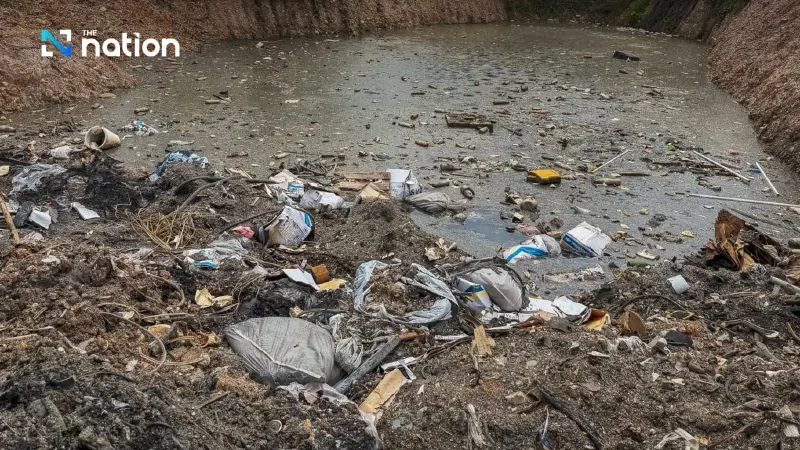


Governors in eight eastern provinces are to coordinate local checks. Inquiries will cover waste hauliers, the factories involved and anyone who benefits from illegal dumping.
- Thailand's Minister of Natural Resources and Environment, Suchart Chomklin, has given all relevant agencies a 90-day deadline to show concrete results in a crackdown on illegal toxic and industrial waste.
- The operation targets illegal dumping networks in eight eastern provinces, aiming to trace waste back to its source and take firm legal action against all offenders without exception.
- Two subcommittees have been formed to coordinate inspections, widen investigations, and prosecute offenders, which include factories, transport contractors, and any complicit officials.
- Key measures include making polluters pay for cleanup and restoration, protecting whistleblowers, and mobilizing local communities to monitor at-risk areas.
Suchart Chomklin, Minister of Natural Resources and Environment, has stepped up enforcement against the illegal disposal of toxic and industrial waste in eastern Thailand.
As chair of the committee responsible for disaster prevention and response in the region, he launched an operation to tackle the networks behind the illegal dumping and burial of toxic waste and trace them back to their source.
He announced the formation of two subcommittees to coordinate efforts to crack down on illegal dumping and enforce the law.
All agencies involved are to work together to carry out inspections, widen investigations and take firm legal action against offenders.
Suchart gave them 90 days to show concrete results.
At a meeting at Prachin Buri Provincial Hall to review progress and tackle the problem of toxic and industrial waste, Suchart set out urgent measures for governors and the relevant agencies in eight eastern provinces.
The provinces are Prachin Buri, Chon Buri, Rayong, Chanthaburi, Trat, Chachoengsao, Nakhon Nayok and Sa Kaeo.
He called on them to work together to close the gaps that allow industrial waste to be dumped illegally.
The dumping affects natural resources and the environment, including water sources, soil and air, as well as agricultural produce and people’s health.

The problem has been building up in Prachin Buri in particular.
Suchart said tackling the problem was a priority for Prime Minister Anutin Charnvirakul’s government.
From now on, he said, no agency would be allowed to evade responsibility by saying “it’s not our job”.
Everyone involved must work together to tackle the problem systematically.
Checks will cover every means of illegal disposal.
They will extend to licensed factories that dump waste illegally, factories operating unlawfully and those operating beyond the limits set by law.
Sites used to bury toxic waste illegally will also be checked, including abandoned warehouses, pits dug for soil and land associated with forests and farming.

Suchart also set out five measures.
- Take firm legal action against offenders without exception, whether they are Thai or foreign investors, influential figures or public officials involved in a failure to carry out official duties.
- Trace the networks back to their source. Inquiries should cover the contractors who transport the waste, the factories it comes from and anyone who benefits. If there are indications of money laundering or the matter is a special case, coordinate with the Anti-Money Laundering Office (AMLO) and the Department of Special Investigation so both agencies can take immediate action.
- Deal with the toxic waste that remains and prevent new waste from being generated. Speed up the restoration of affected sites using scientifically sound methods, with polluters bearing the cost.
- Protect the public. Investigate the effects on the environment and public health, disclose information transparently and set up a system to protect anyone who comes forward with information.
- Mobilise local officials and communities. Provincial governors are to take the lead in bringing together district chiefs, local authorities, subdistrict headmen, village headmen and community networks to keep a close watch on at-risk areas and inspect them.
“I want to see clear action to tackle this problem. Meetings and progress reports alone are not enough. We need action on the ground, real inspections, real arrests and prosecutions of those behind it. The government is ready to support businesses that operate within the law, but we will not allow anyone to use the east as a dumping ground for toxic waste or to seek to benefit from people’s hardship. Within 90 days, every agency must show what it has done in practice to tackle this problem. We will not let toxic waste become a terrible legacy for our children and grandchildren. We must give people back a safe environment,” Suchart said.
