
Anutin outlines Thailand’s outlook to diplomats before UN trip
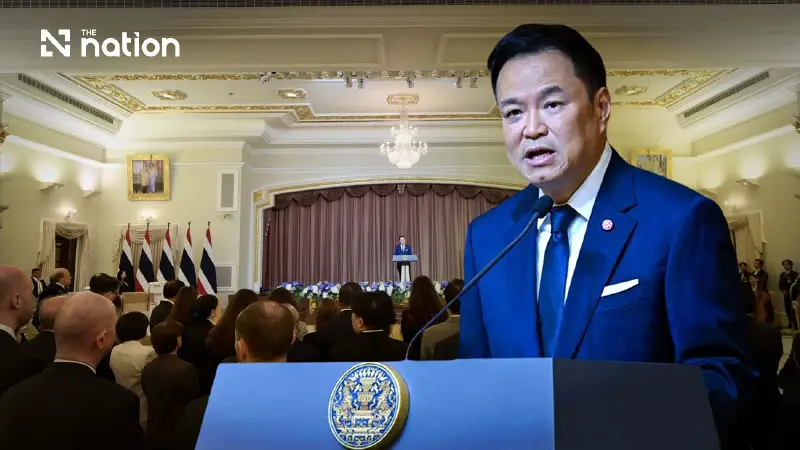


Anutin Charnvirakul briefs 76 foreign envoys and international representatives on Thailand’s economic reform, clean energy and global cooperation.
- Prime Minister Anutin Charnvirakul outlined Thailand's vision for economic restructuring, focusing on future industries, emerging technologies, and preparing for membership of the OECD.
- He emphasised a foreign policy shift from simple trade towards joint development, investment, and innovation in sectors like the digital economy, clean energy, and healthcare.
- Ahead of his trip to the UN General Assembly, Anutin highlighted Thailand's upcoming role as host for the annual IMF, World Bank, and ASEAN summit meetings.
- The Prime Minister reaffirmed that Thailand remains a stable and open country, ready to work in partnership with the international community to address shared challenges.
A group of 76 ambassadors, foreign consuls and heads of international organisations based in Thailand met Prime Minister and Interior Minister Anutin Charnvirakul at the Santi Maitree Building at Government House in Bangkok to hear the government’s policy direction and vision for the country.
Government Spokesperson Rachada Dhanadirek reported that Anutin welcomed the diplomatic and international representatives, particularly ambassadors who had recently taken up their posts in Thailand.
He described the gathering as an opportunity to exchange views, strengthen working relationships and build closer links between foreign missions and the Thai government, with the aim of developing more tangible cooperation.

Outlining his vision for the country, Anutin told the gathering that Thailand was at an important point of transition. The government is pursuing public-sector reform alongside an economic restructuring aimed at future industries, emerging technologies and higher-value economic activities.
Thailand is also preparing for membership of the Organisation for Economic Co-operation and Development (OECD), with efforts focused on raising national standards, regulations and institutions to international levels and strengthening long-term confidence in the country.
Anutin emphasised that foreign policy should help create new opportunities for Thailand and its people. The government views relations with other countries not simply through a diplomatic lens but as gateways to investment, technology, knowledge, markets and human-capital development.
Thailand therefore wants to move beyond relationships centred largely on the exchange of goods and services towards joint development, investment and innovation, particularly in areas expected to shape the future global economy, including the digital economy, clean energy, advanced industries, food and healthcare.

Against a backdrop of global uncertainty and rapid change, the prime minister reaffirmed that Thailand remained stable, open and ready to work with all countries, with friendship, trust and partnership at the heart of its international relations.
He encouraged the diplomatic representatives to use their meetings with the deputy prime minister and foreign minister, Cabinet members and Thai trade representatives to exchange proposals and identify new opportunities that could lead to tangible cooperation between Thailand and individual partner countries.

Looking ahead, Anutin highlighted several major international engagements, including a visit to New York to attend the United Nations General Assembly and participation in a Pre-COP meeting in Fiji.
Thailand is also preparing to host the annual meetings of the International Monetary Fund (IMF) and the World Bank Group in Bangkok in October, while the ASEAN Summit is scheduled for November. The government intends to use these forums to demonstrate Thailand’s potential, expand international cooperation and create new opportunities for the country.
Anutin concluded that Thailand placed importance on its relationships with all countries and was ready to work with the international community to pursue shared growth while strengthening resilience, security and prosperity in a rapidly changing world.

The government described the gathering as reflecting its foreign-policy approach of maintaining strong relations with all countries while using international cooperation to generate economic, technological and development opportunities.
It also underscored Thailand’s intention to act as a partner in addressing common challenges alongside the wider international community.
Following the meeting, Anutin presided over a ceremony to hand THB7 million and relief supplies to the Nepalese ambassador to Thailand to support people affected by disasters in Nepal.

