
US carrier visit could generate THB5m-15m a day in Pattaya
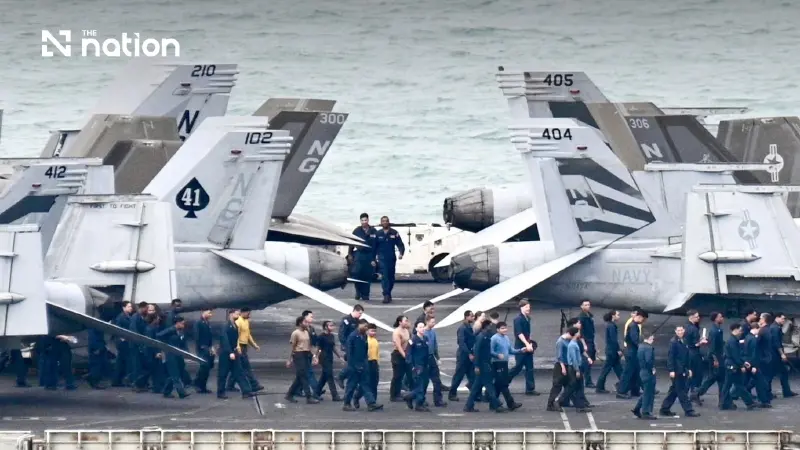


A one-day estimate suggests 5,000 US personnel could generate THB5 million to THB15 million in Pattaya if each spends THB1,000-3,000.
Pattaya’s tourism and service businesses are hoping for a short-term spending boost after the USS Abraham Lincoln carrier strike group arrived on Thailand’s eastern seaboard on Wednesday (September 2, 2026), carrying about 5,000 sailors and Marines for a five-day port visit.
The Nimitz-class nuclear-powered aircraft carrier USS Abraham Lincoln (CVN 72) docked at Laem Chabang in Chonburi. The Arleigh Burke-class guided-missile destroyer USS Frank E. Petersen Jr. (DDG 121) called at nearby Si Racha, while the Ticonderoga-class guided-missile cruiser USS Robert Smalls (CG 62) arrived at Map Ta Phut in Rayong.
The visit is the carrier’s first full port stop since its deployment began in November 2025 and follows 286 days at sea. Thai officials have described the call as a rest, recuperation and logistics stop rather than a joint exercise with the Royal Thai Navy or an operation connected to the Middle East conflict.
Many of the personnel are expected to spend shore leave in Pattaya before the ships’ scheduled departure on Sunday (September 6).
Pattaya businesses hope for short-term lift

Pattaya Mayor Poramet Ngampichet estimated that each service member could spend between THB1,000 and THB3,000 a day, or about US$30–91, depending on the length of their shore leave and whether they stay overnight.
On a simple one-day calculation, spending by all 5,000 personnel within that range would generate between THB5 million and THB15 million. The actual amount is uncertain because personnel will leave the ships in rotating groups, not all are expected to visit Pattaya, and some may travel to Bangkok.
Restaurants, accommodation providers, entertainment venues, shops, transport operators and other tourism-related businesses are expected to receive part of the spending.
Lisa Hamilton, president of the Pattaya Nightlife Business Association, described the port call as a “source of hope” for local operators. She said tourism and business activity in 2026 had been weaker than in any other year during her more than two decades in Pattaya.
Thanet Supornsahasrungsi, president of the Chonburi Tourism Federation, said the wider commercial impact would depend on where the personnel chose to spend their time, as some could continue to Bangkok during their leave.
Security tightened around shore-leave areas

Pattaya has increased patrols around its main beachfront and nightlife districts, with Thai police, municipal officers and other agencies coordinating security on land and at sea.
About 40 buses have been arranged to carry personnel between Laem Chabang and Pattaya, while sailors and Marines are expected to leave the ships in staggered groups to limit congestion.
Poramet said the city’s preparations would focus on safety and fair pricing so that visiting personnel were not exploited by service providers.
US personnel have been prohibited from taking part in several activities considered high-risk, including water sports and jet skiing, as well as bungee jumping, wrestling and boxing. They have also been barred from using cannabis during the port call.
Officials said weekend operations before the ships’ arrival led to 40–50 people being detained on suspicion of prostitution. The mayor separately said police had arrested 25 women for soliciting on the beachfront promenade a week before the port call, while denying that the operation was specifically linked to the US arrival.
Pipatpong Fakfare, an associate professor specialising in tourism at Bangkok University, warned that the sudden arrival of a large group of potential customers could increase the risks of sexual exploitation and sexually transmitted infections.
Pattarachit Gozzoli, a sociologist at Mahidol University, noted that sex work is illegal in Thailand, although enforcement has often been inconsistent in major tourism centres.
First full port stop after 286 days
USS Abraham Lincoln left California in November 2025 for operations in the South China Sea before being redirected to the Middle East.
The US Navy said the strike group spent nearly seven months in the US Central Command area, conducting combat operations in support of Operation Epic Fury and helping enforce what it described as the largest naval blockade in decades.
The deployment included more than 250 consecutive days without a full port stop, described by Democratic lawmakers as a modern-era record, and a total of 286 days at sea before the carrier reached Thailand.
The extended mission prompted reports of food and hygiene-product shortages, water and plumbing problems, falling morale and mental-health strain. Military-focused news organisations also reported incidents in which sailors allegedly attempted or prepared to go overboard.
US Defence Secretary Pete Hegseth said reports about poor conditions had been “completely misrepresented”. The Navy said the carrier’s leadership was continually assessing psychological readiness and that counsellors, chaplains, medical professionals and other support services were available aboard the ship.
USS George Washington relieved the long-deployed carrier in the Middle East in August, allowing the Abraham Lincoln group to leave the region and make its stop in Thailand.
Port call reinforces long US-Thai relationship

Rear Adm. Robert E. Loughran, commander of Carrier Strike Group 3, said the arrival offered sailors and Marines an opportunity to “rest and recharge” after what he described as a historic deployment.
Capt. Dan Keeler, commanding officer of USS Abraham Lincoln, said Thailand had become the group’s first port destination of the deployment and that the visit would deepen mutual understanding and reaffirm cooperation on regional security.
The United States and Thailand trace their formal relationship to the 1833 Treaty of Amity and Commerce, giving the partnership a history of 193 years. Thailand became a US treaty ally in 1954 and was designated a major non-NATO ally in 2003. It remains the United States’ only treaty ally in mainland Southeast Asia.
The two countries maintain regular military cooperation, including the annual Cobra Gold exercise and visits by US naval vessels to Thailand.
US military helped reshape Pattaya
Pattaya’s connection with US service personnel dates to the Vietnam War era, when American troops stationed at bases in Thailand began visiting the coastal settlement for rest and recreation.
Pipatpong said the influx helped transform Pattaya from a quiet fishing village into an international nightlife and entertainment destination within about 15 years. At the height of the period, tens of thousands of US personnel passed through the area each year.
Although US forces withdrew during the mid-1970s, the tourism, hospitality and nightlife infrastructure that had developed around their presence continued to expand. European visitors later became an important market, followed by growing numbers of Russian and Chinese tourists.
Pattaya has since sought to broaden its image through family attractions, shopping centres, resorts, cultural sites, golf courses and nearby island trips, although its nightlife sector remains a major part of the local visitor economy.
USS Abraham Lincoln and the accompanying ships are scheduled to remain in eastern Thailand until Sunday, completing five days of crew rest, shore leave and logistical support before continuing their deployment.
