
TAT taps UNESCO network and over 55 community destinations for 2027 tourism push



Thailand plans tourism branding pilots in five provinces, subject to review and funding, to turn local culture into experiences that benefit communities.
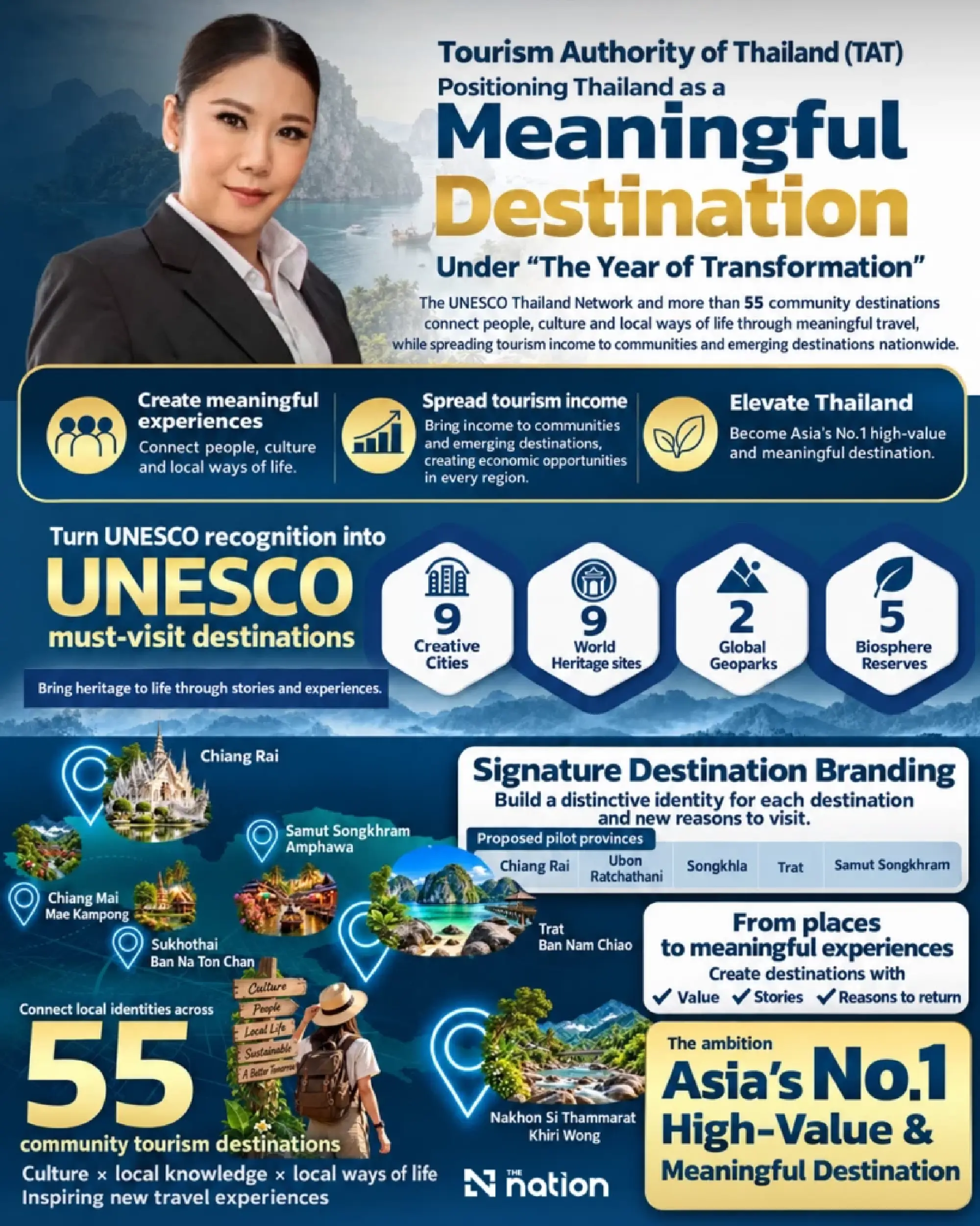
- The Tourism Authority of Thailand (TAT) is developing its 2027 marketing plan by creating new travel experiences in over 55 community destinations.
- The strategy heavily incorporates the UNESCO Thailand Network, planning to develop routes and experiences around the country's nine World Heritage sites and other recognized locations.
- This initiative aims to shift focus from individual attractions to meaningful, experience-based travel rooted in local culture and identity.
- A key goal of the plan is to spread tourism income to local communities and encourage travel to lesser-visited destinations.
The Tourism Authority of Thailand (TAT) is developing travel experiences at more than 55 community destinations and drawing on the UNESCO Thailand Network as part of its 2027 marketing plan, aiming to give visitors new reasons to travel and spread tourism income to local communities.
Under “The Year of Transformation”, TAT plans to shift the emphasis from promoting individual attractions towards experiences rooted in local identity, knowledge, culture and everyday life. The broader ambition is to position Thailand as “Asia’s No.1 High-Value & Meaningful Destination”.
TAT governor Thapanee Kiatphaibool said contemporary travellers wanted more than relaxation. They were looking for inspiration, connections with people and cultures, and journeys with personal meaning, informing the inclusion of community tourism and the UNESCO network in TAT’s “Experience Platform” approach.
“Future competition in tourism will not be about who has more beautiful places. It will be about creating new reasons for people to travel and making those journeys as valuable and meaningful as possible,” Thapanee said.

TAT develops experiences at more than 55 community destinations
TAT is working with local partners to improve more than 55 community tourism destinations throughout Thailand, connecting distinctive resources, traditions and knowledge with experiences under its “Meaningful Travel” approach.
Examples identified within the community network include:
- Chiang Rai: Chiang Saen and Ban Tha Khan Thong Homestay
- Nan: Bo Suak community
- Sukhothai: Ban Na Ton Chan
- Chiang Mai: Mae Kampong
- Chanthaburi: The Catholic community on the Chanthaboon waterfront
- Trat: Ban Nam Chiao
- Nakhon Si Thammarat: Khiri Wong
- Chumphon: Ko Phithak
- Phuket: Phuket Old Town
- Songkhla: Songkhla Old Town
- Phra Nakhon Si Ayutthaya: Kong Khong Market
- Samut Songkhram: The Amphawa canal community

TAT sees the community network as a means of encouraging travel to lesser-visited destinations with distinctive cultural, natural and local attractions, helping distribute visitors and income more widely.
Provinces highlighted by TAT include Chiang Rai, Nan, Sukhothai, Phrae, Loei, Nong Khai, Udon Thani, Nakhon Phanom, Mukdahan, Ubon Ratchathani, Buri Ram, Trat, Samut Songkhram, Ratchaburi, Phetchaburi, Chumphon, Ranong, Phatthalung, Nakhon Si Thammarat and Satun.

TAT plans new experiences around nine World Heritage sites
TAT plans to develop routes and experiences around Thailand’s nine World Heritage sites, using their history, local knowledge and connected ways of life to give travellers a deeper understanding of each destination.
The UNESCO Thailand Network brings together different forms of recognition by the United Nations Educational, Scientific and Cultural Organization. The network covers nine Creative Cities, nine World Heritage sites, two Global Geoparks, five biosphere reserves and several elements of Thailand’s intangible cultural heritage.
Thailand is home to several UNESCO World Heritage sites that highlight the country's rich history, ancient architecture, and diverse ecosystems. These protected locations span centuries of culture and nature across different regions:
Historic Capitals: Sites like Ayutthaya and Sukhothai showcase the magnificent architectural and cultural achievements of Thailand's ancient kingdoms.
Prehistoric & Cultural Heritage: Locations such as Ban Chiang, Si Thep, and Phu Phrabat preserve early human history, Bronze Age artifacts, and ancient religious traditions.
Natural Sanctuaries: Vast jungle areas like Khao Yai and Kaeng Krachan protect critical forest ecosystems and endangered wildlife.
TAT intends to turn international recognition into a starting point for cultural and educational travel. The proposed experiences would introduce visitors to the stories and communities associated with the sites, presenting them as destinations with meaning beyond their listed status.
“UNESCO should be more than a seal recognising a place’s value. It should inspire people to experience for themselves the stories, culture and ways of life within each destination,” Thapanee said.

Five provinces proposed for destination branding pilot
TAT plans to introduce its “Signature Destination Branding” programme in Chiang Rai, Ubon Ratchathani, Songkhla, Trat and Samut Songkhram. The proposed pilot locations remain subject to further consideration and budget allocation.
The branding strategy would give each destination a recognisable identity through its stories, culture, people and distinctive qualities. TAT aims to build emotional connections that influence travel choices, developing a broader identity for each place beyond the promotion of individual attractions or events.
The proposed provincial themes are:
- Chiang Rai: Contemporary arts and culture, Lanna identity and creative community networks.
- Ubon Ratchathani: Religious traditions, culture and major festivals of northeastern Thailand.
- Songkhla: Old-town character, multicultural heritage and ways of life in the southern border region.
- Trat: Nature, learning experiences and quality tourism in eastern Thailand.
- Samut Songkhram: River communities, food culture and travel experiences along canals.
TAT to assess spending and community benefits alongside visits
Thapanee said the success of the “Meaningful Destination” approach would be assessed through visitor numbers, average spending per trip, length of stay and the distribution of income to communities. Evaluation would also consider how travellers perceive each destination’s image and identity.
“The key goal is not simply to increase visitor numbers, but to give each place value, a story and reasons for tourists to return,” Thapanee said.
“That will help generate sustainable income and strengthen local economies over the long term.”
