
French students clash, over 5,000 arrested as 400 schools shut on October 2


French unions call a teachers’ strike for October 6 as the interior minister says around 5,000 people have been arrested during school protests
- Violent clashes between high-school students and riot police across France on October 2 resulted in the closure of 400 schools.
- The protests are a response to poor learning conditions, including overcrowded classrooms, teacher shortages, and deteriorating buildings, which students blame on chronic underinvestment.
- The nationwide unrest has led to approximately 5,000 arrests, mostly of teenagers, and injuries to 65 education staff.
High-school students clashed with riot police across France on Friday, October 2, 2026, as protests over classroom conditions and funding grew increasingly violent. The unrest left 400 high schools, roughly one in 10, closed. Interior Minister Laurent Nuñez told TF1 television on October 2 that police had arrested around 5,000 people, most of them teenagers, since Monday, September 28. Education Minister Édouard Geffray said 65 education staff, including 40 headteachers, had been injured during the unrest. Geffray urged parents to keep their children from joining the protests.

Fires and clashes spread across French cities
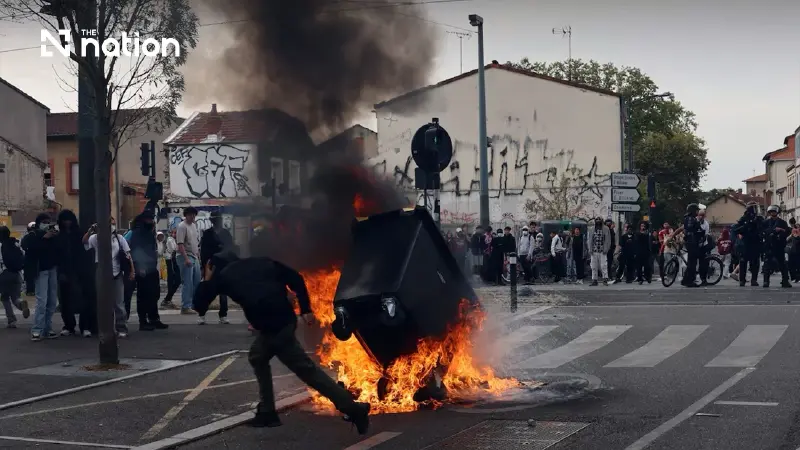
Violence erupted in cities across France on October 2, with tear gas filling streets in Strasbourg, fireworks directed at police lines in Marseille and rubbish bins set alight in Rennes.
In Pantin, on the outskirts of Paris, protesters burned objects including fences and threw firecrackers at riot police before fleeing. A protester in Toulouse threw a rubbish bin into a fire outside Lycée Déodat-de-Séverac during the nationwide demonstrations.
A spokesperson for the regional education authority said a youth sprayed petrol at a teacher in La Ciotat, near Marseille. A social-media video broadcast by BFM TV showed a man clutching his face after a hooded, masked person sprayed liquid from a bottle at him, but Reuters could not verify the circumstances.
The school protests began in the Paris region during the previous week and became increasingly violent as they spread nationwide. Several students interviewed by Reuters in the Paris region earlier in the week said they would stay away on October 2 because of the escalating violence.

French teachers plan October 6 strike
Trade unions called a teachers’ strike for Tuesday, October 6, a week after public-sector workers walked out, as students continued demanding better learning conditions.
Students blockading high schools have complained of overcrowded classrooms, frequent teacher shortages and deteriorating buildings, blaming years of underinvestment. Their demands include more resources and the recruitment of substitute teachers.
“We are 35 per class, we don’t have enough chairs in classrooms,” 15-year-old Kesia told Reuters in Pantin, adding that a one-hour lunch break did not give everyone enough time to get food. Kesia then ran off as police used tear gas.
Teacher Sandra Champain-Seller described the violence as “regrettable”, but said years of unanswered demands, alongside the political and geopolitical context, had contributed to students being in “a real state of anxiety”.
Some parents backed the students’ demands. Vincent Martin joined his daughter outside Hélène Boucher high school in Paris, saying students were “fundamentally right to demand ... better learning conditions”.

France proposes education increase below inflation
France’s draft 2027 budget, presented on October 1, would increase education spending by 1.7% to €65.53 billion (US$73.77 billion), excluding teacher pensions. The proposed rise would fall below inflation.
Education has traditionally been France’s largest budget item, but debt-servicing costs are projected to reach €74.5 billion in 2027, overtaking education under the draft spending plan.
According to the Organisation for Economic Co-operation and Development, France’s education spending sits around the middle of the range among member countries. Spending increased between 2015 and 2022, although education’s share of the budget declined slightly.
Planned budget cuts have aggravated the education funding crisis and fuelled discontent. The Nation’s September 2025 coverage of French anti-austerity protests provides earlier context on opposition to spending cuts.
President Emmanuel Macron and his centre-right-leaning government face consistently poor opinion-poll ratings, with the school unrest unfolding about six months before the 2027 presidential election.
French authorities investigate alleged police violence
French authorities have opened several investigations into allegations of police violence during the school protests. Rights groups have accused officers of using excessive force against minors, including batons, tear gas and Flash-Ball projectile weapons.
One investigation concerns a 16-year-old who suffered an eye injury after police fired rubber bullets into a crowd of protesters, according to his friends.

Government officials have argued that the demonstrations have changed character. After a crisis meeting on October 1, a source close to the prime minister said the movement had shifted from protest to urban violence, while Justice Minister Gérald Darmanin said “outsiders” had hijacked it.
Intelligence agencies told the crisis meeting that politicians from the hard-left France Unbowed party, known as LFI, had initiated the movement. Senior LFI lawmakers rejected the allegation and accused the government of politicising the protests ahead of the election.
Darmanin also told RTL radio that parents of those responsible for damaging property should pay reparations.

