
FAA expects US air travel to normalise after nationwide departure halt
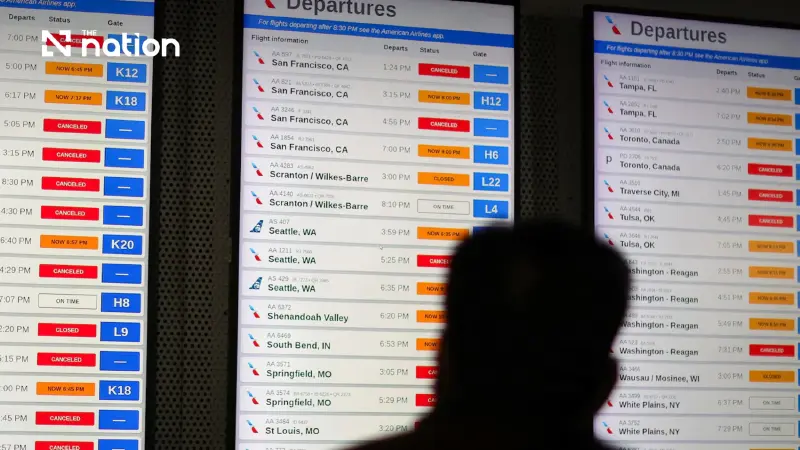


The Federal Aviation Administration expects most services to return to normal by late Sunday as investigators examine a router installation.
- A nationwide halt on flight departures, the longest since the 9/11 attacks, was ordered by the FAA due to a major communications system failure, stranding thousands of passengers.
- The FAA administrator expected flight schedules to return to largely normal by late Sunday, although thousands of cancellations and delays continued as airlines worked to reposition crews and aircraft.
- Officials attributed the disruption to a faulty router installation during routine maintenance by a contractor, L3Harris, and have ruled out a cyberattack.
- The incident highlighted the strain on the aging US air traffic control system, prompting calls from the Transportation Secretary for $50 billion in funding for upgrades.
Tens of thousands of passengers remained stranded at US airports as airlines worked to restore services following a nationwide ban on departures.
Federal Aviation Administration (FAA) administrator Bryan Bedford expected largely normal schedules by late Sunday.
Although departures were allowed again on Friday evening, carriers still had to get flight crews and other personnel into position to resume services.
Some college football teams were also stranded on Friday before their Saturday games.
Airlines issued travel waivers so passengers could move their journeys to later dates without paying extra.
JetBlue cancelled nearly 45% of its Saturday flights, compared with about 25% each at American Airlines, Delta Air Lines and United Airlines.
FlightAware, an aviation website, recorded about 9,200 cancellations and 7,500 delays on Friday.
Its Saturday count stood at more than 6,150 cancellations and over 7,300 delays as of 6.45pm Eastern Time (11.45pm GMT).
More than 530 flights scheduled for Sunday had already been cancelled.
Bedford apologised on Saturday and described the system as stable. Nearly all flights awaiting departure across the country had been held on the ground for almost five hours on Friday under the FAA’s order.
No nationwide halt had lasted as long since the September 11, 2001 attacks, and Friday ranked among the worst days in US air travel history.

Seventeen of the FAA’s 22 en route centres, responsible for aircraft during the cruising stage of a flight, experienced communications disruption.
Bedford attributed the decision to stop departures to the possibility that a centre could lose communications completely.
“No facilities went dark. Nothing was fully lost,” Bedford said.
According to US Transportation Secretary Sean Duffy, the trouble began on Friday afternoon with unstable radar and communications systems at air traffic control centres.
Officials described how the router problem caused data to overwhelm other communications centres.
“We had over 1,000 connection attempts every four to five seconds, and what that did was (it) gave us issues with our communication with airplanes, and it also caused some disruption with our radar,” Duffy said.
The White House responded with an emergency meeting in the Situation Room on Friday, while federal agencies rushed to establish whether a cyberattack had taken place.
Officials subsequently linked the disruption to routine maintenance that had gone wrong.
Duffy identified the installation of one or more new routers by FAA contractor L3Harris at a remote facility as the source of the problem.
Speaking to reporters on Saturday, he made clear that the precise fault remained unresolved.

“We're working to determine whether we had incompetence, meaning was it user error or installer error from L3Harris, or did they install a faulty router?” he told a news conference.
“We haven't determined what the fault was.”
L3Harris stated that it took the incident seriously and was helping the FAA investigate.
The agency was conducting further tests with the company to check for additional risks.
The last price reported for L3Harris shares after the market closed on Friday was about 4% lower.
The US air traffic control system was already dealing with ageing technology, equipment and communications problems, and a shortage of several thousand controllers.
Friday’s disruption was its most dramatic sign of strain so far.
Democratic US Representatives Rick Larsen and André Carson reported that the Transportation Department had spent only US$1 billion since receiving US$12.5 billion last year, although it had awarded contracts worth US$4.3 billion over that period.
Congress had approved the US$12.5 billion the previous year.
Duffy called on Friday for US$50 billion to upgrade air traffic control systems, increasing his earlier request of US$30 billion.
Further funding this year also received support from House Speaker Mike Johnson in a Fox News interview on Saturday.
His Republican Party controls Congress until next year, when Democrats will take over following their gains in the November 3 midterm elections.
Larsen is due to chair the House Transportation and Infrastructure Committee next year, while Carson is set to chair its aviation subcommittee.
The two lawmakers outlined their response in a joint statement on Saturday, saying their panels would “hold the administration accountable for what happened to make sure this chaos does not happen again.”
Source: Reuters
