
NSTDA Advances “Food Surplus Credit,” Turning Surplus Food Recovery into Carbon Credits to Drive Asia’s Sustainability Agenda
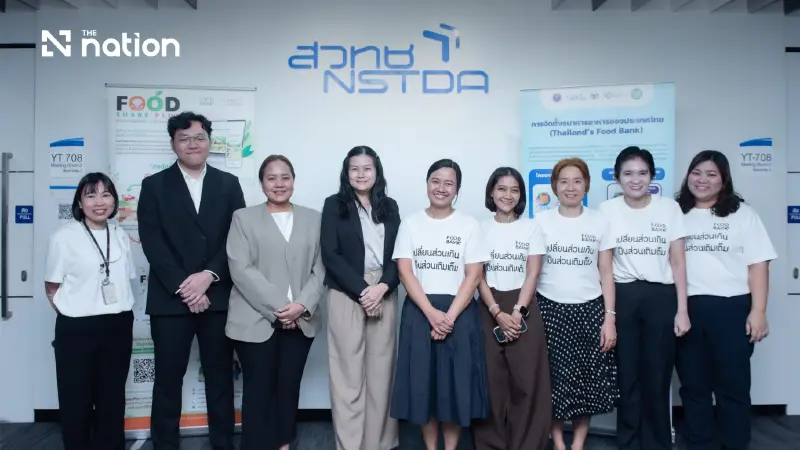


The National Science and Technology Development Agency (NSTDA), under the Ministry of Higher Education, Science, Research and Innovation (MHESI), is advancing sustainability innovation through its Thailand’s Food Bank project.
At the NSTDA x Press Interviews event titled “The Food Surplus Credit: Unlocking the Carbon Value of Surplus Food — A Major Agenda for Asia,” NSTDA highlighted a new T-VER methodology that enables greenhouse gas emission reductions from the recovery and donation of eligible surplus food to be quantified and developed into carbon credits.
The methodology measures greenhouse gas emissions avoided by diverting food waste from landfill and deducts emissions generated during the recovery and redistribution process, including those from food storage, transportation and packaging. This provides businesses with measurable environmental benefits that can support transparent Environmental, Social and Governance (ESG) reporting, while creating an additional incentive for surplus food recovery and contributing to Thailand’s transition towards Net Zero.

Dr. Pattamaporn Prachomrat, Senior Policy Researcher at NSTDA and Project Leader of Thailand’s Food Bank, said food surplus is not only a food security issue. Edible surplus food that is not recovered or put to beneficial use may become food waste and ultimately be disposed of, resulting in greenhouse gas emissions. “Thailand’s Food Bank aims to establish an efficient and safe mechanism for managing surplus food. The Food Surplus Credit concept provides an additional incentive for the agricultural and food industries by demonstrating tangible environmental and economic benefits. This is an important agenda that Thailand and the wider Asian region need to advance together,” she said.

Ms. Jantima Samneangngam, Project Leader of the Development of Guidelines and Environmental Impact Assessment of Food Surplus Project, and Senior Research Assistant at TIIS, MTEC, NSTDA, said linking surplus food donation with carbon credit mechanisms requires reliable data and scientific knowledge. TIIS has therefore developed tools and methods to systematically assess greenhouse gas emission reductions from surplus food recovery and donation, providing accurate, credible and verifiable data to support carbon credit development and sustainability reporting by businesses in Thailand and internationally.
She further stated that T-VER-S-METH-09-09, “Management of Food Surplus and Utilization as Donation for Human Consumption,” provides a systematic and verifiable approach for quantifying greenhouse gas emission reductions from eligible surplus food recovery and donation activities.

The methodology has been approved by the Thailand Greenhouse Gas Management Organization (Public Organization), or TGO, under the Thailand Voluntary Emission Reduction Program (T-VER). Under the program, eligible greenhouse gas emission reductions can be certified as carbon credits, or TVERs, which can be traded in Thailand’s domestic voluntary carbon market. The methodology calculates greenhouse gas emissions avoided by preventing food waste from being sent to landfills and deducts emissions generated during recovery and redistribution, including energy used for refrigeration and freezing, transportation, food preparation and packaging. Eligible surplus food must be clean, safe and provided free of charge in accordance with the food safety guidelines for food donation. The current methodology does not cover beverages.

“The carbon value embedded in surplus food represents a new opportunity for Thailand. If surplus food donation can generate carbon credits, it can not only reduce environmental impacts but also create economic opportunities and new incentives for businesses to participate in reducing food waste,” Ms. Jantima said.
She added that the TIIS-MTEC-NSTDA research team recently met with the Asia Carbon Institute (ACI) to exchange knowledge and explore how Thailand’s methodology could be further developed in alignment with ACI’s framework and applied more widely across Asia. The discussion highlighted the potential for the methodology developed in the Thai context to be adapted by other countries, contributing to regional efforts to reduce food waste and greenhouse gas emissions.

“NSTDA is ready to advance Thailand’s Food Bank model and Thailand’s T-VER methodology as a regional model for surplus food management linked to carbon credit mechanisms. Surplus food is not merely waste to be disposed of; it represents ‘new carbon value’ that can generate economic, social and environmental benefits,” she said.
“Through research and technology, NSTDA is ready to contribute to Thailand’s and Asia’s transition towards a low-carbon economy.”
About Thailand’s Food Bank
Thailand’s Food Bank, implemented by NSTDA in collaboration with its network partners, is a key national mechanism for the systematic and safe recovery of surplus food. The initiative integrates information technology and national expertise from NECTEC, BIOTEC and MTEC to improve food redistribution, helping food reach recipients more effectively while reducing social inequality.
The initiative also incorporates the assessment of greenhouse gas emission reductions, enabling eligible reductions from surplus food recovery and donation to be developed into carbon credits in an accurate, transparent and measurable manner.
More information: https://www.nstda.or.th/foodbank/
