
Thailand broadens solar scheme with THB75bn funding plan
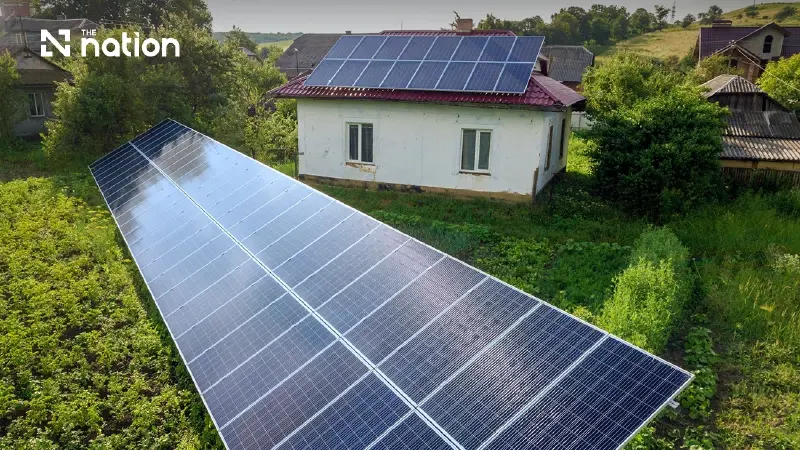


Thailand’s government seeks THB75 billion in loans to expand its public solar scheme, offering THB50,000 subsidies and wider installation options.
Prime Minister and Interior Minister Anutin Charnvirakul has signed a proposal seeking THB75 billion in loan funding to expand Thailand’s “People’s Solar” programme, which will provide subsidies of THB50,000 per household and support up to 1.5 million homes.
The updated scheme will allow solar installations not only on rooftops but also on the ground and floating systems, while households will be able to sell excess electricity back to the grid at a maximum of 5 kilowatts for THB2.20 per kilowatt-hour under 20-year contracts.
Polapee Suwunchwee, Deputy Interior Minister, said Anutin signed the project proposal and energy transition loan spending plan on October 1.
The proposal, worth THB75 billion, consists of THB50 billion for the first phase and THB25 billion for the second phase. It has been submitted to the loan spending review subcommittee under the emergency decree authorising the Finance Ministry to borrow funds, chaired by former Energy Ministry permanent secretary Kulit Sombatsiri, for further consideration.
Scheme expanded beyond rooftop solar
The revised plan broadens eligibility from the original proposal, which focused only on rooftop solar installations, to include on-ground and floating solar systems.
The change aims to address limitations faced by households and farmers, particularly in rural areas where some homes may not have roofs suitable for installing 5–10 kilowatt solar systems.
Under the expanded approach, households with available open land receiving sufficient sunlight or ponds suitable for floating solar installations can also participate.
“Not every home can install solar roofs because some roofs may not be able to support a 5-kilowatt system. If a household has open space that receives sunlight, it can install an on-ground system, or if it has a large pond, a floating system can also be installed. We are not imposing restrictions; households only need to have an electricity meter,” Polapee said.
The government expects registration for the programme to open on November 1, 2026, subject to an official announcement.
Support covers 1.5m households
The first phase aims to support 1 million households, with an additional 500,000 households to be added later, bringing the total target to 1.5 million households.
Each participant will receive a subsidy of THB50,000, with the total funding amounting to THB75 billion.
Households will be able to install solar power systems with capacity of up to 10 kilowatts. However, the government will limit purchases of surplus electricity returned to the grid to 5 kilowatts, at a rate of THB2.20 per unit (kilowatt-hour) for a 20-year contract under a Net Billing system.
Electricity authorities will replace existing meters with smart meters free of charge for participating households.
The government said households with average electricity bills of THB3,000–4,000 per month are expected to see immediate savings. Those with lower electricity usage can also participate if they wish to generate income by selling excess power back to the grid.
State banks offer low-interest solar loans
The programme will also receive support from three state-owned specialised financial institutions: the Government Housing Bank (GH Bank), Government Savings Bank (GSB) and the Bank for Agriculture and Agricultural Cooperatives (BAAC).
The banks will provide solar installation loans with a special interest rate of 2.5% per year and a repayment period of seven years.
Income from selling electricity back to the grid will be automatically used to repay solar installation loans. If any funds remain after loan payments, participants can use the balance to reduce existing debts with the banks.
The government has also required solar installation providers to meet international standards, have qualified engineers on staff, maintain financial stability and be registered on the electricity authorities’ official Vendor List to prevent fraud.
