
Chula expert outlines 3 Bangkok flood threats on Oct 7
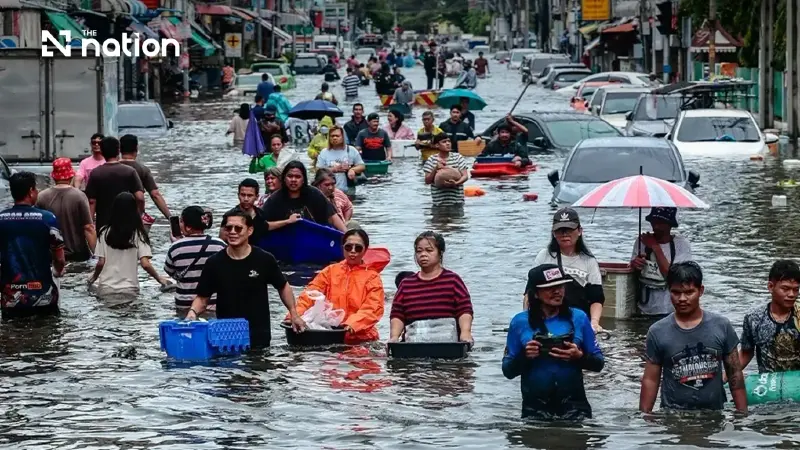


A Chulalongkorn University expert explains Bangkok’s flood risks and proposes four measures covering communities, data, infrastructure and coordination.
- Thailand’s flood crisis stems from three converging sources: upstream river flows, heavy local rainfall and high tides.
- The “new normal” of flooding is driven mainly by unusually intense rainfall that overwhelms urban drainage systems designed for past conditions.
- Despite annual water-management spending of 100 billion baht, flood damage remains substantial. According to the report, prevention costs just one-thirty-third as much as dealing with the aftermath.
- Proposed solutions include preparing communities, integrating water data for forecasting, upgrading infrastructure and making water management a national priority.
Bangkok faces flooding from upstream runoff, intense local rain and high tides, with heavy downpours alone capable of overwhelming its drainage. Assistant Professor Pongsak Suttinon, head of water resources engineering at Chulalongkorn University, outlined the risks at an October 7, 2026 briefing.
Pongsak, also a committee member of Chulalongkorn University’s Water Resilience Center, spoke at “The Water Wake-Up Call”, a media briefing and water laboratory visit. Pongsak said flooding in Bangkok, its surrounding provinces and the Central region could be explained through science and urban development rather than fate or superstition.
Three water sources threaten Bangkok
Pongsak described Bangkok’s exposure as a confrontation with three “water armies”, each affecting how quickly water enters or leaves the capital:
Upstream runoff: Water from the Ping, Wang, Yom and Nan river systems converges through Nakhon Sawan before flowing towards Bangkok. Pongsak compared the narrowing route to four traffic lanes being squeezed into one.
Local rainfall: Heavy rain falls directly on Bangkok’s economic areas. Pongsak estimated that the capital generates about one-third of Thailand’s GDP, worth roughly 6–7 trillion baht a year.
High tides: Higher water levels in the Chao Phraya River and coastal areas can prevent gravity drainage when they rise above drainage outlets, while also making it harder to pump water out of Bangkok.

The 2011 floods caused 1.4 trillion baht in damage and losses
Thailand’s 2011 floods caused about 1.4 trillion baht in damage and economic losses, equivalent to 70% of the national budget of 2 trillion baht at the time, according to the figures cited by Pongsak. Upstream runoff was the dominant force as all three flood sources coincided.
Thailand typically receives about 1.5 metres of rain annually, rising to roughly 3 metres in the South, according to Pongsak’s account. About 80% falls during the wet season and 20% during the dry season.
Pongsak put Thailand’s combined reservoir capacity at around 70 billion cubic metres, compared with approximately 40 billion cubic metres at China’s Three Gorges Dam alone.
Five storms affected Thailand in succession in 2011, filling reservoirs and leaving no room to retain water from subsequent downpours, Pongsak explained. Like an overflowing basin, the excess water spread into low-lying areas, with high tides compounding the flooding.
Industrial damage and losses reached about 1 trillion baht, particularly affecting industrial estates in Ayutthaya, according to Pongsak. The disruption heightened concerns among businesses and foreign investors about Thailand’s role as a manufacturing base.
Pongsak characterised the 2011 disaster as a physical crisis, contrasting it with five or six other major economic crises that he classified as financial.

Extreme local rainfall can overwhelm Bangkok’s drainage
Bangkok can now experience paralysing floods without a major surge of upstream water or tides as severe as those in 2011, Pongsak said. Extreme local rainfall can be sufficient on its own.
Pongsak cited a historical design benchmark for Bangkok’s drainage system of 60 millimetres, or 6 centimetres, of rain an hour, based on 30 years of rainfall records. Heavy rainfall over the past four to five years has exceeded those historical extremes, Pongsak said.
Bangkok Biznews cited a recent extreme-rainfall example of 200–300mm in a day, with an estimated 250 million cubic metres of water falling on the capital. That volume is roughly a quarter of the capacity of Pa Sak Jolasid Dam.
Bangkok Biznews put the combined maximum discharge capacity of the capital’s pumps, canals and drainage tunnels into the Chao Phraya at about 100 million cubic metres a day. The resulting estimate of 2.5–3 days to remove 250 million cubic metres is a simplified calculation assuming no further inflow and continuous operation at the stated capacity.
Bangkok’s extensive concrete cover limits the amount of rain that can soak into the ground, Pongsak explained. Runoff instead flows along roads and into drains, accumulating in depressions and neighbourhoods below the level of surrounding land.
Bangkok Biznews noted that rainfall of 300mm a day could also overwhelm other major cities. The examples cited included flooding at Japan’s Narita Airport and a single-day downpour of about 600mm, or roughly 2 feet, in Nakhon Si Thammarat.

Water-management spending has not ended recurring flood losses
Bangkok Biznews identified three economic challenges facing Thailand’s flood response: substantial annual spending, continuing damage and lengthy construction times.
Annual water-management spending: About 100 billion baht, described as 25% of Thailand’s total capital budget.
Recurring flood damage: Approximately 70–80 billion baht a year despite that expenditure.
Construction lead times: Major flood bypasses and diversion canals in the Chao Phraya basin require around eight to 10 years to build, leaving the country exposed to further losses while projects are delayed.
Bangkok Biznews cited prevention costs at roughly one-thirty-third of the cost of disaster damage and subsequent recovery, arguing for greater investment in preparedness and risk management.
Four proposals connect household readiness with national coordination
The flood-response proposals reported by Bangkok Biznews begin with households being able to cope independently for at least three days and extend to coordination across government and business.
Prepare communities for flooding
Community preparedness would involve four practical measures:
1. Households should keep enough food, medicines and drinking water for at least three days if flooding cuts them off.
Communities should practise flood drills and develop preparedness skills, much as they do for fire evacuations.
2. Homes should have separately controlled circuit breakers and switches for ground and upper floors, allowing electricity downstairs to be disconnected independently. Residents should move vehicles to higher ground before access roads flood.
3. Relief agencies should use real-time information to coordinate supplies and identify available parking and shelter space, preventing thousands of boxed meals from spoiling in one area while flood victims nearby go without.
4. Create an integrated water-data platform
The proposed water-data platform would combine information from Thailand’s relevant agencies, improve forecasting and turn complex measurements into clear instructions. Residents would receive understandable guidance on what to do and when to prepare to evacuate.
Adapt infrastructure to changing water conditions
The infrastructure proposal calls for faster development of bypass routes that divert floodwater around Bangkok, while balancing drainage with storage for the dry season rather than unnecessarily releasing water to the sea. Other measures include raising tidal flood defences, with a 50-centimetre increase given as an example, and studying river gates similar to those used in the Netherlands.
A national water-management agenda would bring public agencies and businesses into closer coordination, reduce wasted public spending and support long-term confidence in the Thai economy.
