
Crisis should lead to rethink by firms and govt
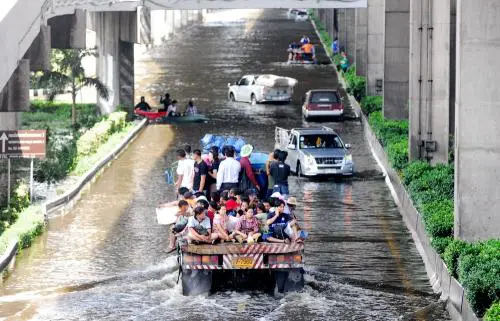


Thailand's worst floods in five decades should spark a rethink by companies and the authorities on how to prepare for any disasters that could disrupt business activity and cause huge losses, said an expert in business continuity planning.
Vilaiporn Taweelappontong, a partner at PwC Thailand, said that to ensure continuity, businesses needed to come up with plans to minimise losses to their property and damage to their operations.
She said the need for such planning was heightened after the political unrest in April and May last year, which disrupted a large number of businesses.
She added that the government should also focus on this type of planning to minimise damage on the scale currently being experienced. She urged the authorities to push business continuity planning on to the agenda of the Asean Economic Community, so that all member countries could assist one another when disasters like this happen.
“No matter what occurs, if we are well prepared, then we can survive,” Vilaiporn said.
PwC Thailand has about 100 clients using its consultancy service on business continuity management. Most of them, including a commercial bank, are in Bangkok.
The flooding is now creating serious supply-chain disruption, particularly in the automotive and electronics industries. All five industrial estates in Ayutthaya and two in Pathum Thani, housing mainly auto-parts makers and electronics firms, are inundated.
Honda, Toyota, Nissan and Mazda have suspended operations because of a shortage of components and spare parts, while several electronics firms are fuming over the need to halt production. US-based Western Digital acknowledged last week that the closure of two plants in Ayutthaya would weaken the company’s earnings below analysts’ expectations.
Damage to the agricultural and industrial sectors is estimated to be well over Bt100 billion, while damage to property is as yet unaccounted for.
Vilaiporn believes the huge damage stems from the fact that the affected plants did not have business continuity plans to deal with natural and man-made disasters.
Such plans are formulated to act on emergency response and rescue activities in relation to any disaster, and the rescue efforts will cover affected employees and their families, properties and the supply-chain system. Man-made disasters include political unrest, fires and epidemics.
According to the National Economic and Social Development Board, Thailand’s risks include floods, windstorms, fires, protests and terrorism. The nation is least prepared for handling low-likelihood earthquakes, as this kind of disaster has never taken place in the country.
Flooding is the highest risk to the business continuity in the Central region, Vilaiporn said.
During the current crisis, PwC Thailand is helping clients with frequent communications on updated flood information. Communication is the key to relieving the impact of a disaster and lessening damage, she said, adding: “Our policy is that you must be contactable.”
A company with a disaster-management plan in place usually has a priority list for rescue activities and moving items such as machinery and equipment to an alternative site to minimise business disruption. Those basic plans should be made in advance rather than being left to when disaster strikes.
The critical procedure is to identify the company’s priorities and replacement strategies, especially alternative sites for operations. “That requires some investment,” Vilaiporn said.
PwC Thailand expects more businesses in future to have alternative sites, spare power generators, and shelters to accommodate evacuees.
While most countries experience disasters of one form or another, it should be realised that prevention to reduce business risk is more crucial than remedial action, she said.
