
Push to boost number portability
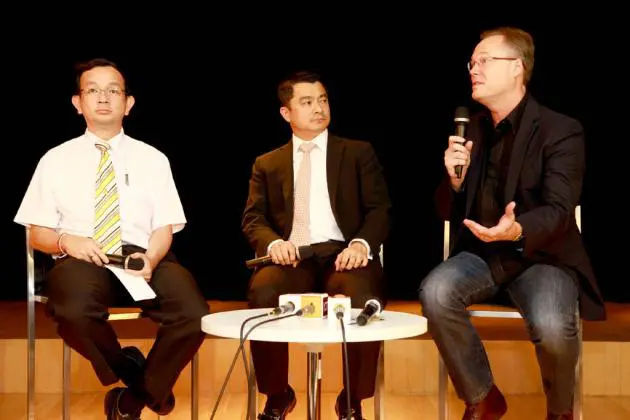


The telecom regulator will seek ways to boost the capacity for mobile number portability so subscribers can quickly switch away from cellular networks with poor service.
Settapong Malisuwan, a member of the National Broadcasting and Telecommunications Commission (NBTC), said yesterday that the “market mechanism” would be used to punish operators with low quality service.
The NBTC would also specify service standards in the terms of reference (TOR) for the planned bidding on the much-needed 3G-2.1GHz spectrum licences, such as the allowable drop and success rates.
The watchdog had no regulations to fine telecom operators for accidental network failures, he said.
Clearinghouse Co can port 400 mobile numbers per operator per day and complete the porting within three days. The NBTC reportedly wants the company to expand its porting capacity and shorten the porting period to one day.
Number portability allows cellular subscribers to move to a new network and use their existing mobile phone number on that network.
Settapong and other commissioners visited the head office of Total Access Communication (DTAC) at Chamchuri Square to evaluate its operation following three network crashes in the past 20 days.
CEO Jon Abdullah said that what happened during the past 20 days was “bad luck”.
He denied accusations that DTAC was spending more on dividend payments and less on network infrastructure. DTAC plans to lay out Bt40 billion within three years on network upgrades as well as the additional rollout of its 3G-850MHz network, he said.
It would take time for DTAC, which has about 23 million subscribers, to collect data to see how many customers left its network after these three breakdowns.
DTAC yesterday extended its sincere apologies and committed itself to working hard to regain customer trust.
Norway’s telecom giant Telenor is DTAC’s major shareholder. When asked by The Nation how Telenor views the problem, Glenn Mandelid, director of communications for Telenor in Asia, said Telenor Asia considers the problems at DTAC as unfortunate but Telenor Group fully trusted DTAC’s management. The company was taking all necessary precautions to minimise any inconvenience for customers.
The latest network problems followed a major upgrade to prepare the network to provide 3G services. These were operational issues that needed to be handled by DTAC, he added.
In the fourth quarter of 2010, DTAC entered into an agreement with Ericsson (Thailand) to upgrade its entire 2G network by replacing all the equipment installed over the last 18 years with the latest technology in two years to serve as a sound base for 3G.
However, on December 21 last year, DTAC experienced a network fault that was the result of a critical migration from one database to another. The root cause of this fault had been found and changes in design have already been made. To reduce the chance of future faults, DTAC decided to suspend its existing upgrade to re-examine all processes and procedures.
On January 5, DTAC experienced another network fault that affected many customers in the southern provinces.
The company found that its mobile switching centre in Surat Thani was underperforming and the call success rate of DTAC customers in such areas had dropped to about 50-60 per cent, resulting in congestion in its network system and causing over 1.8 million customers to have difficulty in dialling out or receiving calls.
Eventually, DTAC’s technology team was able to resolve the problem and the situation gradually returned to normal on the same day.
Over 900,000 affected DTAC customers were from the seven provinces of Chumphon, Surat Thani, Trang, Krabi, Nakhon Si Thammarat, Phuket and Phang Nga. The rest were spread over varous parts of the country.
On January 8, a brush fire in Phetchaburi and a car accident in Pranburi destroyed two critical fibre routes, severing service to the South. DTAC’s emergency repair teams responded quickly and had fibres spliced and service restored in 2.5 hours.
The NBTC sent its staff to examine DTAC’s mobile switching centre in Surat Thani last weekend.
