
Stainless steel pioneer to refocus on Asia


Play
A pioneer in the Kingdom in the manufacture of faucets and shower and bathroom accessories from stainless steel, VR Union Co is now focusing on Asia for export opportunities.
The company will this year celebrate its 40th anniversary. It will concentrate more on promoting its VRH brand not only in Thailand but in the international arena, focusing on Asean countries and others in Asia. A budget of Bt30 million will be allocated to facilitate its marketing strategy this year.
However, the company is looking at increasing the retail prices of its products because of the rising cost of labour in the wake of the new minimum wage of Bt300 per day coming into effect in Bangkok and some other provinces on April 1. This will increase the company’s labour costs by between Bt14 million and Bt15 million per year. To survive this, the company will hike retail prices by at least 7 per cent. VR Union employs 400 workers who are subject to the wage increase. In addition, another 100 staff are also waiting for salary adjustments.
One of the company’s marketing strengths is its long-term guarantee strategy; some of its products have a lifetime guarantee. Its products are marketed under two brands, VRH to capture medium to high-end consumers and Hoy to focus on the low-end group.
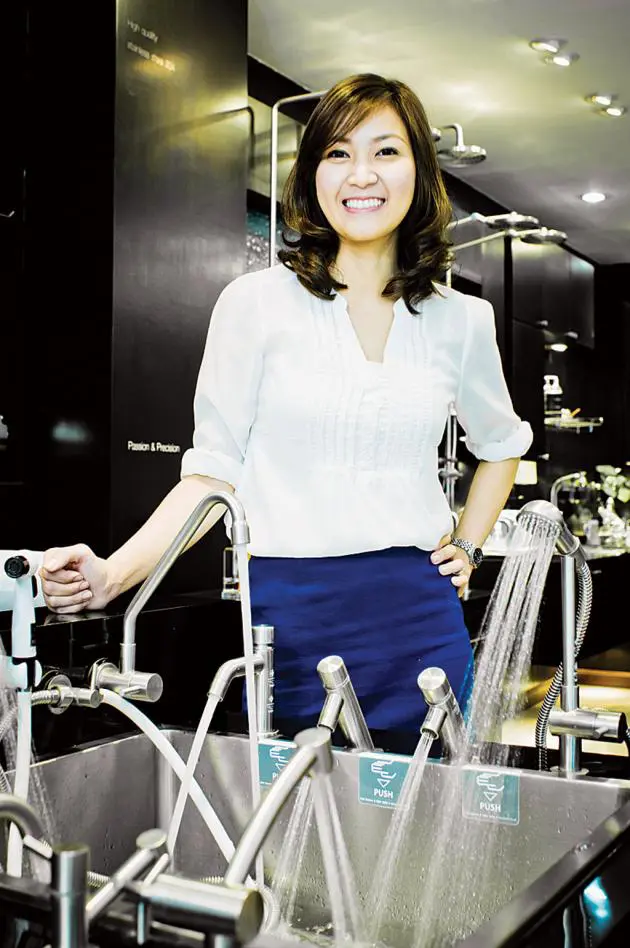
Chanida Hathaipantalux, a member of the company’s board of directors, said costs and business management were now priorities to ensure profitability. As a result, productivity development and cost reduction have been undertaken. Chanida now spends most of her working time in the factory at Krathum Baen, Samut Sakhon.
Chanida, 29, is a member of the second generation of the Hathaipantalux family, and she manages the company under her father Suwee’s wings. Her responsibility is to focus on export markets and manufacturing development to ensure cost reduction.
She is a key person systemising data collection in the company, pointing out that every manufacturing process should be recorded to allow procedures to be back-checked whenever problems occur. Her goal is to reduce waste from 5 per cent currently to zero by focusing on lead-time management throughout the manufacturing process.
“Our manufacturing relies on many parts and materials, so it’s hard for us to achieve just-in-time management. What we are doing is to concentrate more on using common parts,” Chanida said.
Suwee Hathaipantalux, the company’s founder, started out as a lathe operator for steel and stainless steel. In the beginning, the company produced simply designed products such as wires for kitchens and door handles, progressing to bath accessories later.
As an active businessman, Suwee has created export opportunities by visiting international fairs abroad although he can’t speak English. Foreseeing great business opportunity, Suwee set up an export division to explore overseas markets. However, VR’s exports at the moment focus on original equipment manufacturing (OEM) for Mexico and European countries.
Chanida’s two degrees, in international business from Bournemouth University in England and in industrial management from Huachiew Chalermprakiet University in Samut Prakan, allow her to handle both exports and manufacturing management.
She said the company’s business advantages were a small number of competitors, its own service team, and providing long-term guarantees ranging from 12 years to the life of the product. As an expert in stainless-steel business, the company selects the best-quality materials for its production. As a result, its stainless-steel goods have been selected by many hospitals.
On the other hand, one weak point is a low degree of advertising compared with other, larger brands. To deal with this, Chanida is managing marketing-promotion strategies including brand building, creating more advertising through both billboards and print media.
Chanida is also the person who initiated idea of changing the company’s logo from one that was hard to understand to a simple design. The strategy was aimed at allowing customers to recognise the brand more easily.
She foresees accessing the domestic market more while exports shift towards the Asian region. Consequently, the export share of total sales dropped last year when compared with its value in the past six or seven years. The company’s total sales last year were reported at Bt700 million, up by 20 per cent. Sales revenue is projected to grow by 15 per cent this year.
“We brainstormed in our office on whether to [continue focusing] on markets in South America and Europe, which impose more import restrictions and quality inspections [than in Asia], pushing up our prices. In addition, we experienced sharp sales drops in Mexico due to the economic slowdown,” said Chanida, adding that the company had been looking more towards Asia for three years.
The coming single market under the Asean Economic Community will create great business opportunities. To deal with the seamless market, the company is looking for sole agents in potential countries such as the Philippines and Singapore, as well as others in Asia. However, in big countries such as India and China it should have two agents.
To boost domestic sales, Chanida has accessed more of the retail market through modern trade and 700 construction-material shops nationwide. In addition, four new product designs will be launched this year to celebrate its 40th anniversary.
The company’s innovative designs have been patented and many have won design awards from both the Thai government and international organisations.
Because of the increasing cost of labour, Chanida has suspended the company’s investments for one or two years. It plans to undertake more mechanisation to facilitate cost management.
