
Don’t Wait for the Next Crisis: IMF Urges Developing Nations to Overhaul Tax Systems and Rebuild Fiscal Buffers Now
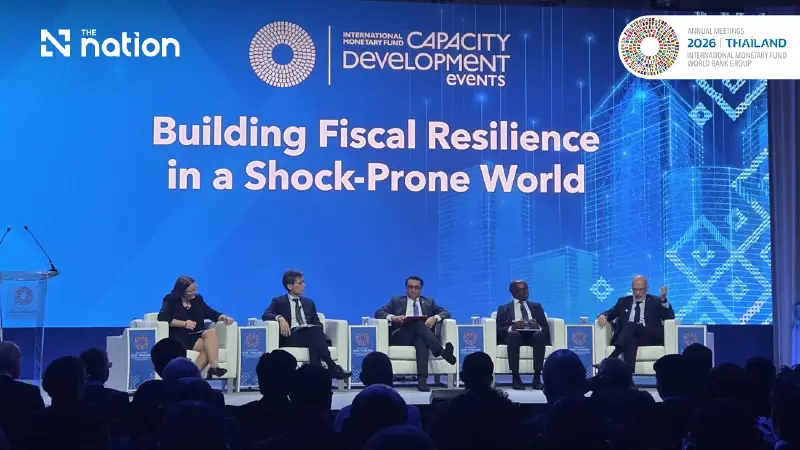


Officials say stronger tax collection, smarter spending and capable institutions are the best defence against the next crisis
- The International Monetary Fund (IMF) is urging developing nations to proactively overhaul their tax systems and build fiscal buffers to prepare for future economic shocks, citing shrinking financial flexibility due to rising debt and declining foreign aid.
- Key recommended strategies include strengthening domestic revenue collection, improving public spending efficiency, and building capable, resilient public institutions.
- Countries like Nepal and Zambia are presented as successful examples: Nepal increased its tax-to-GDP ratio by closing tax exemptions, while Zambia boosted domestic tax's share of the budget through digitalization and administrative reforms.
- The reforms require a combination of domestic political commitment and international technical support to design and implement, with a focus on building sustainable local capacity.
Officials say stronger tax collection, smarter spending and capable institutions are the best defence against the next crisis.
Governments must repair their tax systems and public institutions before the next economic shock arrives, rather than after, the International Monetary Fund (IMF) and senior finance officials from Japan, Nepal, and Zambia warned on Thursday (October 15), as rising debt and falling foreign aid leave developing nations with shrinking fiscal room.
Speaking at a capacity development event titled "Building Fiscal Resilience in a Shock-Prone World" during the IMF–World Bank Annual Meetings, panellists argued that domestic revenue mobilisation, sound public financial management, and efficient spending form the bedrock of resilience—and that governments urgently need the institutional skills to deliver them.
'Act now, act early'
Rodrigo Valdés, director of the IMF’s Fiscal Affairs Department, warned that losing fiscal resilience carries severe long-term costs.
"It's much better to avoid a fiscal crisis," he said, urging countries already under pressure to move urgently and those with low tax revenues or high exposure to shocks to prepare immediately.
He pointed to the IMF’s latest Fiscal Monitor, which features a chapter demonstrating how governments can redesign tax systems to foster growth rather than simply cutting expenditure.
While acknowledging that such reforms are politically challenging, Valdés stressed that developing nations possess the technical tools to design and execute them.
Catriona Purfield, director of the IMF’s Institute for Capacity Development, who moderated the panel, encapsulated the core takeaway as "act now, act early."
Nepal: Revenue holds up despite disasters
Nepal’s Finance Minister, Swarnim Wagle, revealed that daily revenue collections were running close to target and up by 18 to 20 per cent year-on-year, despite severe natural disasters, trade shocks, and supply chain disruptions.
Nepal’s tax-to-GDP ratio exceeds 20 per cent—a high figure for a low-income nation—but Wagle cautioned that this masks a key vulnerability: heavy reliance on trade taxes.
He credited recent resilience to institutional strengthening and tax policy corrections supported by the IMF and Japan, including a domestic revenue mobilisation strategy.
A crucial step was closing tax exemptions granted for political reasons. Impartial tax expenditure reports, which estimated the cost of these loopholes at roughly 2.7 per cent of GDP, directly informed this year’s budget, announced in May.
"Institutions, systems, and perseverance" were the main lessons, Wagle noted, adding that successful reform requires both home-grown commitment and external technical support.
Drawing on Nepal’s experience of a catastrophic earthquake 11 years ago, trade blockades, the COVID-19 pandemic, and foreign exchange shocks, he urged governments to classify shocks and tailor their policy responses accordingly:
Severe, rare events: Demand immediate liquidity, such as IMF emergency financing or World Bank catastrophe facilities, which Nepal drew on within hours of past crises. For the most extreme events, innovative risk-financing instruments are essential; Nepal signed up to one that morning, becoming the first South Asian country to do so.
Slow-onset, systemic risks: Rely primarily on fiscal buffers, stress testing, and scenario analysis. Because shocks cross borders, regional and international cooperation remains vital.

Zambia: From diagnosis to digital tools
Dingani Banda, Commissioner General of the Zambia Revenue Authority, outlined how domestic tax contributions to the national budget rose from 49 per cent in 2021 to approximately 73 per cent in 2025, despite major commodity price swings.
Purfield highlighted that under its recent IMF programme, Zambia restored fiscal and debt sustainability while simultaneously doubling social cash transfers, introducing free schooling in 2022, and recruiting 40,000 teachers.
Banda explained that a second tax administration diagnostic assessment in 2022 shaped Zambia’s five-year reform plan.
Key measures included creating a large taxpayer office, a dedicated mining revenue department, and a mining sector regulator. The authority also prioritised digitalisation, integrated customs systems, data-driven risk management, and electronic invoicing.
While challenges remain—notably a backlog of value-added tax (VAT) refunds—Banda confirmed that refund payments have increased sharply alongside government plans to clear remaining arrears.
To ensure reforms survive beyond donor assistance, Zambia has built delivery models that transition from temporary project status to permanent operational practice, with local teams working alongside external advisers.
The authority has also created a dedicated artificial intelligence unit, enabling local staff to maintain advanced risk engines independently. A cooperating partners group, chaired by the Secretary to the Treasury, coordinates international donors to avoid duplication.
Japan: Focus on impact, efficiency, and visibility
Hideaki Imamura, Japan’s Senior Deputy Vice Minister of Finance for International Affairs, emphasised that fiscal stability underpins all IMF activities, calling for tighter integration across its three core functions: surveillance, lending, and capacity development.
Because capacity development relies heavily on voluntary donor contributions—with partners like Japan providing significant funding—Imamura urged the Fund to focus on impact, efficiency, and public visibility to maintain support among taxpayers in donor nations.
He called for deeper collaboration with regional bodies such as the ASEAN+3 Macroeconomic Research Office (AMRO) and urged the IMF to showcase success stories like Nepal and Zambia as models for other member states.
Funding support and sustaining reforms Capacity development depends heavily on international partners. Valdés noted that most of the Fiscal Affairs Department’s funding comes from donors, pooled through the Global Public Finance Partnership (GPFP).
This framework supports multi-year, country-focused programmes that respond faster than traditional one-off missions.
Addressing alternative revenue sources, Valdés was asked whether citizenship-by-investment (CBI) schemes could assist small, climate-vulnerable states.
He noted that while the IMF takes no formal stance for or against CBI programmes, it advises caution: governments must not treat volatile CBI revenues as permanent income, and strict transparency is essential to avoid governance risks.
Concluding the session, Wagle stressed that there are no shortcuts to the painstaking work of building public institutions.
True resilience, he emphasised, means having the internal capacity to assess revenue losses and spending needs immediately after a shock, deploy fiscal buffers, and rally regional and international support whenever a crisis exceeds national resources.
