
IMF–World Bank talks highlight AI opportunities and fiscal risks


On day four of the 2026 IMF–World Bank meetings in Bangkok, experts warn of fragile growth, AI risks and debt pressures as protesters demand a voice.
- The talks highlighted an AI-led investment boom as a key opportunity for growth, whilst also noting its potential to improve public services.
- Officials warned this boom masks significant fiscal risks for many countries, which are struggling with high inflation, debt, and rising energy costs.
- The IMF urged governments to rebuild their financial buffers, advising developing nations to strengthen tax collection and improve spending efficiency to build resilience.
- A key recommendation was for countries to use targeted support for vulnerable households, rather than broad subsidies, to preserve limited fiscal resources.
The 2026 Annual Meetings of the International Monetary Fund (IMF) and the World Bank Group entered their fourth day in Bangkok on Thursday (October 15), as officials discussed how to sustain economic growth amid rapid advances in artificial intelligence (AI), rising energy prices, high borrowing costs and climate risks, while protesters gathered nearby.
Dubbed the “financial Olympics”, the October 12–18 meetings at the Queen Sirikit National Convention Center highlighted the contrast between an AI-led investment boom and the economic pressures confronting many countries.

AI boom masks uneven global growth
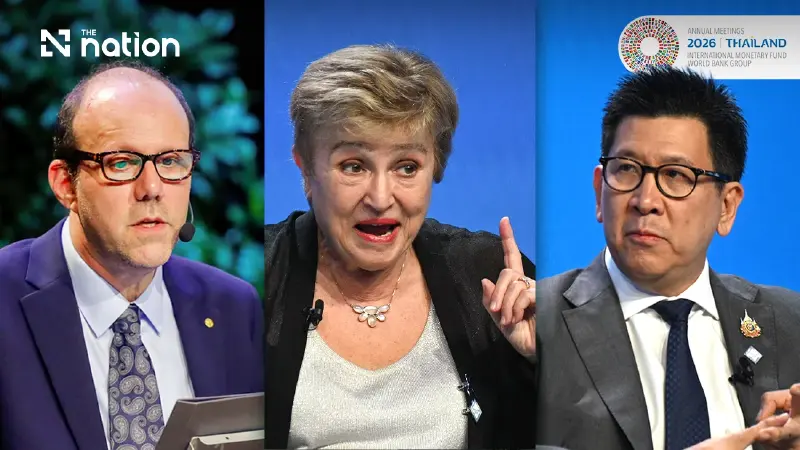
At a debate on the global economy, IMF Managing Director Kristalina Georgieva warned that the Fund’s forecast of 3.1% global growth for 2026 masked widening differences between countries. The United States, China and India were benefiting from AI investment, while Thailand and South Korea gained from their links to AI supply chains. Other economies, meanwhile, struggled with inflation, debt and higher energy costs.
“We have a world economy that is like on one leg,” she warned, questioning the consequences if AI investment faltered. Higher food and fuel prices, potentially exacerbated by El Niño, could keep inflation elevated, prompt monetary tightening and increase debt-servicing costs, she added, urging governments to rebuild financial buffers.

Deputy Prime Minister and Finance Minister Ekniti Nitithanprapas described Thailand as a small boat facing four storms: rising energy prices, geoeconomic fragmentation, higher borrowing costs and AI disruption. Foreign direct investment applications increased by 47% to about US$44 billion in the first half of 2026, he noted, stressing that Thai people and businesses must benefit from the new investment. He outlined the Skill Bridge programme, designed to link foreign investors with Thai universities and small and medium-sized enterprises to facilitate knowledge transfer.
IMF urges targeted support in Thailand
During an IMF regional outlook briefing, Krishna Srinivasan, director of its Asia and Pacific Department, warned that Thailand’s projected growth of 2.1% in both 2026 and 2027 was well below ASEAN’s forecast of 4.9% for 2026.
He recommended targeted assistance for vulnerable households burdened by debt, rather than blanket fuel subsidies, arguing that governments should “protect people and not prices”. Social registries and digital tools could help deliver support more effectively while preserving limited fiscal buffers.
The IMF expects Asia to account for about two-thirds of global growth in 2026 but cautioned that prolonged energy shocks, higher borrowing costs and a reversal in AI spending could erode the region’s resilience.

Stronger tax systems and practical AI
At a separate session on fiscal resilience, Rodrigo Valdés, director of the IMF’s Fiscal Affairs Department, urged developing countries to strengthen tax collection, improve spending efficiency and build more resilient public institutions before the next crisis.
Nepal’s Finance Minister Swarnim Wagle reported year-on-year revenue growth of 18–20% despite natural disasters and other disruptions, while Zambia reported that domestic tax revenue’s share of budget funding had risen from 49% in 2021 to about 73% in 2025.

World Bank Group Chief Economist Michael Kremer focused on using AI to improve public services. Governments needed open-access tools, systems that integrate AI with human expertise, rigorous quality standards and sustainable financing to expand successful projects, he argued.
He cited AI-assisted weather forecasts delivered to more than 50 million farmers in India, illustrating how the technology could support agricultural decisions and help farmers manage climate-related risks.

Protesters demand a voice in policy
Meanwhile, outside the meeting venue, the People’s Network Against the World Bank and IMF demanded greater transparency and public involvement in development decisions. Network representative Supaporn Malailoy warned that agreements could undermine social welfare, environmental safeguards and community rights.
Police stopped demonstrators at Rama IV intersection as they attempted to reach the convention centre. After a brief confrontation, the group staged a sit-in on Ratchadaphisek Road, pledging to stay until 7pm on Friday (October 16). Officers remained deployed to maintain security and manage traffic.
Separately, Lumphini Police Station announced that the outbound lanes of Phloen Chit Road, between Phloen Chit and Nana intersections, would be closed from 8am to 1pm on Friday for a public march.

Thai cultural showcases continue
Beyond the economic discussions and protests, Thailand continued to showcase its cultural heritage. On Wednesday night, Prime Minister Anutin Charnvirakul hosted delegates at Government House, where Rattikarn “Nene Royal” Amloy, the 16-year-old Thai singer and guitarist who won America’s Got Talent 2026, performed at a reception featuring traditional arts, music and Thai cuisine.
Following a day of intensive economic discussions, international delegates took part in individual Muay Thai training sessions on Thursday evening, gaining first-hand experience of Thailand’s soft power. The showcase was also designed to feature traditional techniques and the Wai Khru ritual, presenting Thai cultural heritage alongside the economic agenda.
