
IMF warns of widening economic gaps amid an AI investment boom
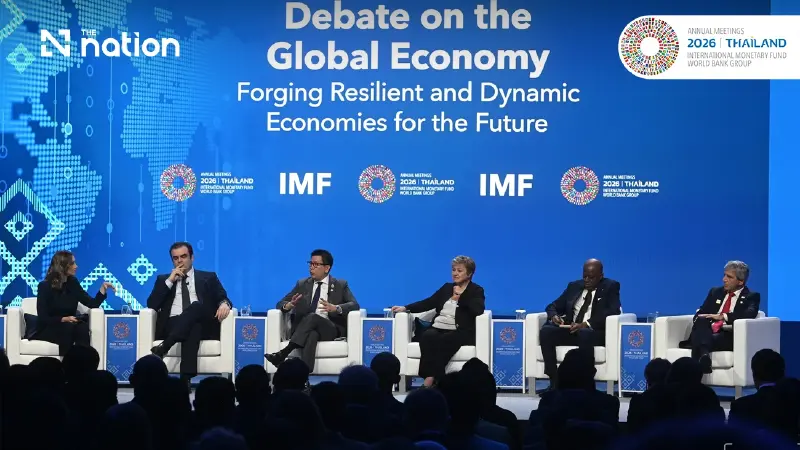


At the IMF–World Bank meetings in Bangkok, IMF chief Kristalina Georgieva warns that global growth of 3.1% is fragile as Thailand pursues investment and reform.
- The International Monetary Fund (IMF) has warned that global economic resilience is fragile, resting on a widening gap between the performance of different countries.
- This economic divide is being driven by an investment boom in artificial intelligence (AI), which is creating uneven growth that primarily benefits producer nations like the US and China.
- While some economies benefit from AI, many others are struggling with challenges such as high debt, inflation, and rising energy costs, which exacerbates the disparity.
- The IMF cautioned that the world economy is dangerously reliant on the AI sector for growth, creating significant risk should this single area of strength falter.
Global economic growth may hold at 3.1% in 2026, but that resilience rests on increasingly fragile foundations as investment in artificial intelligence (AI) drives uneven growth and governments confront high debt, inflation and rising energy costs, the International Monetary Fund (IMF) has warned.
IMF Managing Director Kristalina Georgieva gave the warning at the “Debate on the Global Economy: Forging Resilient and Dynamic Economies for the Future” during the IMF–World Bank Annual Meetings in Bangkok on Thursday (October 15).
She was joined by senior economic policymakers from Thailand, Greece, Argentina and Nigeria.
“So, yes, growth has been resilient. But this resilience is on a fragile foundation today,” Georgieva told the discussion. The IMF’s projection for 2026 remained at 3.1%, the same as its estimates in October 2025 and April 2026.

She highlighted widening differences between economies benefiting from AI and those hit by war or rising fuel costs. The United States, China and India were among the AI producers, while Thailand and South Korea benefited through their links to AI supply chains, she added.
Rising energy and food prices, potentially exacerbated by El Niño, could keep inflation elevated, prompting central banks to tighten monetary policy and pushing up debt-servicing costs. AI investment had become a crucial source of growth, raising the risk of disruption if expectations proved unrealistic or AI systems operating beyond human control threatened financial stability.
“We have a world economy that is like on one leg. The rest of the economy not so strong. What happens if this leg wobbles?” Georgieva asked.
She called on governments to rebuild policy buffers and reduce debt. She also warned of persistent economic imbalances, citing China’s weak domestic consumption and heavy exports, insufficient saving and large deficits in the United States, and inadequate investment and productivity growth in parts of Europe.
Despite these challenges, Georgieva expressed greater optimism than a year earlier that excessive global economic imbalances could be resolved.

Thailand faces four economic storms
Thailand’s Deputy Prime Minister and Finance Minister Ekniti Nitithanprapas likened the country to a small boat navigating four storms: higher energy prices, geoeconomic fragmentation, rising borrowing costs and the disruptive spread of AI.
Oil imports raised Thailand’s living costs, while supply-chain diversification opened investment opportunities. Ekniti put Thailand’s 10-year government bond yield at around 2.3%, below those of the United States and Europe, crediting fiscal discipline and macroeconomic stability.
Yet stability alone was insufficient, he argued. The government also needed to help low-income households and small and medium-sized enterprises (SMEs) adapt to technological change and participate in new supply chains, rather than allow economic inequalities to widen.
“Building resilience is to support them to absorb the shocks, and also to accelerate the transitions to help them deal with bigger storms coming,” Ekniti told the panel.
He called for deeper regional integration, noting that trade within ASEAN accounted for about 22% of the region’s total trade, compared with around 60% for trade within the European Union. He cited the ASEAN Power Grid, which could help countries share hydropower from Laos and reduce their exposure to energy shocks.
Ekniti also backed ASEAN’s Digital Economy Framework Agreement, closer links between national digital identification systems and cross-border QR payments connecting Thailand with Singapore and Malaysia. Thailand was also negotiating a free-trade agreement with the European Union, he added.

On investment, Ekniti reported that foreign direct investment applications in the first half of 2026 had increased by 47% to approximately US$44 billion. He highlighted opportunities in AI, smart electronics and electric vehicles, while private investment had grown by more than 10% for two consecutive quarters.
He outlined the Skill Bridge programme, designed to connect foreign investors with Thai universities and SMEs, transfer knowledge and strengthen local participation in global supply chains. Simplifying investment approvals and removing bureaucratic obstacles were also priorities.
Ekniti compared new investment opportunities to high-speed trains arriving in Thailand, with Thai people and businesses waiting on the platform.
“We [are] trying to open more doors for Thai people, Thai businesses, to go into the speed train and then use [those] opportunities to upgrade Thai productivity,” he said.

Europe targets its productivity gap
Kyriakos Pierrakakis, president of the Eurogroup and Greece’s minister of economy and finance, described Europe as “mindful, but not alarmed” about rising bond yields. He cited a rise in average 10-year bond yields from 1.1% in 2016 to around 4% in 2026, making fiscal credibility more important. Greece’s experience, he argued, showed why discipline and structural reform had to advance together.
“The markets are looking at your fiscal trajectory. And especially in a high-yield environment, they’re looking at it much more acutely,” he explained.
Pierrakakis identified productivity as Europe’s biggest challenge, contrasting average annual productivity growth of 1.8% in the United States with 1.1% in Europe over three decades. He advocated banking integration, stronger capital markets and larger cross-border businesses, arguing that internal fragmentation restricted growth.
He pointed to the Savings and Investment Union, which combines capital market and banking reforms. Citing IMF estimates, he likened internal European barriers to tariffs of 110% on services and 40% on manufacturing, and urged faster action to remove them.

Argentina and Nigeria draw on crisis reforms
Argentina’s Economy Minister Luis Caputo cautioned that resilience could disappear quickly if a major country encountered financial trouble. He defended President Javier Milei’s policies, reporting a 30% reduction in government spending, the elimination of the fiscal deficit and a decline in inflation from 211% in 2023 to around 30%.
“We do not need the whole world to collapse. Just one country, one important country getting into trouble could generate a systemic risk and affect all of us,” Caputo warned.
Caputo also credited reforms with creating more than 500,000 jobs and reducing poverty from 57% to 32%. He projected around US$200 billion in investment under Argentina’s Incentive Regime for Large Investments (RIGI) over the coming years and identified food, energy and critical minerals as sectors offering further opportunities.

Nigeria’s central bank governor, Olayemi Cardoso, described how monetary tightening, foreign exchange reforms and greater transparency had helped restore confidence after a currency crisis. The central bank raised rates by around 800 basis points in 2024, he noted, while inflation subsequently eased from about 34% to 15% and reserves reached their highest level in 18 years.
Cardoso also pointed to the removal of costly subsidies and the unification of multiple exchange rates. He highlighted the Dangote refinery as a means of adding value to Nigeria’s oil production.
He also reported clearing more than US$7 billion in overdue foreign-exchange obligations. Easier remittance transfers had helped raise monthly inflows from roughly US$200 million to US$600 million, reaching about US$950 million by July.
“We were able to do the right things through an orthodox monetary policy approach, which helped to stabilise the economy. We were, believe it or not, able to pay off those debts, and we were able to attract investment,” he explained.

Across the discussion, speakers highlighted a common challenge: resilience depends not only on withstanding shocks but also on credible policies, institutional reform and measures that help businesses and workers benefit from economic change.
