
IMF to Thailand: Shield Indebted Households, Not Fuel Prices, as ASEAN Peers Pull Ahead
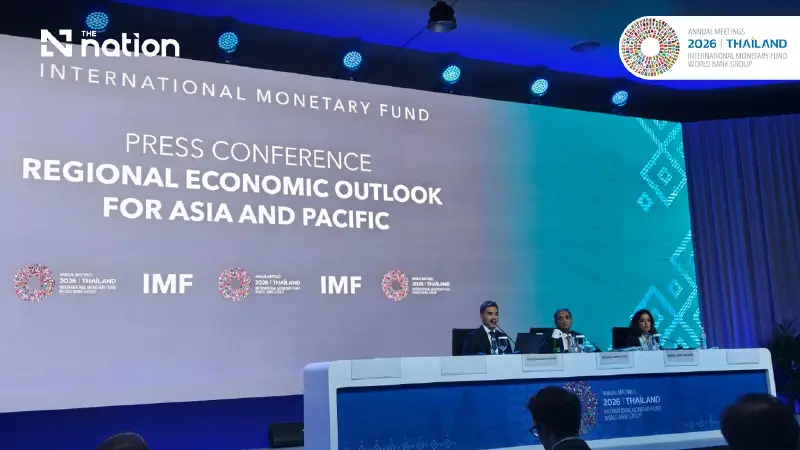


As ASEAN peers ride the tech boom, IMF says Thailand's 2.1% growth leaves little cushion and urges targeted help for debt-laden households, not fuel caps
- The International Monetary Fund (IMF) has advised Thailand to provide targeted financial support to vulnerable, highly indebted households instead of implementing broad fuel price subsidies.
- This recommendation is based on the principle of "protecting people, not prices," as general subsidies are costly and drain the country's shrinking fiscal buffers.
- The IMF's warning comes as Thailand's projected economic growth of 2.1% significantly lags behind its ASEAN peers, who are surging ahead on a technology-driven boom.
- The fund suggests using social registries and digitalization to deliver targeted aid effectively, which would be a more efficient use of fiscal resources than price caps.
As ASEAN peers ride the tech boom, IMF says Thailand's 2.1% growth leaves little cushion and urges targeted help for debt-laden households, not fuel caps.
The International Monetary Fund (IMF) has urged Thailand to support vulnerable, highly indebted households with targeted aid rather than broad energy subsidies, warning that the country’s fiscal buffers are shrinking while regional peers surge ahead on a technology boom.
The recommendation was delivered Thursday (October 15) during a press briefing on the Asia and Pacific economic outlook at the 2026 IMF–World Bank Annual Meetings in Bangkok.
Thailand is projected to grow just 2.1 per cent in both 2026 and 2027, according to the Fund's Regional Economic Outlook, released at the IMF-World Bank Annual Meetings in Bangkok.
That compares with 4.9 per cent for ASEAN as a whole this year, 8.4 per cent for Vietnam and 5.2 per cent for Malaysia. The 2026 figure was raised by 0.6 percentage points from April.
Asked how far household debt is holding back consumption, Krishna Srinivasan, director of the IMF's Asia and Pacific Department, said successive shocks – the pandemic, the war in Ukraine, tariffs and now the energy shock – had worn down fiscal buffers across the region.
"This is the time to embark upon growth-friendly fiscal consolidation that does not hurt those hit by the shocks," he said.
Governments should use social registries and digitalisation to deliver targeted support, anchored in a well-defined medium-term fiscal framework that reassures investors. The guiding principle, he said, is to "protect people and not prices".

The report details Thailand's own response to the oil shock, which began in February. Bangkok capped fuel prices with subsidies, released petroleum reserves, diversified procurement, restricted some exports, introduced work-from-home arrangements and offered cash transfers and cost-of-living top-ups.
Price-smoothing measures helped contain the pass-through of higher energy costs to inflation, the report said, but the baht came under depreciation pressure, as did the currencies of Indonesia, India and the Philippines, although this has partly eased.
The IMF warned that few such measures across the region are time-bound or clearly targeted and that exit strategies remain unclear in some economies. Broad fuel subsidies and price controls are costlier and weaken incentives to cut demand, it said.
The Fund also flagged longer-term concerns relevant to Thailand.
Its analysis of social safety nets said ageing economies such as Thailand must ensure households have decent incomes in retirement, and that policy should focus on making consumption more resilient among vulnerable, highly indebted households.
It also urged continued work on the "Bangkok Blueprint", the joint IMF, World Bank and Bank of Thailand framework against cyber-enabled financial fraud, which it called a rapidly emerging regional threat.
ASEAN: tech boom lifts growth, energy a vulnerability
Growth in the Association of Southeast Asian Nations (ASEAN) is forecast at 4.9 per cent this year and 4.7 per cent in 2027, upgrades of 0.4 and 0.1 percentage points, respectively, driven largely by technology-related exports and investment.

Vietnam leads at 8.4 per cent in 2026, up 1.3 points. Malaysia is projected at 5.2 per cent and Indonesia at 5.1 per cent. By contrast, the Philippines (3.4 per cent) and Cambodia (3.0 per cent) were cut by 0.7 and 1.0 points.
Srinivasan said ASEAN's energy intensity is about 7 per cent of GDP, higher than Asia's 4 per cent average, leaving some members especially vulnerable if the shock persists. Malaysia and Brunei, as energy exporters, are benefiting.
He urged Indonesia to keep subsidies targeted within its 3 per cent deficit anchor, which markets watch closely, and urged Malaysia to continue fiscal consolidation by broadening the tax base and trimming incentives and subsidies.
On artificial intelligence, he said ASEAN's priority should be skills and lifelong learning.

Asia: still the world's growth engine
Asia's growth is projected to ease from 5.0 per cent in 2025 to 4.8 per cent in 2026 and 4.4 per cent in 2027, though 2026 is 0.4 points stronger than April's forecast.
The region will still contribute about two-thirds of global growth – 68 per cent, Srinivasan said.
The IMF credits three forces: adaptation to the oil shock through inventory drawdowns, alternative suppliers and renewables; an AI-driven boom in semiconductors and data centres; and trade that has held up better than feared, helped by surging intra-Asian commerce.
But "resilience is not unlimited", he said, noting that inventories cannot be drawn down indefinitely and fiscal costs are rising.
Risks are tilted to the downside: a prolonged or renewed Middle East escalation, a reassessment of AI profitability, fiscal strains and higher sovereign borrowing costs, and a potentially severe El Niño that could worsen food and energy inflation. Faster AI productivity gains or more predictable trade arrangements could provide upside.

China: more stimulus needed
China is forecast to grow 4.5 per cent this year and 4.0 per cent in 2027. Mr Srinivasan said domestic demand remains weak, rebalancing has not materialised and inflation is hovering near deflation.
He called for greater near-term fiscal stimulus and repeated the Fund's call for property-sector support worth about 5 per cent of GDP over three years, including triaging developers.
Japan and Korea: contrasting gains from AI
Korea's growth is forecast to accelerate to 3.3 per cent from 1.1 per cent in 2025, a 1.4-point upgrade. Japan is projected at 0.7 per cent.
Report figures show Korea's current account surplus reaching a record 19 per cent of GDP in 2026, against about 4 per cent for Japan, reflecting Korea's dominance in memory chips.
Sonali Jain-Chandra, the department's deputy director, warned that such concentration heightens vulnerability to any correction in AI demand but said Korea's tight monetary stance remains appropriate, with windfall tax revenues being saved.

India and South Asia
India's growth is forecast at 7.0 per cent in 2026 and 2027, up 0.5 points, after a stronger-than-expected first quarter, with medium-term growth of 6.9 per cent.
Srinivasan said the rupee should not be treated as a gauge of economic success and called India's GDP data revisions consistent with good practice.
Bangladesh's growth was cut by 1.1 points to 3.6 per cent. Jain-Chandra said inflation hit 8 per cent in September, tight monetary policy must continue, and revenue, at about 7 per cent of GDP, is among the world's lowest. The IMF is in talks on a new programme requested in May.
On Sri Lanka, she said staff-level agreement on the seventh review was reached in early October, with another review before the programme expires in March. Any follow-on arrangement is the government's choice. She also stressed central bank independence in Nepal.
Uneven recovery
Pacific island economies are projected to grow 2.6 per cent this year, a 0.2-point downgrade, hit by food and fuel costs. Low-income economies also saw sizeable cuts.
The IMF's analysis of millions of online job postings found employer demand for AI-exposed jobs fell by as much as 10 per cent but has since stabilised, suggesting, Srinivasan said, that AI is "reshaping" the labour market rather than eliminating work.
The region needs nearly 150 million jobs over the next decade, the Fund's blog said.
